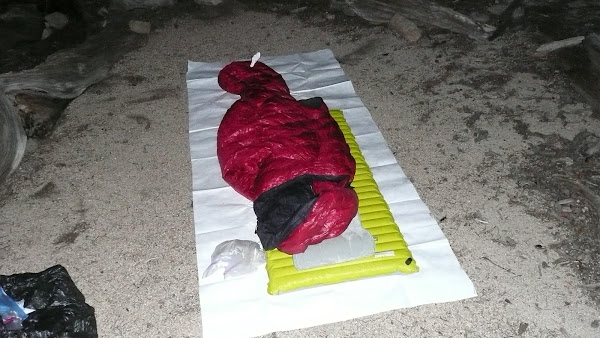
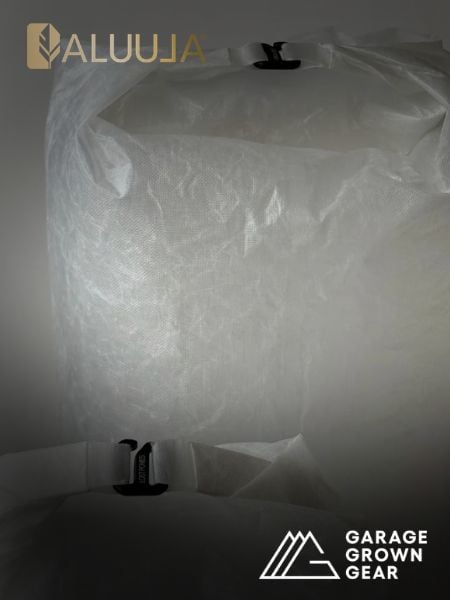
Interesting question for me as I contemplate the merits of tyvek versus a similar house wrap called Home Guard (http://www.hgpbp.com/?page=housewrap). I have used tyvek and honestly prefer the home guard. It is of similar weight and is less paper-like than tyvek and stronger. Admittedly, unlike tyvek it is woven and has microscopic perforations to breathe. On the practical side I have used it extensively as a tarp and groundsheet with no leakage whatsoever even in extended heavy rains. The also make a slightly heavier version which like Tyvek is not woven and not perforated, but is less strong and slightly heavier.
The issue for me is whether to invest in more cuben gear or begin making my own gear with this home guard. I have a MLD soul bivy with a cuben floor and HMG Ultamid 2 cuben tent. Both big investments and gear I tend to overprotect which impacts efficiency and convenience on the trail.
As an example I just returned from a 12 day canoehiking trip in the wilderness of Labrador, which was very cold and wet: 5C to -4C. There was 2 of us and we used the HMG Ultamid 2 with Home Guard ground sheets. There is not shortage of deadwood in that part of the world and we relied on fires to cook, dry and stay warm. It was my first trip in a single wall cuben tent and was reluctant to pitch it anywhere near the fire and was glad I didn't as anything that was at all close did get flanker holes including a new Western Mountaineering Flash jacket and arteryx goretex rain paints . . . moan!
When we loaded the canoe I took a 9×12 foot piece of the Home Guard on a whim. The first time I have taken a tarp additional to a tent. It turned out to be the critical piece of gar on the trip. It rained everyday for the first 7 days. Even aggressive hiking with 60lb packs left us hypothermic after 3 or 4 hours caused by the evaporative heat loss evaporating sweat. I am usually good at monitoring my body temperature and am careful to avoid sweating, especially in winter. These were very challenging conditions, with a tight timeline, and staying on your feet took all your concentration.
To stay warm, we would build a large fire around noon and stand over it to dry and warm a little. Then when we made camp at the end of each day at around 5PM, the Home Guard tarp was the first thing we pitched and built a fire right in its opening for warmth and drying. It of course too got flanker burns, but was of no concern as a 9 x 100 foot roll costs $120. This tarp kept us dry while cooked and lay back on spruce bows and chatted, repaired our bodies and gear every evening. Without it we would have been miserable cooped up in a tent with not secondary heat source.
As I consider my gear performance during the trip I am realizing that when ultralighting with fire as a heat and clothes drying source, which is necessary in this climate, you have to accept that some it will get damaged. Which is leading me to consider less expensive options, which may be slightly heavier than cuben, but which function almost as well, and can be replaced at a pittance of the cost.
So, for me the answer is: Tyvek (or Home Guard) is not bad at all. If it is relatively light, functional and cost effective to replace, it is perhaps ideal!! Fo for comfortable Fall camping Labrador next year, I am considering venturing into the MYOG world to make a beak for my cuben tent that would extend from its peakt to the edge of the fire. Far enough away to protect the tent and close enough to keep me warm!
Footnote: I realize 60lbs does not fall within the prescribed limits of ultralight in this community, but trust me, we carried nothing we didn't need, and virtually all of all of what we did carry was ultralight gear. There are no trailheads , indeed there are no trails, and notwithstanding the merits of bearspray and batoning wood with a knife, a shotgun and axe are your best friends. We ran low on food on our way back to the first food cache and a couple fresh spruce grouse came in handy for supper.
Newly considering the merits of light, but discardable, gear:
Derrick