Travis-
Yes, I have modified my Lunar Solo e. Ever since I received it last year, I have been frustrated with the setup of the stock version. There were three pitch issues that bothered me: the "sagging" of the mesh walls, the lack of space between the ground and lower edges of the canopy for vetilation, and low head room inside. Multiple pitches of the tent, quite a few measurements, and many hours of thinking and theorizing confirmed my initial impression: the bungee cord guylines to the floating floor were limiting the geometric capabilities of the tent design.
The furnished bungee cords (3/32" diameter) have a working length of approx. 11" fully relaxed and a maximum length when stretched (under considerable tension) of approx. 16-17". The tension when stretched this far (5-6") results in way too much pull on the tent floor; the working stretch range without getting too tight is about half of that, maybe 3". The raw starting length of each bungee looks to be just over 12" to allow for attaching to the webbing at the floor corners and sewing into the fly webbing.

The canopy guylines (webbing) have an practical adjustment range of about 8" from fully extended to cinched as close as possible to the fly edge. This close cinching would only be used in "hunker-down" mode when you want the fly as close to the ground as possible. I did pitch once this way last winter (snow, windy, zero degrees) when I was testing my sleep system based on a 20 degree bag.
The disparity between a 8" adjustment on the fly guyline and only a ~3" stretch range for the bungee cord made it obvious that the bungees were the limiting factor. In addition, I wanted to raise the canopy (for reasons above) and the apparent options to accomplish this would be to fully extend the fly webbing and/or attach the webbing to stakes heads that were above ground level.
I purchased Easton aluminum gold 8" long (plus 3/4" head where I secure the canopy webbing) stakes and then pitched the tent with the stake heads protruding about 2 to 2 1/2" above ground level. This achieved part of my goal in that the fly was higher but introduced a new problem: any tension on the bungees now pulled the tent corners up off the ground.
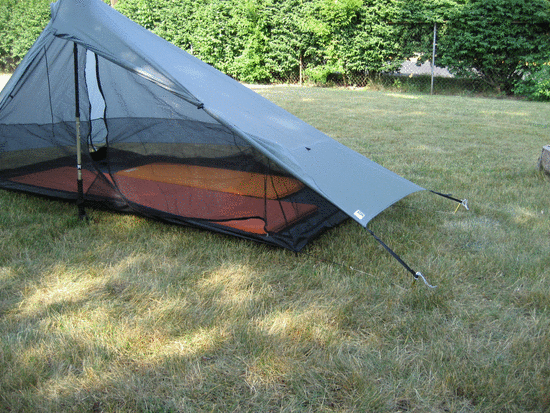
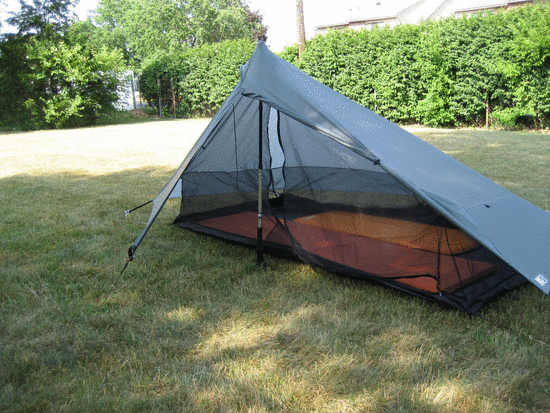
I had also been experimenting with the length of the pole to achieve maximum height. The optional pole available from SMD is 46" inches long including 5/8" that protrudes through the grommet at the tent peak. I felt that this was shorter than necessary and for a while used a trekking pole length of as much as 49". For now I settled on an approx. 47" length which is used in the pictured setup; this is effectively about 1 1/2" longer than the optional pole.
Finally, several weeks ago, I bit the bullet and cut the bungee cords where they are sewed into the stake end of the canopy guyout webbing.
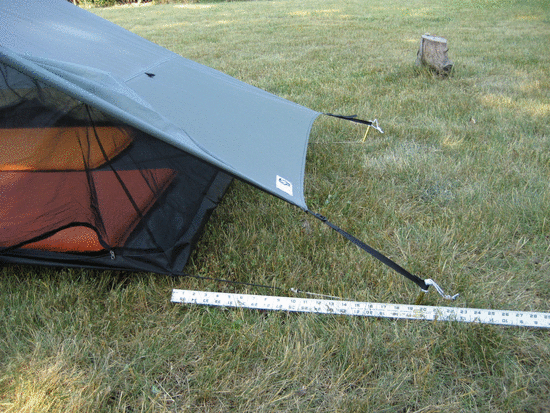
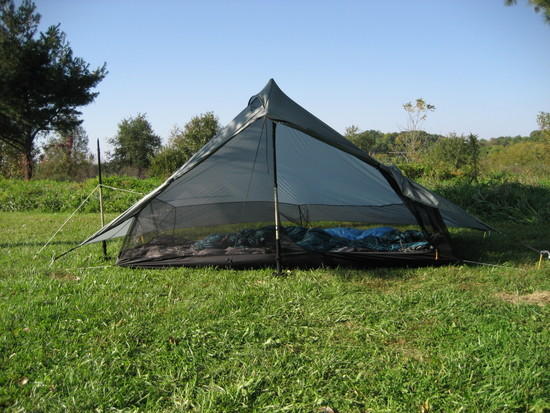
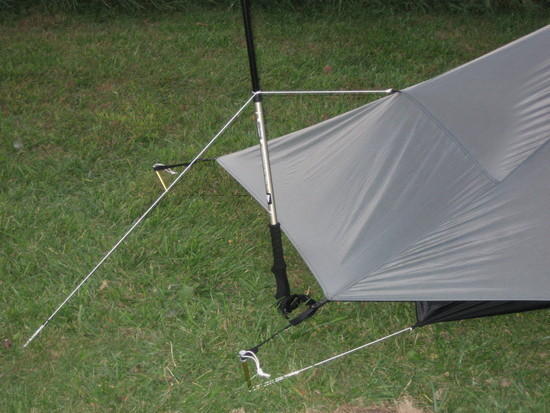
To try to achieve maximum height at the edges for ventilation, maximum interior vertical room, and the straightest hanging of the mesh sidewalls, I extended the canopy guyline webbing to it's maximum practical length and placed the stakes as far out as this would allow, leaving the heads 2" plus above the ground. This was a significant improvement and appears close to maximizing the tent design.
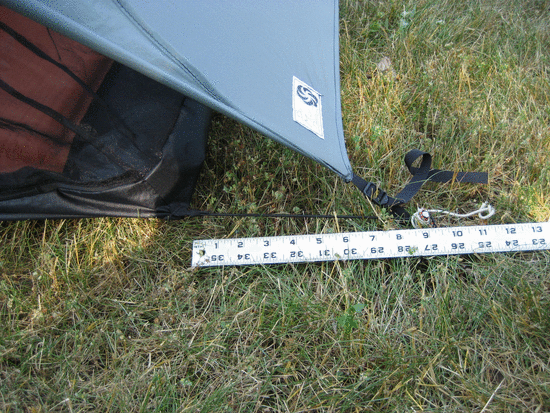
Under the as-furnished bungee setup, the maximum distance from the tent floor corners to each stake was approximately 14" with significant tension on the bungee. With the bungee cords no longer attached and the canopy webbing at full extension, this dimension can now be close to 20".
With the bungees cut, it was immediately obvious that leaving the floor free-floating with no comnnection to the stakes was not an option; just no proper shape if not secured. So I took some odd pieces of cord and cobbled-up some extensions for the bungee cords; I used simple fisherman's knots to join the two lines.
The tent setup in the pictures is using these temporary guylines. I simply tied the ends of the extended cord to the base of the stakes so the bungees had slight tension to keep the floor properly positioned. Achieving this pitch requires that the canopy guylines be above ground level and the floor connectors be at the base of the stake on the ground. They can't be connected; this was brought up in a review of the original LS (http://www.backpackgeartest.org/reviews/Shelters/Tents/Six%20Moon%20Designs%20Lunar%20Solo/Chuck%20Kime/Initial%20Report/).
My task now is to determine a permanent solution for the floor attachment guyline. The key requirement is that they will work at the extremes of stake placement allowed by the canopy webbing, approx. 9" and 19"+ from the floor corners as well as positions in-between. Odds are that in-between positions would be used infrequently such as when ground conditions dictate stake placement but it must be allowed for. Also would like to avoid having to tie 5 knots to adjust the guylines in bad weather. So far, I have come up with these alternate guyline approaches:
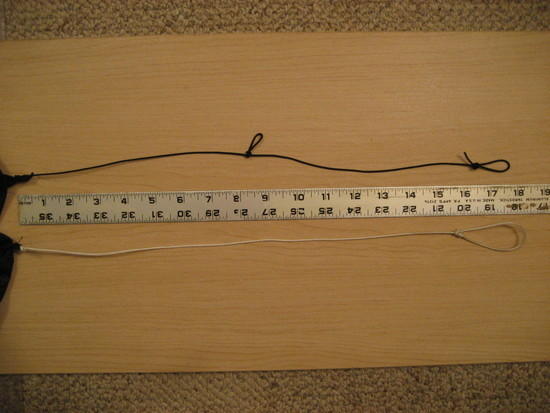
1- A longer one-piece bungee cord with loops in several positions on the cord for the stake. I probably will try 1/16" diameter shockcord; it's lighter, appears at least as "stretchy", but I'm not sure of it's durability. The top example in the picture below illustrates the concept; I mocked up this sample on some 1/8" shockcord I have. Loops would have to be at the end, another to accomodate a 9" stake position, and probably a couple in between. Would have to experiment to allow for the actual "stretchy-ness" of the selected cord. When pitching, simply put the stake thru the best loop to provide moderate tension, push the stake in the ground, and snug the fly strapping.
2- A piece of light cord with mini line tightener or tautline hitch to just snug the corner in postion around the stake. This eliminates the "floating floor" concept but I'm not sure that any movement of the floor is necessary once it has been properly pulled into position. Will have to try this one.
3- A combination of shockcord and normal cord similar to my trial guylines. I haven't solved the cinch-it-up difficulty when there is a joining knot in the middle of the two-part line.
4- A combination of bungee and normal cord with one being the "fixed line" attached to the tent corner webbing and the other looping around the stake and sliding on the fixed line with a tautline hitch or other friction knot. See the lower example in the picture. Actually the shockcord could be either the straight fixed line attached to the tent corner or the outer section with the stake loop at one end. I have to play with this one yet; I don't know how shockcord will behave in either position and don't know if will allow a friction knot to slip.
One combination I've also been thinking about is to use non-stretch guylines (as in #2 above) for the front corners of the tent, "anchoring" the front edge so it won't move and then using lightly-tensioned shockcord guylines for the back three corners to maintain the shape of the floor. More experimenting.
At any rate, I'm going to continue trials and will post my final solution whenever I get there. Would welcome any knot/shockcord expert's opinion. The one nice thing about this mod is that I can restore factory condition if necessary just by replacing the original shockcord with just a little stitching required. All in all, I'm much more satisfied with the tent configuration now that the bungee limitation is gone.
Hope this sufficiently answers your questions.