Topic

Shelter Recommendation

  • This topic is empty.
Viewing 25 posts - 1 through 25 (of 29 total)
PostedSep 28, 2013 at 9:36 am

I currently have a ZPacks Hexamid that works for most of my trips. I have had a few trips that I have needed something with a bit more stability when conditions go South.

I am currently looking for the lightest 1 Person, Double Walled shelter that can handle 30-40 mph winds, heavy rain, and moderate (8-10 inches) snow load.

Anyone have any ideas? I would like to be around 2.5 lbs or less.

After the above requirements have been met, the most important things to me are:

1. Weight
2. Interior length/width
3. Ease of setup/takedown
4. Freestanding (not a requirement but would be nice)

Thanks

Ross L BPL Member
PostedSep 28, 2013 at 10:09 am

When things get ugly, I use a Stephensons Warmlite 2C. Works for me.

PostedSep 28, 2013 at 10:23 am

@Stephen – That could work, although the crossing pole is heavy, I will keep that on the list.


@Ross
– Pretty expensive, and I don't really need 2 person or a true 4 season. Thanks for the suggestion.

@Lapsley – Saw that one, but too heavy. Thanks for the suggestion.

Steve Davis BPL Member
PostedSep 28, 2013 at 10:39 am

expensive, but i love my big agnes flycreek ul2 for light weight and stable. i use my hexamid in most conditions.

PostedSep 28, 2013 at 10:43 am

@David – With the fabric inner and cross pole wouldn't it be around 3 lbs? Or does the fabric inner not add any weight over the mesh?

Frank H. BPL Member
PostedSep 28, 2013 at 10:54 am

I think weight is the last thing to worry about when looking for a "bomber" shelter.

PostedSep 28, 2013 at 11:08 am

That would be close enough to 2.5 lbs. Especially since I could leave the crossing pole at home when only expecting rain and not snow.

Stephen M BPL Member
PostedSep 28, 2013 at 11:45 am

2.5 lbs for a winter shelter is light in my book, I was thinking of getting
one myself.

Matt Dirksen BPL Member
PostedSep 28, 2013 at 12:42 pm

Just curious.

Why should it need to be double walled? There are good single walled fabrics out there that can satisfy your requirements.

Matt

PostedSep 28, 2013 at 1:53 pm

Big Sky Revolution 1P.

I had one for a minute but exchanged for Big Sky's MIrage 1P (single wall hybrid), which I love. When i can get around to it, I plan to post a mini-review. Some people complain about customer service (mostly in the past it seems), but my experience was excellent and the craftsmanship is very high quality. What i like most though (and I tried Moment DW also in my quest to find a solo tent) is that there is loads of head room. Moment was pretty lacking in that regard for me and I'm only 5'10". Set up is extremely easy, and meets your weight requirement if I remember correctly. Good luck w/ search.

EDIT: not sure about snow load but if kick off vestibules occasionally would probably be fine.

PostedSep 28, 2013 at 4:08 pm

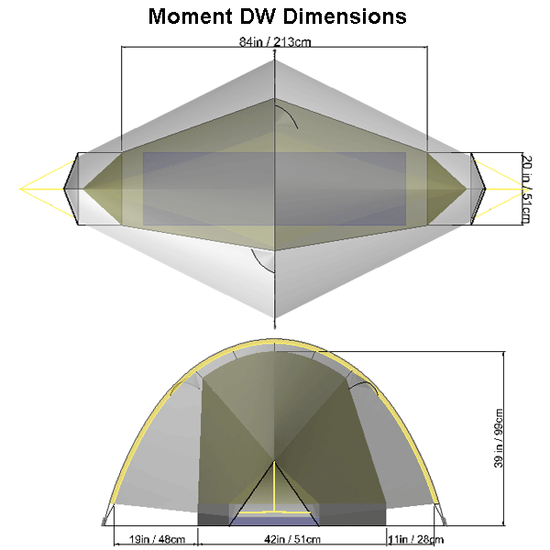
TT Moment DW
1. Weight
About 36 oz with solid inner. Add 10 oz for x pole or 1 oz less for CF pole
2. Interior length/width
Moment size

3. Ease of setup/take down
I don't know of a shelter that is easier or faster to set up. About 1 minute in fair weather , sets up dry in the rain
(fly and inner together)

4. Freestanding (not a requirement but would be nice)
With optional X pole but it does set up with 2 stakes as it is , add 2 for the pole guylines and you can handle rough weather.

Interior height :
Inside Moment
This is me , 5'8" sitting on a 1.5" fully inflated mat, inside the inner set at the standard height.
You can have it a bit higher by reducing the pole radius.
This is a shot from the original Henry Shires tests of the Moment ;
Under snow Moment
Note that he was not inside the shelter so no banging on walls…

franco@tarptent

PostedSep 28, 2013 at 8:44 pm

As you can see in Franco's post the snow photo of the MOMENT DW shows a slightly deformed Xing pole from the snow load. The loaded fly has cause this.

By properly shortening the Xing pole and running it BENEATH the fly this problem can be avoided (short of a tree avalanche). The fly supported on two axis by the main pole and the internal Xing pole makes for a nice solo winter tent.

With the two poles in place adding guy lines at each side of the main pole tie-outs and on ski poles at each end from the "former" Xing pole strap points (See photo at Tarptent product site.) make it nearly bomb proof in high winds.

DISCLAIMER: As with any tent one must push or shovel snow away from the base of the walls in a heavy snowfall to keep it from pushing inward all around.

PostedSep 28, 2013 at 8:57 pm

For winter I still prefer the TT Moment DW over the Revolution 1P for the Moment's low end vents and the fly bottom being closer to the ground to keep out snow. Henry Shires has venting well done on his newer tents and venting in winter is very important.

That said the Revolution 1P would make a good solo winter tent as well.

Turley BPL Member
PostedSep 29, 2013 at 3:29 pm

+1 Big Sky Revolution 1P…..

I use the BS Rev 1P w/ optional Breathable Fabric inner and the inner does a very good job of blocking wind. The canopy is a double door/vestibule design and the crossing poles create an incredibly easy to set up shelter. Though I haven't used this in light snow load conditions I confident it would preform very well…..it also has two additional guyout points midway up the end panels for use in very windy conditions.

Big Sky quality is on par with that of MLD and other high end manufacturers…..

Dean F. BPL Member
PostedSep 30, 2013 at 7:36 am

I've never used a Big Sky product, since they were having delivery difficulties around the time I was in the market for a shelter. But I've heard good things, so if you have deep pockets are really want freestanding it may be the way to go.

But "free-standing" is a con! It's a marketing gimmick. Or, at best, a "feature" aimed at the inexperienced and gullible. There is a technical term for a free-standing tent in a high wind: "box kite." Thus it will head for the horizon if not staked down, so it will need stakes anyway. A non-free-standing tent merely collapses if a critical stake fails, and flutters around on the ground a bit or gets caught in the nearest bush, but generally won't set off for Nebraska in the way that a kite-tent will. (But I did once run into a guy here on BPL who insisted that he hikes on featureless rock plains. I'm not sure where he finds those…)

I HAVE owned one of the older 1.5-walled Moments, and liked it a lot, though I eventually went 'mid in a fit of simplification. It's not freestanding (except "sort of" with the optional longitudinal pole) but everyone who insists upon a freestanding tent is sort of having an error-in-concept, anyway.

So, I will say this:

For a non-tarp the Moment is conceptually about the simplest tent I've ever used, and ABSOLUTELY the quickest to erect. It only uses two stakes (minimum), so you just stake one end, insert the pole, then tension and stake the other end. Poof- erected. It's never taken me more than 90 seconds, and not infrequently less than 60. Finding stake-out points in precisely the correct spots can be challenging for a dome tent or even a 'mid on some ground, but where are you never going to find TWO? For that matter you would only rarely even need stakes at all, since you could bring slightly longer lines and reasonably expect to always find a couple of trees, bushes, or rocks to tie off to.

In any conditions where the Moment would need more than two stakes, ANY other tent would need extra guys, too, including an ostensibly "free standing" one.

PostedSep 30, 2013 at 7:52 am

Thanks for your comments Dean, although I disagree that freestanding is a con or marketing gimmick aimed at the inexperienced. I have used many many shelters. I am currently using a customized Hexamid Solo+ for 60-70% of my trips. I can see a few benefits to free standing.

First, I would never use a tent without staking it down, that is not the point of freestanding.

Here are the advantages I see:

1. Site Selection – I can pitch it, lay down, move it, stake it. I have also had many cases where stakes could not be inserted into the ground (granite) and had to move it or find rocks.

2. Removing Debris – I can lift the tent, shake it to clean it out. Not really necessary, but nice.

3. Won't Collapse from a Single Stake/Guy Failure – If the ridgeline stake/guy line fails on my Hexamid, it is game over. Not so on a freestanding. I have time to get out, restake it, and go back to bed.

4. Better wet snow load.

Turley BPL Member
PostedOct 1, 2013 at 8:15 am

"But "free-standing" is a con! It's a marketing gimmick. Or, at best, a "feature" aimed at the inexperienced and gullible."

Disagree……I've used for the last 5+ years a Cuben MLD Grace Solo Tarp paired with a SL Bivy with full head net extensively (and still do). This was my shelter system of choice while living in the PNW and stomping around in the Olympics. The softer ground was much more accepting of stakes which increased site selection opportunities.
Since moving to SoCal, I've found site selection/areas smaller and often rock strewn making stake insertion difficult. It is in areas like these that I find a shelter requiring minimal stakes beneficial.

Viewing 25 posts - 1 through 25 (of 29 total)
Loading...