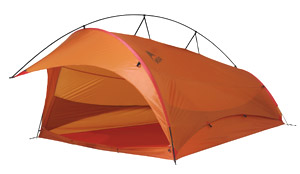
I have had some requests to provide details on a tent I designed as a solution to a problem detailed in this thread "Lightweight tent for the Scottish Highlands"
(http://www.backpackinglight.com/cgi-bin/backpackinglight/forums/thread_display.html?forum_thread_id=78532&startat=60)


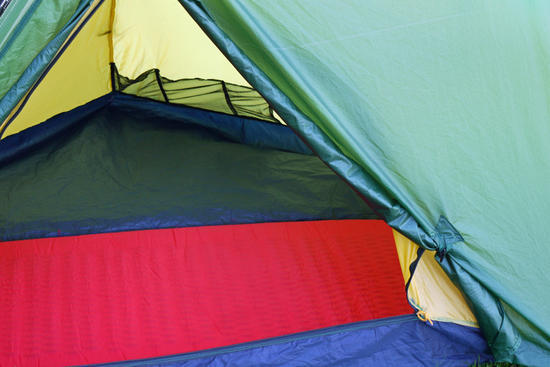
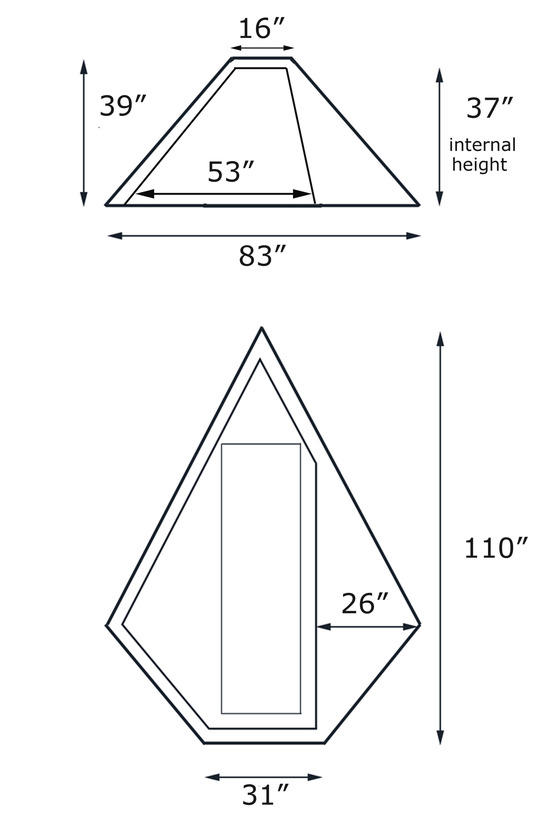
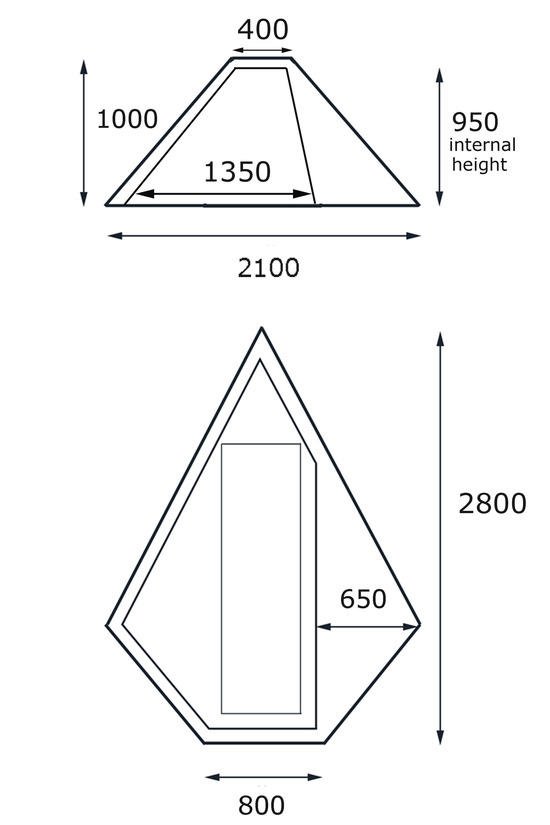
It is a double walled tent weighing 960 grams (34 oz.) which so far has performed well in strong winds. To try and minimise weight, I designed it so that the space (and fabric) is where it is needed and nowhere else. There is a lot of width at arm level, sit-up headroom and then very narrow and low with just enough foot space at the other end.
The tent has 2 doors on the right hand side. They can open individually, depending on wind direction, or the whole side of the tent can be opened up. I originally intended to put a door on either side of the tent, but I wouldn't have had rain protected entrances that way. Also, with the weather we get in Scotland, sometimes it is best just to stay in the tent and having the extra internal space makes it a lot more comfortable.
The flysheet is 30D silnylon at 50 grams/m2,from Extrem Textil in Germany. They have a lot of tent accessories too and are a good source if you are based in Europe.
The original alloy poles I got from China, which are fine but weigh about 60 grams/metre. I have since changed these to Easton Nanolite, at about 45 grams/metre. Quest Outfitters stock these.
The inner tent is made from nylon panels, with a large mesh panel in the door. I got the nylon from Extrem Textil also, it weighs 38 grams/m2. It is not ripstop though, and it was also very difficult to sew. They have now replaced it with a ripstop nylon of the same weight, which I haven't tried yet.
The floor is PU coated nylon, weighing 56 grams/m2 (2 oz.), available from just about any fabric supplier in the UK. I used the heavier PU coated for the bathtub floor rather than silnylon as the ground is almost always wet here and I have had seepage through a silnylon floor before. I think the extra 30 or 40 grams of weight is well worth it especially as it can be difficult to dry stuff out here.
I used a No. 5 zip for the flysheet door with double sliders, to open from top or bottom. The inner tent has a No. 3 curved zip with double sliders, which after much experimentation, I have concluded that 400mm radius is the tightest it will go without kinking. People more skilled at sewing than I might be able to do better than this though. The No.3 zip weighs half that of the No. 5 and I was tempted to use this for the flysheet doors also, but decided to err on the safe side.
I used 1mm dyneema guylines with mini clam cleats, but I think I will change it to 2mm, the 1mm stuff is a bit difficult to get a grip off.
I could probably have got the weight down to below 900 grams (32 oz) but I didn't want to take any chances with several big hikes in the pipeline.
Weight breakdown:
Flysheet 390 grams (14 oz)
Inner tent 321 grams (11 oz)
Alloy poles 131 grams (5 oz)
Pegs 8@ 6 gms 48 grams (2 oz)
Guylines, cleats etc 25 grams (1 oz)
Stuff sack 15 grams (0.5 oz)
Seam sealing 30 grams (1 oz)
I have recently started using it without the inner tent as the midges are not so bad now, this gives me a shelter weight of 640 grams (22 oz) and a much smaller pack size.