Topic

Is a Merino Blend any better than a Synthetic for odor?

  • This topic is empty.
Viewing 10 posts - 1 through 10 (of 10 total)
PostedSep 23, 2013 at 1:26 pm

I have a really weird item of clothing in my closet.

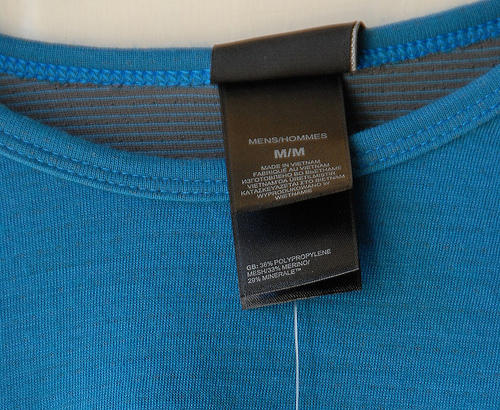
The North Face Summit Series Baselayer
38% Polypropylene
33% Merino Wool
29% Minerale

I got it on Gear Swap, and the person that sold it got it from a Sample Sale, so I don't think it actually saw a production run. I can't find much info online, but Minerale is supposed to be a polyester blended with volcanic minerals that fight odor.

From touching it, I believe the inside layer is the Minerale, and the outside is the Merino Wool. I also hypothesize that the horizontal lines running through the grey interior are the Polypropylene, as are the seams all over the shirt. My hypothesis tells me volcanic rock is dark, so the grey is likely Minerale. A synthetic interior/wool exterior makes the most sense. And Polypropylene is shiny, like the threads running horizontally and the seams. Speculation.

So my question is:

I primarily want to use this as a layer that won't pick up odor over long periods without washing. Is that going to work out? Or will the Polypropylene/Polyester just stink up? Is there any actual benefit with blending in wool to a fabric in terms of odor resistance?

Also, anyone have more info on this particular shirt?
t

Stephen Barber BPL Member
PostedSep 23, 2013 at 2:08 pm

I don't know anything about this particular item, but I've used the Patagonia merino wrapped around a synthetic core and had no stink issues at all.

PostedSep 23, 2013 at 2:12 pm

I think there's a review/spotlight/article somehwere on BPL about merino blends vs just merino and just synthetic.

From what i remember, Merino blends are good at staying odor free while being more durable and faster drying due to the synthetic fibers blended in, so the best of both worlds.

From my personal experience, I have a Stoic Alpine Merino 150 long sleeve I wear that keeps me nice and dry even in warm weather. I've worn it as my only shirt while backpacking and taking my time in the High Divide loop in the Olympic National Park over the course of 4 nights. My pits themselves would smell, sure, but the shirt itself did not absorb the smell. Plus, it does dry noticeably faster than my ibex woolies 150 (100% merino) when i get swamp back as I almost always do with a pack on (no matter the season).

I'm sure the article is floating around here somewhere, though. Do a custom google search if the BPL search doesn't work. I believe several different shirts with differing wool percentage was compared.

PostedSep 23, 2013 at 2:31 pm

Rab MeCo uses 65% Merino and 35% Cocona polyester. My experience with it so far is quite good as far as odor, but these are on short trips. I've not done anything more than 3 days with it, so i can't say how well the cocona-poly part would hold up on say a thru hike on the AT or the like. But, at least the majority of the fabric is Merino so it shouldn't stink too much.

I've also found that blends of Merino and even untreated nylon work pretty good as long as the Merino is predominant over the nylon. Nylon is less intensely stinky than other synthetics because it's less extremely hydrophobic, plus it's lighter and stronger/more durable than polyester. I'm looking forward to trying my new tights with the 67% Merino and 31% nylon/2% elastene.

But obviously a pure Merino garment is going to be less stinky and over greater periods of time over most other blends.

Personally, when it comes to thinner, lighter, and non felted Merino garments, i think blends are the way to go to increase drying time and durability. But i have no idea about that shirt that you have. First time i have ever even heard of that odd combo.

I've also experimented with using some 55% Merino to 45% acrylic lightweight sweaters, and found it to be quite improved stink wise than any untreated synthetic. However, acrylic doesn't add much advantage since it's one of the least durable synthetics (though still stronger than thin, non felted wool). It's also got a decent specific gravity compared to polyester too (it's quite close to nylon).

PostedSep 23, 2013 at 3:05 pm

Historically, I've insisted on 100% merino, but I am rethinking the blend thanks to the good info you guys have and my own experience. I'll have an opportunity to test odor control next week on this item and will report back.

But in theory, it makes sense. Moisture travels through the synthetic and into the wool, so perspiration doesn't sit in the fabric and cause odor at all.

David Chenault BPL Member
PostedSep 23, 2013 at 8:01 pm

Max, that's a weird combo of materials. I would guess with that high syn content, you won't get significant odor control over 100% poly.

To follow up to my article linked to above, I think that merino/poly blends with a merino content from 60-80% are absolutely the future of baselayers. Companies are still playing with how the two materials are blended, and in the ones I've used recently, fabric content is not an accurate predictor of performance. For instance, you'd expect the current Patagonia Merino 1 (65% wool, 35% poly) to have good abrasion resistance, but for me this hasn't proven to be the case. Wait a few years and I think things will be more settled.

PostedSep 23, 2013 at 8:14 pm

David, that's interesting about the Patagonia blend. What about Rab MeCo which is extremely similar blend?

PostedSep 24, 2013 at 7:28 am

I agree with Justin about the Rab and the 1/3 synthetic, 2/3 merino blend.

I was a fan of 100% merino clothing until I noticed mine wore out faster and didn't handle abuse that well compared to the smelly 100% synthetic clothes.

Having 1/3 synthetic, 2/3 merino seems to be very odor free.
I went 3 active days with my Rab shirt and although my pits did stink, the shirt was amazingly odor free.

Now to see how much it can handle long term abuse.

Viewing 10 posts - 1 through 10 (of 10 total)
Loading...