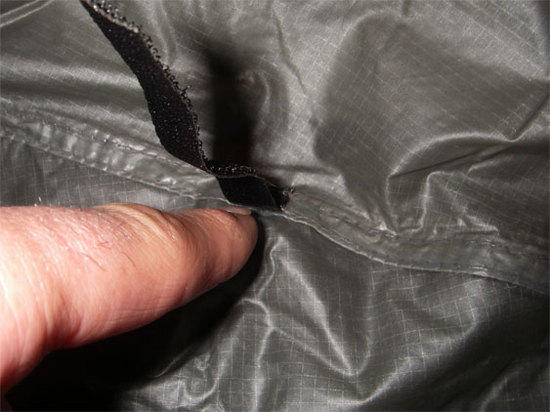
I have been using a Tarptent Rainbow for years now and I am generally quite happy with it. Unfortunately, the Rainbow has one problem I have not been able to fix:
It leaks where the Velcro straps are sewn into the seam. I have seamsealed the area but it has not helped a bit. As soon as I get heavy or extended rain, water starts running down the mesh from these spots and pools inside the tent. These spots are the four Velcro straps for holding up the rain fly and the elastic band to hold up the inner net.
I am currently on a several months long hike through fall where I expect lots of rain and this is turning into a serious problem for me.
As Seamsealing has not helped I am now considering to cut off three of the four Velcro straps that I hardly use anyways and seal the area again. But this still leaves one Velcro strap and the elastic band. I have already used very thinly diluted Silnet hoping that it would penetrate the Velcro material, but the Velcro and the elastic band are still channelling the water into the tent.
Any suggestions how to solve that problem?
Topic
TT Rainbow: How to prevent leakage from Velcro straps
Become a member to post in the forums.
- This topic is empty.
Capillary action…
This is the same with every strap/ribbon doo dah that sticks out of the fly .
Oddly your previous TT, the Contrail , is the only one (that I can think of at 5AM) that does not have them ,at least not over the floor area.
You have mentioned "diluted" but to work well it really needs to be very diluted.
In your case , because the top is already done, I would try to paint in a very diluted solution underneath, from the inside of the tent.
A bit tricky to do because of the mesh door on one side.
BTW, the whole base needs to be done. So not just paint over the top but you need to lift up those straps and do under them.
(I'll post some pics later just for general info…)
Incidentally having had one Rainbow seam sealing session interrupted by heavy rain, (I only had those 4 points to do*…) the next morning, after the rainy and windy night, I found some lovely rain drop patterns under them making me think that ,possibly, that is the cause of some of the "misting" I read about.
I fixed that the next day, did a water test and it was fine.
BTW, I had to re-do one of my own shelters because of that.
Can't remember which one.
* I use a thinner solution over those than the one I use on the rest of the tent.
I rubbed my seam sealer (from a tube) into the stitching when I made mods on both my SW Moment and Scarp 2 then tested them with a garden hose. So far no problems from capillary action in teh threads.
Seems you have to put pressure on the sealer to make it thoroughly penetrate threads. Rubbing it in for a good 30 seconds works for me.
Pressure..
Yes, forgot that bit.
I use an irrigation syringe so I squirt and "paint" over the stitching with that.
Now, this is the bit that some may overlook :

Franco,
we have talked about this problem before and I have heeded your advice and used Silnet with the consistency of olive oil but this did not do the trick.
Eric,
how did you rub it in? Fingers, brush or what? As I'm on a hike right now, my options are very limited to solve the problem. I don't carry paint thinner or brushes, just a little tube of Silnet…
GT,
You might consider trying other sil sealing products, such as Sea to Summit Ultra Seam Sil, NAPA Permatex Flowable Windshield & Glass Sealer, or even GE Silicone Glue, all of these straight and undiluted. Rather than diluting to get a thin coat, consider using alcohol soaked and wrung out paper towel to smear a small bead to a thin coat.
Or it may be that there is so much gunk there now, that nothing will work. It is an axiom of covering products, be they paint or whatever, that thin coats work better than thick ones. This raises the question of how to remove the gunk, and I honestly don't know the answer. On your house or furniture, you can scrape and sand, but obviously not on your tent. If it was applied with a mixture including mineral spirits, it will eventually peel off of its own accord, but that doesn't help you in the meantime.
Disclosure of bias: I have often posted against using thinners, especially mineral spirits, on silicone sealers because it contains oily substances that are the kiss of death to sealers. This is contrary to much conventional wisdom on BPL.
Become a member to post in the forums.