Topic

Why barefoot isn’t best for most runners

  • This topic is empty.
Viewing 25 posts - 76 through 100 (of 153 total)
Dean F. BPL Member
PostedOct 1, 2013 at 12:40 pm

You've seriously NEVER done a deadlift, Craig? Huh. Maybe I'm suffering from selection bias but I'll admit that sounds rather odd to me.

I'll disagree with Piper that running is useless. It is clearly a good aerobic workout, and there are benefits to that. She is probably correct, though, that the quickest way to improve running performance (i.e. run faster longer) is to do interval training.

However, I will enthusiastically agree that weight training improves your hiking! I improved monstrously after starting deadlifts and squats (REAL squats- with a dumbbell with weights on my scapulae), whereas as I mentioned I'm forced to run semi-regularly and don't really find that it helps me carry a load much at all.

Aerobics isn't really what limits my hiking- it's my back and legs getting burned. So, actually, maybe that IS an endorsement of running regularly. Do others find that their aerobic fitness is what limits their hiking?

I'm also a mediocre weightlifter. I definitely cannot dead/squat/bench/anything my weight, which is prodigious. Well, except pullup, of course- by definition you are pulling up your weight- but not even very many of those unassisted. But I'm improving, slowly.

I know of nothing scientific to back any of this up- JMHO…

Joe Clement BPL Member
PostedOct 1, 2013 at 2:30 pm

I hate running, and I hate being barefoot, so when I misplaced my Vivo Barefoot shoes for a year, I didn't miss them. I haven't tried to run since my knee surgery last year, but I sometimes think about pickup football, tennis, or basketball and miss it. Really disliked distance running, but I can get on a bicycle and do 50 miles, it's fun, and my knee doesn't hurt. Buy the right bicycle seat, and you don't have to worry about Mr. Happy going to sleep.

PostedOct 1, 2013 at 2:54 pm

Miguel, this is how humans fly

Yeah, there's that, too. But technically it isn't flying… it's gliding. Flying is powered. Human's aren't capable of self-powered flight, except by using assisting contraptions. We don't have the upper body strength to fly on our own.

But we are very well designed to run. Long distances. Longer than any other animal in the world. Even our perspiration system is ideally designed to help us run and walk better. Our legs are disproportionately long for our bodies compared to most other mammals. And we stand upright… which means we are specifically designed to walk and run. We have heels upon which we bear weight when walking, but we also have the ability to change our gait to mid-sole and forefoot gait, which only work well for running. They work best when we run barefoot or close to barefoot. Having many of us lived out lives running a certain way in heavily shod shoes, we have to train to get the right posture and foot placement again. Do it wrong and you can badly injure your legs and feet. It takes quite a lot of time to retrain our legs to properly run barefoot.

It doesn't matter what anyone here who doesn't like running says… running for me is pure joy. When I'm in great shape it is like flying. And if you have ever seen Olympic sprinters and long distance runners in person (I went to the University of Oregon, my room mate in the dorms was a U of O champion runner, and I often met and talked to Alberto Salazar and Rudi Chapa during my runs by the Willamette River) doing their thing, you'd feel that humans are exquisite when they are running.

To whoever said that "YOU" didn't grow up barefoot… well, that is quite a big one-sided cultural assumption. I grew up in Japan and the Philippines back in the 60's and 70's, when people still spent all of their time barefoot in the house and often at work and outside, and outside it was mostly thin sandals most of the year. No one wears shoes in the house here to this day. Much of the world never wears the kinds of shoes people do in the States and Europe. Being barefoot is normal for me and most of the people I know here.

PostedOct 1, 2013 at 3:02 pm

Before I tried weight lifting and intervals I would try to stay in shape with bicycle commuting, running and hiking. So we're talking as much as 2-3 hours of aerobic exercise during a weekday and 1 or 2 day hikes of 3-6 hours on weekends. All I pretty much could achieve was maybe not declining.

I've been lifting weights now for a year and doing exercise bike sprints off and on during that time. Before my big trip to Glacier this summer I was sprinting 2x a week, lifting 2x a week and hiking less than once a week. I had wanted to hike the parking garage stairs with a heavy pack on before the trip but I flaked out on that. On our 4th day of the trip we had to hike 20 miles. I felt great. I could have gone another 5 miles. (Kootenai Lake to Granite Mountain Chalet campground and my pack was 17 pounds.)

So, each week I do approximately 2 hours of lifting (where most of that is waiting to lift) and 15-30 minutes of sprinting (where most of that is resting between sprints) plus one 3-6 hour day hike. This turned out more effective than I expected.

Additionally, rather than just keeping myself at some kind of equilibrium I've actually changed my body composition. I have muscles. I can cut and toss the branches like a champ when we do trail work.

PostedOct 1, 2013 at 3:13 pm

Piper, I've heard and read that, too, that putting in a significant amount of weightlifting makes a big difference in what you can do overall. May I ask what kind of weightlifting routines you do? I assume you are lifting free weights and not using exercise machines?

I don't think Crossfit is "stupid" (did it for three years), just that it can easily lead to over-training. Many of the serious Crossfitters I've known are some of the overall fittest and strongest people I've ever met. Though I've never hiked long-distance with any of them and don't know how well they do hiking-wise. Running-wise almost universally all of them hated running. Which continually put me at odds with them. Running comes naturally to me; weightlifting on the other hand is something that I dread.

PostedOct 1, 2013 at 4:09 pm

"we were, on average, not designed for long distance running."

Tell that to the Kenyans and Ethiopians. Or even a lot of Westerners. Whether or not people are predisposed to sprinting or long distance running is, to a considerable degree, a function of where their ancestors evolved.

" We were made for sprinting. We hunted in groups that would sprint after food sources and sprint away from prey. Sprinting is distinctly aneorobic. Sprinting is, in essence, an interval."

We also hunted in groups, or as individuals, that would patiently run slowly after their prey until the prey dropped from exhaustion. No human ever out sprinted a deer or antelope. Quite the opposite, we ran after them slowly and forced them to start running again before they had recovered from their last sprint. Over a day, or more, the recovery deficit accumulated until they were unable to continue.

"Long distance, hard running has shown to drastically reduce the production of testosterone in men, while at the same time increasing cortisol levels."

Run that one by my wife. ;o)

"Interval training, which is proving to provide similar if not better cardiovascular results (and endurance) than constant running does the opposite."

Actually, a well designed program of longer distance training, hill work, intervals, and REST is the best way to train, if you are a serious runner. If you are just looking for decent cardio vascular fitness with a minimum of time and effort, interval training may suffice, but if you want to get really fit cardio vascularly, and build endurance for extended efforts, you will have to make the investment in time and energy that distance training requires. There are no shortcuts, even here in America. I have yet to hear of a marathoner or ultra marathoner running a competitive time on intervals alone.

CW BPL Member
PostedOct 1, 2013 at 4:23 pm

I think it depends on what/where you run. If you run the trails (or similar ones at least) you'll be hiking/backpacking the latter will undoubtedly become easier. If you run flat roads all the time and then try to hike long steep grades, I doubt the running will make much difference.

I tried weight training for a year to put some weight back on and failed miserably. I'm 135 lbs and was benching about 165, squatting 195, and deadlifting 225. At the end of the year I hadn't gained any weight or strength, so I gave it up and just maintain with body weight exercises. I also recently added running back but none of my runs are flat and the long 20+ milers are on the trails I hike and backpack.

Interesting thing about Crossfit that isn't advertised, but is more common than one would think and more common to Crossfit than most any other fitness activity – Rhabdomyolysis.

CW BPL Member
PostedOct 1, 2013 at 4:49 pm

I probably wasn't. I do have abs though, and look more like the sprinter than the marathoner you posted, despite doing long slowish runs on the weekends.

Interesting thing I've been trying the last month and a half – MAF HR targeting. When I started running again recently I was easily back to 7:15-730 miles over 5-8 mile runs (~!500 ft change). I found that despite that being an easy(ish) pace (I could easily carry a conversation) for me, my HR was averaging 170. Side note – I later found that's likely about 10 BPM higher than normal due to the paleo diet. I've been targeting an HR of 150 for every run the last 6 weeks and after the first 3-4 my speed dropped from 9:07 miles to 8:51 miles while maintaining the same HR. Short story – running slower (or at least at an easier rate) can make you faster. Speed work would probably accomplish similar results but require more effort. I was fast when I ran competitively back in 7th grade (4:45 mile and 16:42 5K). Now I'm more interested in running longer. YMMV of course.

PostedOct 1, 2013 at 5:00 pm

"Last time I checked, you weren't Kenyan or Ethiopian."

Which is why I also mention "some Westerners". Quite a few, in fact.

"Aren't Kenyans and Ethiopians primarily vegetarian? That would explain why they didn't evolve to have to sprint for food."

Ever been to an Ethiopian restaurant? ;0)

See also persistence hunting. There is a lot of stuff out there on the subject.
This link will get you started.

http://en.wikipedia.org/wiki/Persistence_hunting#Persistence_hunting_in_human_evolution

"Your comment about exhausting much faster and enduring animals is amusing. The problem with your statement is that running the equivalent of a marathon daily until you exhaust a food source would require levels of glycogen stores that wouldn't have been available. This is why they were hunting. In fact, depleting glycogen stores to such a significant degree would mean becoming prey rather than being prey, if you know what I mean. Not to mention the influx of cortisol and reduction in positive hormones."

Amusing, except that it is true. See persistence hunting, above. The people who practiced it didn't run a marathon every day. One kill would last a small group for
many days, when combined with the edibles gathered by non hunters in the group. Also, these people probably spent a considerable amount of time in a ketotic state, where glycogen was not the main fuel source. Not sure what you're getting at with the cortisol line of argument.

"I suspect we would not have survived as a species." Yet that type of hunting was practiced, and here we are.

"Humans aren't stupid. If they can scavenge and sprint in groups, they will. And they did."

Scavenging I can accept as a possible food source of opportunity, if the meat hadn't gone bad, but you still haven't made a case fo humans outsprinting an antelope or deer.

Successful marathoners have to train running long distance because…they run long distances. This is called specificity of training. They also "teach" their bodies to work under this type of stress (to the feet, knees, etc). You are confusing training intervals with training for a marathon. I simply said that intervals will improve your cardiovascular conditioning better than long distance running and I stand by that. Way more positives with respect to health."

I am quite familiar with specificity of training, David. As I said earlier, intervals are an integral part of training for a marathon, so I am not sure what you are getting at here. As for intervals providing better cardio vascular fitness than
distance running, I find that to be not credible. References?

"As far as reducing testosterone, you could read this recent study: Source:
Arq Bras Endocrinol Metabol. 2006 Dec;50(6):1082-7."

Mine was always normal when I had blood work done, and I was doing ~70 miles/week in the build up phase of marathon training. I doubt I was much different than all the others I ran with/competed against.

"Which body is better for health and performance?"

The one that isn't a result of anabolic steroids?

PostedOct 1, 2013 at 5:20 pm

Dave, that photo you posted is downright ridiculous.

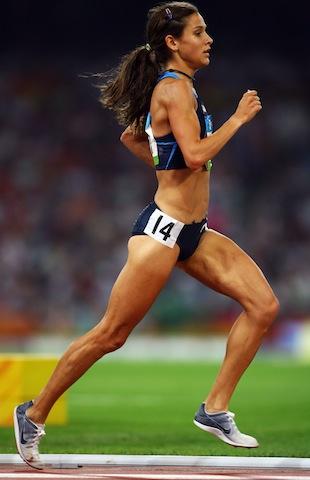
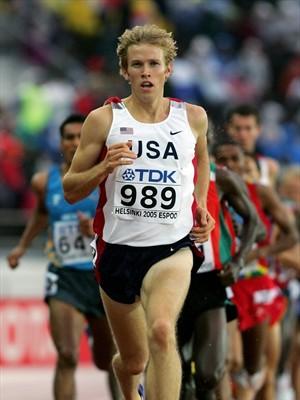
Here are pictures of two of the US's fastest distance runners:

1
Kara Goucher.

2
Ryan Hall.

They look like some pretty fit and healthy humans to me.

This entire discussion is taking an idiotic turn. We might as well be arguing about how Judo doesn't prepare you to swim a record backstroke.

PostedOct 1, 2013 at 6:07 pm

I do know one thing for sure and that is that Eric has hit a rich vein of form with these pot stirring threads:). The lads on fire!!!

PostedOct 1, 2013 at 6:35 pm

I do squats, overhead presses, bench presses and deadlifts. I do these all with the olympic bar and plates. I started with the Starting Strength program and now I struggle to make progress anymore so have been trying other things like Wendler's 5/3/1. I struggle with deadlift. If you aren't perfect with form you can really hurt yourself. I think there's too high a price to pay for a mistake so I quit doing them back in July so I would be safe for my backpack trip, but I started them up again last week.

I do a few other things, but not with as much effort toward progress. I am still working toward a pull-up. Right now I jump to the bar and pull myself up the rest of the way, then let myself slowly down. Then there are lunges and pushups. I was amazed the other day when I hadn't done pushups in months and did 5 sets of 10 regular pushups. When I started all this I could not do even one.

Basically, I'm focused on strength and not on body-building. I think it really helps.

Kattt BPL Member
PostedOct 1, 2013 at 6:46 pm

I don't work out, but I probably should . I don't run, but that seems like a healthy thing to do. I move around, work outside, ride my bike, walk a lot. I have never lifted weights, but I can do 5 pull ups.
We all have different bodies and whatever gets one moving is good, particularly if it's fun.
This "sucks"; that is "stupid"……will get you harsh replies every time,

PostedOct 1, 2013 at 6:58 pm

"We all have different bodies and whatever gets one moving is good, particularly if it's fun.
This "sucks"; that is "stupid"……will get you harsh replies every time,"

Well said, Katharina.

+1

spelt with a t BPL Member
PostedOct 1, 2013 at 7:06 pm

Piper, have you tried deads in sumo stance? I hated them till it I tried it that way. Much better base, better flex from my hips and a more natural motion for me. I think they're often recommended for shorter people.

PostedOct 1, 2013 at 7:18 pm

"If you think steroids are just used by people who are exceptionally large and muscular, did you not follow the recent Tour De France biking scandal?"

It was tongue in cheek, David. They're all using at that level, or at least most of them. In just about every professional sport. Aw heck, even at the professional college level. About the only amateurs left are in high school and junior high, and apparently some of them are using, too. Sad.

"Tom and I are discussing and hopefully, he starts squatting and I start running."

I already do negative squats, i.e. I start out fully loaded for the eccentric motion, hold my position at the low point, drop the weight, and return to a standing position working only against body weight resistance. It's a full body exercise that has yielded consistent results for many, many years now. I give it considerable credit for my backpacking longevity. ;-0)

"I could post some pics of top cross fitters like Jason Khalipa who is remarkably strong and who trains intervals."

Yes, but what can he do with all that muscle in the real world? Can he run a respectable 10K? Surf? Swim a mile? Climb? Swing a hammer all day……? There are pictures like his plastered on the cover of every body building mag from sea to shining sea. ;)

PostedOct 1, 2013 at 7:23 pm

Can't believe you people are arguing about this at all. It's pretty easy really.

Movement is good. Doesn't matter much which kind.

Little to no movement is bad.

Eating healthy helps, as does getting plenty of sunshine.

It's that easy.

Example:

Walks great distances. Sometimes runs (usually out of fear). Sometimes lifts weights. Eats fairly well. Gets lots of sunshine.

.hobbit

Not much exercise at all. Only runs in fear, and then only short distances. Never lifts weights. Eats a pretty nasty diet. Gets very little sunshine.

.gollum

Choose which one you want to be!

Kattt BPL Member
PostedOct 1, 2013 at 7:41 pm

""Tom, it's all just for the chicks"

Now we're getting real."

Chicks

Edited…no idea what it means, but it's a strong little chick

Viewing 25 posts - 76 through 100 (of 153 total)
Loading...