


Cooking solo or with two people,which stove and cookware privies ease and efficient use for two or three days?
Topic
Become a member to post in the forums.
Cooking solo or with two people,which stove and cookware privies ease and efficient use for two or three days?
You just hit one of the "PC or Mac" or "Ford vs Chevy" topics, ha ha!!
I think the answer is, "it depends what you're after, in terms of style, speed, weight and utility".
What are you using now, and what kind of cooking do you plan to do? What will the weather be like?
I'm looking for a ultra light cooking system. I live in the Pacific Northwest. I Want to find a system that keeps my pack weight low and my cooking ease efficient. I have a Crux stove. However I am looking for a stove and cookware that can perform very well And three season weather. I want the versatility of being able to cook fish as well as dehydrated meals. And of course I will have my coffee in the morning.
As my grandaughter likes to say, "You have options."
1. Canister stove with windscreen.
My windscreen sits ON TOP of an aluminum sheet base from a disposable piepan ON TOP of the canister, to protect the canister from the heat of the burner. I drilled a hole in the center of the base plate large enough so the threaded burner "screw" would just pass through and, when tightened, hold the aluminum "plate" tightly in place. The edges of the plate were turned up 1/4" so the MSR windscreensiting on top would stay in place.
To make the windscreen "base plate" more compact so I could fold it in half for travel I cut it in half through the center hole and taped it underneath with Gorilla Tape. Works great.
2. ESBIT, wood or alcohol stove with Caldera Cone ti stove
I use a CC Sidewinder and size-matched 3 cup anodized aluminum pot for solo and 2 person cooking. I much prefer ESBIT to alcohol and I prefer wood (in the optional Inferno wood burner insert) for winter camping.
In any case an anodized or ceramic coated aluminum pot (best heat conductivity) that is wider than it is tall is the most fuel efficient cookware. This is well known among backpacking "cognizanti", tall, narrow Foster's can pots notwithstanding.
So these are my answers to lightweight cooking stoves and pots. For winter, where snow melting is important I take a JetBoil 2 liter bottom finned pot with lid and neporene cozy. You need a large pot for making water from snow.
For me, solo, it's a Trail Design's Caldera Cone Keg-H.
For my wife and I, we don't "cook" on the trail. We dehydrate and make "just add water" meals. We re-hydrate in an insulated 3 cup ziplock refridge storage container (with lid).
So for two of is it's a Caldera Cone with a 1.3 liter pot. Each of us requires about 12 ounces of hot water for a meal, and the 1.3 liter pot gives plenty of room for sloshing around. In addition, we bake, and a wide bottom pot makes that easier.

Marcia-
You do need to be more specific about what kind of cooking you want to do. How much water do you use to make a typical one-person meal? Is it different for breakfast and dinner? Do you make a hot lunch, too, or just snack for your mid-day meal?
Do you need to simmer? Saute? Or just boil water? (Most of us here just boil water and add it to a boil-in-bag meal or something similar.) When you talk about making dehydrated meals, are you just adding water to a bag, or are you cooking in the pot?
You did mention frying the occasional fish, which adds complexity. Being able to simmer or to set the heat on a fry pan so as not to scorch usually means a canister stove of some sort. There are those who can do it, but trying to fry or simmer with the usual UL stoves- i.e. alcohol- is extremely difficult.
Then, if you want to use a canister stove in extreme cold, then it should probably be a remote rig with the ability to invert the canister so that it feeds liquid (and the stove should have a preheating capability). Roger Caffin discussed this extensively in his recent Evolution of a Winter Stove series, here:
http://www.backpackinglight.com/cgi-bin/backpackinglight/caffin-evolution-of-winter-stove.html
But you specified three-season use, so I guess I'd say pick any relatively lightweight canister stove, if you need to fry stuff or cook in your pot. Fire Maple makes a couple that are the current UL darlings in that category. (FMS-300, FMS-117, FMS-118, etc.) It pains me to say that, since I'm an alcohol stove lover, but there you are. Also, don't get a titanium pot. As such things go titanium doesn't conduct heat as well as some other options, which leads to a hot spot on the pot bottom that can scorch. Get an aluminum pot instead- they are cheaper and more thermally conductive so the hot spots aren't as egregious, and you can get then damned near as light as titanium, anyway. Check the Trail Designs website.
All that being said, if as you mentioned you are looking for lightness and efficiency for only two or three days as your highest priority, then other options are better. In such a case we can expound in great detail about various fringe UL stove options (really). Just look at the mention of the Caldera Cone, above… But they will all be difficult to fry or simmer. Steam-baking is very possible, but frying and simmering is tough.
Pot sizes depend upon how much you cook, really. But for "one or two people" as you specified, somewhere around 1L is a good size. I use a 0.9L pot. It's enough to make me a large meal with a hot drink, but in a pinch it's still big enough to make a 2-person meal. But if you are making large, complex meals for two you might want to go up a size, to maybe 1.3L. The gram weenies on here use much smaller pots, but you don't sound like a fanatic. Yet. And, as you found out in your other thread, very few of us UL freaks will carry more than one pot.
Of note- wide/short pots are a bit more efficient than tall/thin pots, because more of the stove's heat is swirling around the pot bottom rather than being lost around the side. However, the tall/thin mug-like pots are much easier to pack, and the difference in efficiency is not terribly huge, so many people still prefer to cook in a mug-like pot. 750ml mug-pots are available, which is a good size for a solo hiker.
EDIT– Google reveals that the Optimus Crux that you mentioned is listed as 3oz. That's not bad at all- if you are familiar with that stove and like it, keep it. Can you shave an ounce with a lighter stove? Sure. So we can certainly nitpick it, but since you already own it we might be hard pressed to find something that is better ENOUGH to justify spending the money. The only annoying thing about top-canister stoves (as opposed to remote canister stoves) is that fitting one with a windscreen without detonating your canister can be a bit of an engineering challenge. A windscreen isn't strictly necessary, but it does boost efficiency. On the other hand, fireballs in the wilderness are unsightly…
Roger really is our local stove guru. Here is another good article of his called Recent Developments in Canister Stoves:
http://www.backpackinglight.com/cgi-bin/backpackinglight/2013_developments_canister_stoves.html
This is probably too minimal for what you want but it’s interesting to read the reasoning for choosing the system. I suspect you’ll end up with a couple of stoves for different needs and take the one most appropriate for a given trip.
The Lightest Kitchen? A Cook Kit for Ultralight Backpacking
http://www.backpackinglight.com/cgi-bin/backpackinglight/00122.html#.Ui5ZNLxx0xA

Far and away, the best setup for me has been any one of the 3 clones of the caldera cone I have made. I go with the keg for solo or duo in the summer, msr .85 kettle most of the time and msr 2 liter in a group, in late fall/ snow, or to bake pizzas with my son. The 3 fuel option(wood fire is my preferred method) is just too easy, and the durability is very good for what it is.
The only downside is the amount if tiny bits of wire, stakes, etc. needed to rig it all up. Hopefully somebody thanked me for the trail magic of leaving 2 ti stakes way up in the Hundred Mile Wilderness a few years ago!
I don't know how you could go wrong, especially if you like to fiddle. If you aren't a fiddler, the word us that jetboil is awesome.
Have fun figuring out your style!
Logan
I want a spouse who is easy to live with and will make me happy. Who should I pick?
YMMV (your mileage may vary).
If you are just getting into BPing or UL BPing, I would recommend a canister stove and a 0.9 to 1.5 liter pot with HX fins. It would work on any trip, including snow camping, be very good for longer trips, and there's a very quick learning curve. Play with that, get good with it, there will always be trips where that is the best option (does anyone (even the most ardent, alky gram-weenie) not have a canister stove in their closet?). Then see if you can get by with a 0.5 liter pot, low-cook meals, etc, and you can save even more weight and space in the future for not much more $$.
If you aspire to have extremely low pack weights and are willing to be very involved and invested in your cooking system, then alcohol, wood or Esbit are the possible paths forward. If you might lean that way, an Esbit "stove" (really a pot support) with the Walmart grease pot introduces you these very low-weight systems with minimal cost and (more importantly) immediate success. Alcohol catfood-can / beer-can stoves and any wood-fired stove takes practice and patience.
"For me, solo, it's a Trail Design's Caldera Cone Keg-H."
I've got the Keg-F, essentially the same. Light weight and ease of use if you just need to boil a bit of water. Alcohol stoves are a good way to keep the weight down.
One thing to consider for cooking fish is the Brasslite Trailbaker kit at 2.5 oz.
It offers 20 min of baking time per 1 oz of alcohol.
Baked trout uses less oil and cooks more evenly, is tastier in my opinion.
So by baking the fish rather than frying you can carry much less oil.
http://www.brasslite.com/OrderForms/trailbakerOrder.html
The Evernew 1.3 L pot is perfect for the trailbaker.
A caldera Cone TRI-TI is available to fit the Evernew 1.3L pot.
You could then use wood, alcohol, or esbit.
You could fry fish on the CC but that would add the weight of a fry pan at about 8 oz average.
You could also get a Jetboil SOL which would weigh more than the whole CC + Trailbaker, which would be an "Instant" water boiler, and would require a fry pan or Trailbaker for cooking fish.
I personally ordered the TRI-TI after looking at all of the options.
They are not shipping till mid month.
You have already gotten a lot of great suggestions and advice from the posters above, so I'll try to add a different perspective…
With that said, I feel compelled, even though it seems somewhat unfashionable to do so these days (for reasons I don't entirely understand), to suggest the most obvious and ultralight cooking system possible: a small open cook fire used in conjunction with an inexpensive bailed pot. This has been my go-to system for 15 years. I've used it in the Appalachians and in the Cascades, in winter and in summer, on long, strenuous trips and on easy-going jaunts in the woods, and I have yet to find a superior way to cook food.
I think that when we have a hypothetical problem (e.g. how to cook food in the backcountry), we tend to gravitate toward products that will help us accomplish this instead of seeking skills that will allow us to do the same thing, oftentimes in a cheaper and lighter fashion. I don't know why we do this (maybe it's a cultural thing, maybe it's human nature?), but I am just as guilty as of it anyone else.
Luckily, I had the great fortune to be introduced to backpacking without a stove ever coming into the equation. I backpacked hundreds (maybe thousands) of miles over many years without any kind of stove, even as a back-up, and I did so in the rainy weather of the Appalachian summer. So I guess I see this whole issue a little differently than most people who have always used stoves, since I know firsthand that you can easily go without one if you have the proper knowledge, skills, and preparation.
With that said, you obviously still need the proper knowledge, skills, and preparation to safely cook with an open fire, and many people don't want to deal with that. I totally get it.
My suggestion is: if you're interested in being able to cook your food with nothing else but a match, some wood, and a pot, but would also like to have the safety of a proven system that has a very easy learning curve, then employ a hybrid system.
So once you decide on whatever stove system you end up with (be it alcohol, esbit, white gas, canister, etc.) take both your chosen cook system as well as your newfound fire building knowledge with you in the backcountry next time, and on the best night with the best conditions (assuming fire is permitted in that area) try cooking your food with an open fire that you make from scratch. If it doesn't work, don't fret, you've always got your pre-arranged cooking setup to fall back upon. Do this a few times to gain some confidence and see if open fire cooking is appealing to you or not. The challenge of making an efficient cooking fire in varying conditions each day is really fun for me, but that may not be the case for you, you just have to try it out and see.
Even if cooking over an open fire doesn't end up being the cooking system you like best, the exercise won't have been wasted in the slightest since you'll now have a valuable backcountry skill in your arsenal to employ at a moment's notice should your primary cooking system ever fail you. It's a win-win! :)
For what it's worth: these days I cook probably 90% of my backcountry hot meals using an open fire, but I occasionally play around with wood burning stoves and I'll also occasionally bring a few ounces of alcohol and a homemade simmer cat stove if I think the weather might be nasty and I want an easy to use back-up plan.
Anyway, I hope this was helpful. Good luck finding a system that works for you!
Maybe the reason it's not mentioned much is that for a goodly number of us in the western USA, the open fire method is pretty much illegal these days…especially when the mountains and woods are so extremely dry.
I too grew up in the "cook over a fire" era, and am comfortable with it, but there are obviously too many people who can't keep their fire from going wild – witness the Rim Fire (Yosemite) started by a hunter's illegal camp fire.
I know the Appalachian area is much wetter than our western mountains. I've seen too many videos from there with folks using camp fires in ways which terrify me as a Westerner! Fires built on ground covered with dry, brown leaves, for instance. In your area, it's no big deal apparently. Around here, it would result in another Rim fire.
So while I prefer knowledge over products, I think part of the knowledge needed is when/where to use a fire and and when/where not to.

"Maybe the reason it's not mentioned much is that for a goodly number of us in the western USA, the open fire method is pretty much illegal these days"
What are you talking about??? Every national forest I've been too allows fires from about october/november to early july. Even los padres. Yes it's a seasonal thing but these places are pretty hot and miserable during the summer.
Fires are generally allowed between the forest and timberline at high elevations where there is no fire danger (granite everywhere) but still plenty of fuel – unless it's a well used area that has specific restrictions. This year is an exception.
I'm with Derek, I've been doing the open fire thing for years. It feels natural to me. If you can tolerate the smoke, soot, and extra effort it's really a superior way to cook. Unlimited fuel and adjustable heat. I can cook raw pasta or bake a muffin if I want. I would rather focus on building a fire than fiddling with cook times and measuring fuel. Having a source of heat also lets me get away with bringing less warm clothing for the evenings.
Stomp the coals into a fine powder, dump some water, double check for residual heat, cover with dirt, LNT cook fires.
Recently I've been using esbit and I don't mind it at all, but I'm still an open fire guy when I'm camping with people who don't mind smoke.
Stephen,
I have no idea what the campfire regulations are down where you hike in Southern California (sounds like they're pretty strict) but up here in Oregon, campfires are probably allowed in more areas than they are prohibited. This is obviously going to be a regional thing though, as you mentioned.
I figured I'd chime in with my direct experience here in the Pacific Northwest because it looks like that's where the OP is from, so I figured it would at least be relevant to her.
I also agree with you about the fire risk. I think the problem is that people don't think that they can start a forest fire, and they never really take the risk all that seriously. This is a dangerous combination.
I think the other problem is simply lack of knowledge. I feel like the art of safely making a camp/cook fire is not really being passed down as much as it used to be, so more and more people who are making fires in the backcountry are just kind of ad libbing it. This is obviously asking for trouble.
Not sure what the solution is here other than to learn as much as you can about backcountry fire safety before trying it, and ideally being under the guidance of someone with more experience when you're first starting out.
With that said, this stuff isn't rocket science. I think it's actually much easier to be a safe fire builder than to be a skilled fire builder. In other words, it's easier to learn how not to burn the forest down than it is to learn how to build a fire in the rain. I think gaining the skills to be able to start a fire with confidence in a variety of conditions is the real bottleneck that prevents more people from relying on wood fires to cook their food. But that's just my opinion, and I could be wrong.
I also think people focus on the downsides of cooking over a fire (the effort involved, the skill involved, the time involved, and the smoke and the soot) more than they focus on the benefits (it's lighter, you no longer have to worry about fuel, you've got way more heat control, it gets rid of the bugs, and sitting by a campfire is just plain relaxing/entertaining/deeply fullfilling in a very basic way).
Anyway, my apologies to the OP if I've inadvertently hijacked your thread. Certainly not my intention!
Yeah, I think it's really an issue of knowing the locale, and being more committed to keeping the forest safe than to a favored cooking method. (My personal favorite cooking method is small camp fire! I wish I still lived in Oregon!)
Justin, in saying "these days" I was referring to the present time, late summer in SoCal, the hottest and driest time of year. In my local Angeles and San Bernadino National Forests, open fires are totally banned out side of established campsites with constructed fire pits (not the actual wording of the FS, but close enough in intent).
Ah, I see what you mean. Fires are definitely a seasonal thing. I can see how so-cal would be more restrictive.
Become a member to post in the forums.
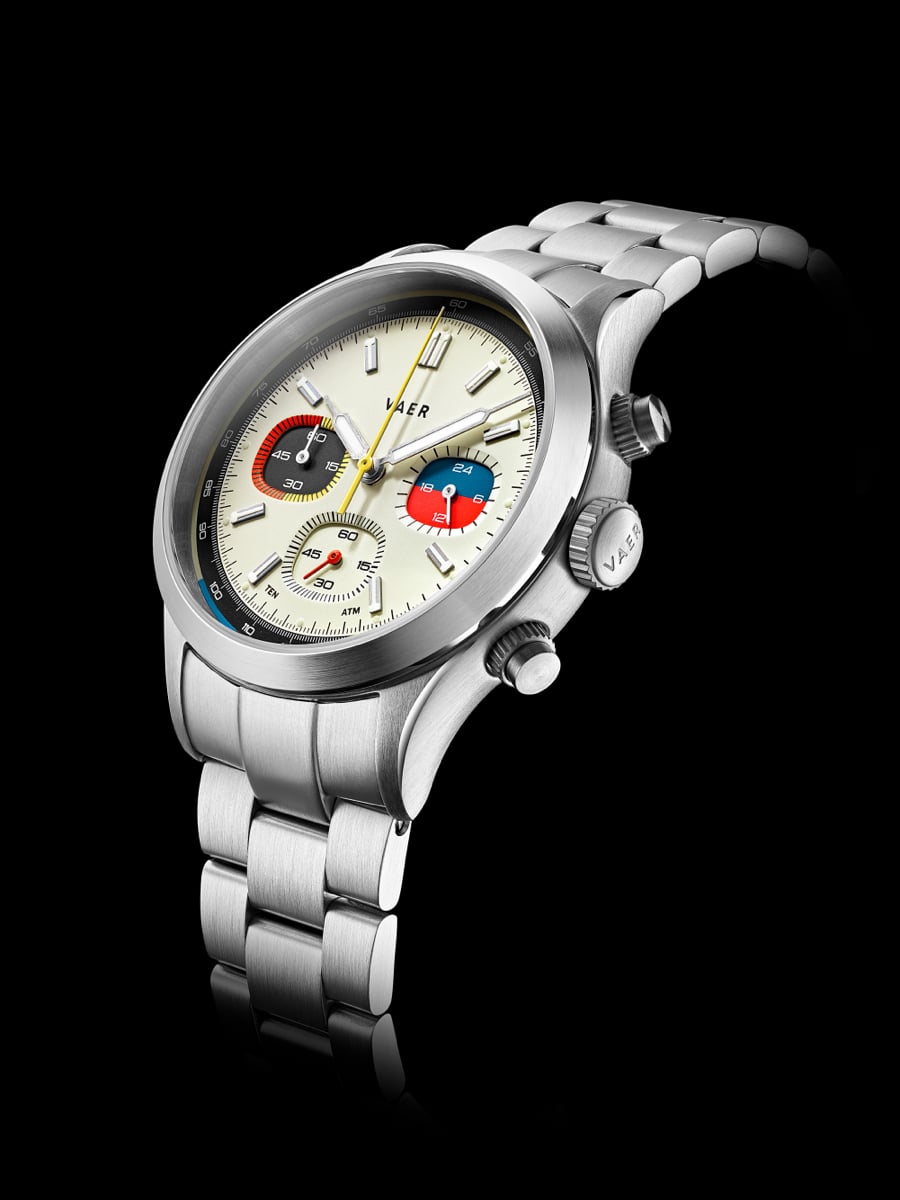 Retro Racing Character, Built for Everyday WearDrawing on the colorful racing chronographs of the 1960s and '70s, the RS1 Rally pairs vintage motorsport style with the durability expected from a Vaer. Its 40mm case houses a Japanese VK63 meca-quartz chronograph movement, complete with stopwatch functionality and an integrated tachymeter scale, while contrasting subdials give the watch its distinctive retro character. Sapphire crystal, 100 meters of water resistance, a screwdown crown, and strong BGW9 lume make it far more than a style piece. At under $300, it's an easy pick for the car enthusiast or chronograph fan.
 © Beartooth Media Group Inc.
 Loading...