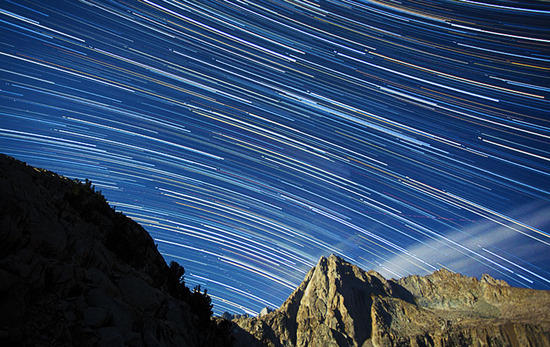
Thanks for the compliments! I used a Canon 6D and 17-40L lens and a $10 shutter remote release. It's actually not terribly difficult though and you don't need $$$ gear to get good shots. Basically you just need to be able to manipulate the settings (ISO, shutter speed, aperture) on your camera, a tripod, and a shutter remote release for the star trail shots.
For the milky way shot, you want a fast lens – f/2.8 or faster and to shoot wide open. For exposure time I use the 600/focal length rule and it seems to work. Any longer and you'll start to see star movement. I used ISO 6400, but my 17-40 wasn't ideal as it only goes down to f/4, so I had to bump the ISO up. If you are at 2.8 or faster you could probably use ISO 3200 or 1600 and be fine.
For the star trails I think I shot at f/4, ISO 3200, with multiple 30 second exposures. Turn in-camera noise reduction off, continuous drive on, set the exposure time to 30 seconds, and set the remote. For good star trails I like to get around 1.5 hours worth of shots. I then stack them with starstax (free software) in gap filling mode. You'll need to make sure to shoot close to the new moon phase and make sure the sky is clear. In my shot, I was out of luck with the moon, so I found out when it was rising and tried to get enough shots before it rose. About half my shots are with the moon rising. I lucked out though and instead of ruining the star trails, the moon lit up the surrounding peaks. There are also some clouds in my shot, but they don't look terrible. Hopefully that helps. There's lots of good tutorials on the net.
The next thing I'm going to work on is getting an interesting foreground along with the milky way.