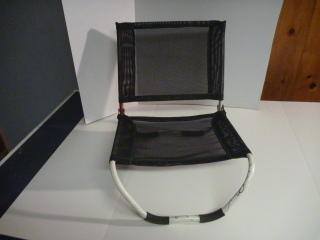
Cross Country Ski Poles were used to make a lighter off-the-ground, self-supporting camp chair. The previous chair was strong, but weighs about 1 lb, 14 oz:


The new chair weighs just under 1 lb, 5 oz, over half a pound reduction.
The seat and back widths are 16". I'm large (5'10", 185#), but a larger person would need a wider chair, of course.
The ski pole tubes are highly tempered, and weigh around 1.2 oz per running foot:

To bend them, they were packed with fine sand, capped and placed in a Ridgid 5/8" tube bender. A Swix pole was used for the chair seat, as most Swix poles do not taper, so can yield a tube that is long enough. A Rossignol pole was used for the chair back, as it is even more highly tempered where strength is needed to hold the shape of the chair when weighted by an occupant. But with the very high temper, the Rozzie tube did ripple a little on the inside of the bends.
An issue with this design is that the seat rails eventually bend, as with this steel LaFuma camp chair that saw much use:

To prevent this, carbon fiber tubes were fit snugly into the rails of the Swix tube, illustrated in the above picture of the tubes used. (The Rozzie tube is seamed, and does not accept a snugly inserted tube.) This added weight over an all alloy chair, but should extend the chair's life.
A look at the folded chair, and a closer look at the connection of the chair seat and back pieces:


Two hardened one inch aluminum alloy bolts, found in many HW stores, were used to hinge the chair seat and back pieces together. The nut, sometimes termed an "architect's" nut, was used for a clean appearance, and the threads coated with threadlocker.
The 5/8" brackets were salvaged from another LaFuma chair.
The protective sleeves on the chair bottom are cut from finely perforated, light 5/8" ID irrigation hose.
Two short one inch lengths of lesser diameter tube were inserted into the seat back rails, and bonded with J-B Weld at the drill holes for the bolt to reinforce the thin Rozzie tube. A larger diameter short length, visible in the picture, was slid over the seat rails and bonded in place to protect the tube from damage by the force of the hinge brackets when the chair is weighted.
Leno-Loc mesh from OWF and Quest was used for the seat and back. The seat is the lighter 5.5 oz nylon mesh, but may be replaced with stiffer mesh to keep the occupant a little higher off the ground. The Rozzie chair back would then be replaced with one a little higher, with the slight upper bend of the chair back eliminated so that the chair will fold completely flat. But the chair has been tested in the field, worked well, and strapped easily to the back of the pack.
As with most very light gear, care must be taken to avoid damage.
While sitting down to cook dinner at the end of the day, this chair is a great blessing.