Topic

Ocean Signals rescueME PLB

  • This topic is empty.
Viewing 25 posts - 1 through 25 (of 32 total)
PostedAug 7, 2013 at 5:29 pm

I'm no expert on PLBs (never owned one), but am looking at getting one and after doing a little bit of research have found that the Ocean Signals rescueME is the lightest unit going around: http://www.adventuresafety.com.au/survive-at-sea-range/rescueme-plb-from-ocean-signals/

It seems well designed (pretty great idea for the antenna) and is so small it'd fit into any of my pockets.

Has anyone got any feedback on this unit or can offer any advice (or any reason not to get it)? I was going to go with an ACR until I saw this one

Thanks

Bob Gross BPL Member
PostedAug 7, 2013 at 6:18 pm

This product is optimized for marine use. Is that what you had in mind?

–B.G.–

PostedAug 7, 2013 at 7:07 pm

The ACR is 16 or so grams heavier and bigger in size, but imo, ACR has a much more extensive catalogue or PLB's, EPIRB's, ELT's spanning many industries including aviation, sailing, military, etc. as opposed to Ocean Signals three or four products …. so I'm definitely more biased to trust their products based on that …. I have the ResQLink+ and it's pretty nice. Also has a test functionality, not sure if the Ocean Signals has that or not …. If you do sail and want it to be water proof, the ResQLink with the + sign after its name is the floatable version of the ResQlink …. which is great if you happen to sail. Good luck with your purchase and may you never need to use it! :)

PostedAug 7, 2013 at 7:34 pm

Bob, I was planning to mainly use this for hiking and inland river running. I'm unsure of whether that should have an impact on my choice? Would some PLBs be better where there are obstructions such as trees? My understanding was that you need a clear view to the sky regardless (correct me if I'm wrong). I wasnt aware that there were PLBs for different uses (ie. marine vs hiking).

I too feel like ACR has a better reputation, but I would hope that in achieving certification the rescueME has jumped through all the necessary hoops. hmm…

Bob Gross BPL Member
PostedAug 7, 2013 at 7:45 pm

"Bob, I was planning to mainly use this for hiking and inland river running. I'm unsure of whether that should have an impact on my choice? Would some PLBs be better where there are obstructions such as trees? My understanding was that you need a clear view to the sky regardless (correct me if I'm wrong). I wasnt aware that there were PLBs for different uses (ie. marine vs hiking)."

Phil, you are looking at this all wrong. The PLB must first get a GPS position fix and then send a signal up to the satellite.

The first function, that of GPS reception, is different in most receivers. Different models are optimized for one particular use or another. For one thing, the mask angle can be quite different for a marine receiver versus a land-based receiver. That means how high from the horizon the satellite signals are rejected. In a marine setting, it is expected that you have a virtually perfect view of the sky. In a land-based setting, that is not expected. It is desired, but different models will operate differently and with a different minimum number of satellites in view. A marine model, a lot of attention is placed on waterproofness. In a land-based model, perhaps only some attention is placed on it, and probably more attention is placed on drop protection.

–B.G.–

PostedMay 20, 2014 at 10:42 am

According to Ocean Signal there's no real difference in land or sea use with modern GPS designs. I compared the data sheets of both GPS modules and sensitivity, accuracy and acquisition time is pretty much identical. Power consumption of the Ocean Signal GPS module is about one third of the ACR GPS module. I'm no expert so what else is there to compare?

There are also no different standards for a 'land PLB' or 'sea PLB'. According to COSPAS-SARSAT:

"…one that is designed to be carried by an individual (such as while hiking/trekking) is known as a Personal Locator Beacon (PLB)."

There's even a hiker on the box of the Ocean Signal PLB1…

I'll just go with the lightest PLB with the longest battery life. Even if it's made by a relatively new company.

But Bob, thanks for triggering my investigation. ;-)

Bob Gross BPL Member
PostedMay 20, 2014 at 1:36 pm

"I compared the data sheets of both GPS modules and sensitivity, accuracy and acquisition time is pretty much identical."

I won't claim that there is outright dishonesty present, but marketing departments often have their way with product specification sheets. Often when there is one specification line that is awkward for them, that it sometimes falls off the sheet that the customer sees. The marketing department will claim that it is just promoting the most important numbers for the customer. Isn't it funny that the numbers that it claims are most important just happen to be the ones that favor its brand?

I won't address the difference between a land-based or marine-based PLB, but there are some differences between land-based or marine-based GPS receivers. The basic GPS receiver chip outputs data that is fundamentally the same, but then the particular device designers take that data and interpret it and optimize it differently to show on the user's display. For one thing, most marine-based GPS receivers spend zero time trying to display altitude. Often they have a slower sampling rate.

This may seem odd, but there is some guesswork going on with any GPS receiver, and this is called heuristics. There are certain parameters that a land-based unit will follow, and others that a marine-based unit will follow. They may get similar results, or maybe not.

–B.G.–

PostedMay 20, 2014 at 1:55 pm

The datasheets aren't from ACR or Ocean Signal but from the GPS module manufacturers (GlobalTop Technology and Quectel respectively) so if there's marketing in them at least it's not from the PLB manufacturers.

Thanks for your additional explanation. I'm sure there are differences in optimization but I personally have enough confidence in the Ocean Signal unit to use it for backpacking.

(If there's a hiker on the box it MUST be right, even if it was put on there by the marketing department ;-)

David Moreno BPL Member
PostedMay 21, 2014 at 6:01 am

OP had me curious, since I've been thinking of buying a PLB myself, and had never heard of this one. I compared them myself and went through part of the order process. Shipping from Australia to NE Ohio was only $10.50 but the handling fee was $90.00!

$340.00 list price became $440.50 with S/H.

I think I'll stick with my plan to buy the ACR and save at least $160.00 and get free shipping. Just my personal opinion but I'll sacrifice the 0.49 oz for that much savings.

Also, the Australian PLB registration is set up for Australia. I'd rather not have to go through the trouble of an American switch over.

If someone lives in Australia, I could see buying it though since a large part of the handling fees seem to be import charges.

PostedMay 21, 2014 at 6:29 am

It seems “to good to be true”, but this is were I bought my “McMurdo 210” years ago …

RescueMe

RescueMe

I didn’t go any further, but if you are interested it’s worth a call to confirm.

David Moreno BPL Member
PostedMay 21, 2014 at 7:25 am

I had just checked the price from the link that was posted in the discussion. I didn't even think to check elsewhere since I had a visitor show up here at the time. They just left so I got back on. Nice to know that it can be found at a less expensive final price. Thanks.

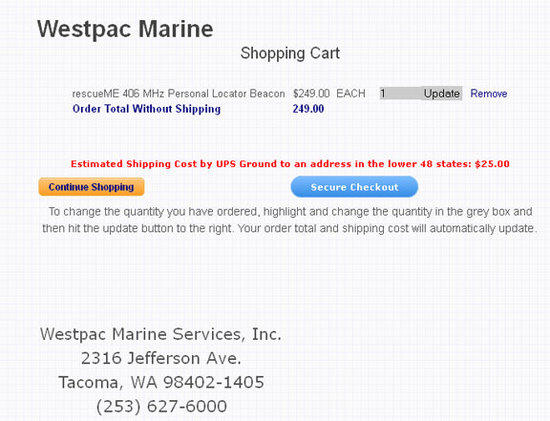
Edit: Through Westpacmarine.com it comes to $275.00 for me with shipping. I doubt it will be any less anywhere else in the US. I'll buy it and post a review after I get it.

PostedMay 23, 2014 at 9:06 pm

If you or anyone else can provide info on the reliability of this one, please let us know.

I know the FastFind works perfectly, or at least did for me in a Colorado location well below timberline and partly surrounded by mountains. This came as no surprise, because the FastFind had been tested and reported favorably by several sources on the web. Never thought I'd actually have to use one.

The FastFind has to be returned to the manufacturer for servicing before reuse, so decided to buy the RescueME from the closest place on Google, Landfall Nav. in CT. A risk, because I haven't been able to find anything like the testing that has been reported for the FastFind. Guess it was the lighter weight and smaller size, plus the retracting antenna that grabbed me, and all the reported specs were at least as good as the FastFind, although I think with the smaller battery the RescueME run time may be substantially less, but still at least 24 hours, which works for me.

It would be nice to see some reliable test reports, though. If the device will not work as well as the FastFind, I would not hesitate to send the FastFind back for service, pay the fee, and return it to the pack.

Bob Gross BPL Member
PostedMay 23, 2014 at 9:49 pm

Samuel, did you feel that the retractable antenna is a good feature or bad feature?

–B.G.–

PostedMay 23, 2014 at 10:56 pm

I also received mine and like the rectractable antenna. It's easy to pull out and you just wind the button to retract.

The little lid over the buttons might be a weaker point. It does feel sturdy enough however and the unit will be just sitting in one place so I'm not very worried about it.

COSPAS-SARSAT has test reports of all approved PLB models here:

http://www.cospas-sarsat.int/en/beacons-pro/experts-beacon-information/approved-beacon-models-tacs?view=tac_beacons

They just seem to test battery life up to 24 hours and don't mention whether it lasts longer. From the rescueME PLB1 test report:

"The beacon “rescueME PLB1” is approved for use while on ground or above ground; it
has not been designed, tested nor type approved for use while immersed in water."

PostedMay 25, 2014 at 8:52 pm

Bob,
With the FastFind, where the antenna pops out, the unit must be sent back to the manufacturer to be reset and the antenna reloaded.

With the RescueME, it can be carried and if the battery is still strong, used again after winding the antenna back into the unit. That's my understanding anyway. It shuts off easily also, although I should think a call to the SARSAT number would be in order if rescue were no longer needed. (Note: The ResuceME can be tested for the GPS function as well as battery strength, and the instructions state the antenna should be extended for the tests. However, being partially color blind, I could not tell whether the LED was red or green for the mili-second it flashed, so was unable to get much from the tests. They caution about draining the battery from repeated tests, so I let it be.)

I watched a deputy sheriff get very frustrated trying to reload the antenna on the FastFind. He also complained (understatement) that they had a difficult time trying to turn it off. (They could have, but did not ask me for assistance.) But don't get me wrong, I'm not complaining, and am eternally grateful to those who responded.

David Moreno BPL Member
PostedJun 10, 2014 at 11:06 am

I got mine today in the mail.

It appears to be solidly made. I agree that the button cover plate would be the weak point, but don't think I'll have any problems with it.

The knob on the top of the unit retracts the antenna very easily and securely, a great feature.

I'm about to try to switch it over to the U.S. system. Hope it's not a real pain, but we'll see.

PostedJun 10, 2014 at 7:03 pm

Re: "I'm about to try to switch it over to the U.S. system."

Could you or someone explain or elaborate about this? I haven't been able to find any info suggesting the need to "switch" the RescueME "over to the U.S. system."
I had no trouble registering it on US SARSAT.

Thank you,
Sam F.

David Moreno BPL Member
PostedJun 11, 2014 at 12:00 pm

The units are made in Australia and are coded for Australian SARSAT. The coding needs to be switched over to US SARAT. I've left them an e-mail and am awaiting a reply. I'll post the info when I get it.

EDIT: See my later post on this for clarification.
Thanks

PostedJun 11, 2014 at 12:16 pm

Australian Rescue Beacons

“Cospas-Sarsat is a global system and distress beacon alerts are received by the satellites from anywhere on the Earth’s surface. If an Australian-coded distress beacon is activated overseas an alert will be sent to the Rescue Coordination Centre responsible for the region in which the distress incident is occurring. A second notification is then sent to RCC-Australia as the registrar for the beacon.

“Likewise, alerts from beacons registered in other countries that are activated in the Australian region will be received by RCC-Australia. Australian residents who buy a distress beacon registered elsewhere should have the beacon recoded with the Australian country code by a local agent and have it registered with AMSA.“

I assume the reciprocal would be true when purchasing an Australian device for use in the USA.

David Moreno BPL Member
PostedJun 11, 2014 at 12:34 pm

I called and asked SARSAT since the e-mail was taking too long. I was told that these units are actually made in Great Brittan.

The PLB's are coded for different areas. Most of the BLB's sold in the US are already coded for the US. If you have any doubt, call SARSAT and give them the code number. They can tell you for sure if it's coded for the US or not.

If your unit isn't coded for the US you will have to contact the manufacturer and have it re-coded for your region (country).

I just spoke to:

Westpac Marine Services, Inc.
2316 Jefferson Ave.
Tacoma, WA 98402-1405
(253) 627-6000
http://westpacmarine.com/dbDisplay/itemDisplay.asp?varItem=ERP0500

I was informed that the RescueME BLB's that they sell are already coded for the US, so regular registration every 2 years is all that's required. I was also informed that the price listed is not a sale price, but the regular price that recently went down.

If you order from them in the next couple of weeks, it's better if you order over the phone instead of from the website as they're having a problem with the computer system listing higher than normal shipping charges. You would be refunded the additional charges, but it's simpler to just order over the phone to avoid the problem all together.

Westpac Customer Service was very polite and helpful.

I'd suggest if you are ordering one from an other US vendor that you call first to check on the coding ahead of time.

Hope this helps clear up the confusion.

I'm registering mine as soon as I get off of here.

PostedJun 11, 2014 at 2:09 pm

Thanks David.

It sounds like WestPac Marine is ahead of the curve.
Good on them.

PostedJun 11, 2014 at 8:20 pm

Thank you, gentlemen, for that helpful information.
I will call the merchant in CT that sold me the beacon and inquire whether it is coded for use in the USA.

Viewing 25 posts - 1 through 25 (of 32 total)
Loading...