


"Magnets, how do they work????"
I'm glag you asked.
Let's start with Maxwell's equations…
Topic
Become a member to post in the forums.
"Magnets, how do they work????"
I'm glag you asked.
Let's start with Maxwell's equations…
"Wait, so if you have it silver-side down, can't the foam act as the air space? Was my hypothesis correct?!"
First you have the aluminized surface. Then you have the wall of the foam touching it, which probably absorbs all IR. No air space next to aluminized surface.
A Neo-air, for example, has aluminized surfaces inside with just air next to them so they work.

is this simply a thread where the blind are arguing with the blind or are the laws of physics actually subject to different interpretations ?
I'm trying to learn something here … and all the disagreeing is spinning my head.

You could make a Daryl Daryl vest out of the TAR pad. I suspect that it would work like a crisping sleeve for a microwave burrito but there is also the possibility that you'll end up smelling like a chimichanga.
Infrared Radiation travels only through a transparent medium. It does not penetrate opaque solids to any great depth.
Microwave will penetrate solids, but IR will not.
IR will not penetrate a layer of nylon and continue on. It will deposit energy (heat) on that layer of nylon. If there is a sufficient "clear air gap" between the nylon and a subsequent IR reflector (that is perpendicular to the source), IR emitted by the heated nylon will be returned.
If there is no gap between the first (opaque) material and the reflector, the heat transfer mechanism is only conduction.
If there is no gap between a foam pad and the reflector, the heat transfer mechanism is only conduction.
Aluminized bubble wrap may work.
A reflective barrier inside an air mat may work. (All bets are off if it isn't nearly parallel to the first surface).
A reflective film bonded to an opaque foam? …. Show me the science that repudiates IR transmission and reflection.
"But, R value measures TOTAL heat loss. Not just convective, conductive or IR alone."
I agree, but this is confusing.
Conductive heat loss is proportional to the temperature difference. IR heat loss is proportional to 4th power of temperature. If you're colder, the proportion of heat loss of IR and conductive will be different.
They must just measure R at a temperature close to real use, which would include IR. Then, it will be approximately correct at other temperatures close to the test temperature. That, and the fact that like you say, the IR is only like 10% or 15% of the total heat loss so it's not that important.
I assume they measure R value in still air, and they cover the insulation with something that blocks air flow out of the insulation so that part of convection is not included. They only include convection that's happening inside the insulation.
Greg, IR is radiation. Heat is molecular/atomic motion. These are two different animals. IR does not pass through solids (well some types of glass and other IR transparent plastics and stuff, this is how IR photography is done.) It reradiates, like a laser. It is not what we interpret has heat. It is like gama rays. You don't feel them. Only the secondary effect, ie, the absorption on an object. Or on the skin. Or in the case of gamma radiation, perhaps enough energy to break a chemical bond. Reradiation occurs when something cools. Generally speaking, this is how things get cooler. Forgive me for bringing up space again, but this eliminates air conduction and other things. When electrons drop from an excited state, they release a photon of energy. Usually this is in the IR range. No air is required for transmission, indeed, air inhibits transmission. The reflecting surface can be as close as as a few angstroms and still function as a reflector. It starts breaking down at the subatomic level, soo, I don't want to go there. This is well beyond the resolution you were talking about.
Your reference is for Building Insulation. Like R value, it just mixes all the heat/radiation up. Very imprecise because they rely on conduction and convection to work…mostly convection.
If you put an alumized coating on a pad, the pad will still not stop it all. Reradiation (from capture and retransmission) will send it through. Atoms are 99% open space. Actually a lot more than that. It happens that IR can penetrate, excite an atom, have the atom drop back and emit a photon, through the entire material. Think of the IR pictures you have seen. As something warms up, it gets brighter.
A glowing piece of metal in a flame will throw off a LOT of IR radiation. It can be reflected the same as light is from a light bulb. Indeed, coating both ends of a doped rod with a mirroring substance is how simple lasers are made. There is NO air space between the rod and mirror, yet it reflects light in the IR spectrum. This is perhaps a better example of reflecting with no gap. It is not necessary.
The silver on a pad will only turn what hits it. This will probably warm the pad a bit, but not more than 5% in my estimation, because the other half of your body is not covered by aluminum ('cept if yu use an aluminized tent.) I cannot make Therm-a-Rest's numbers work. Soo, there *must* be something else going on.
James has it most correct. Light (IR) will scatter (reflect) at an interfaces according to properties of the interface. If you have two interfaces such as skin and Al coated mylar as long as the spacing is wider than the wavelenght of the light they will act like two independent interfaces. If the two interface are closer than the wavelength of light then the two interfaces, for the purpose of that frequency of light, will scatter light differently. The wavelength of IR is around 1 mm down to about a micron, so in spite of government recommendations, IR will reflect if there is a very small amount, depending on the frequency a microscopic amount, of air between it and the Al surface. I'm sure the 3.5" recommendation if it actually based on something, is based more on lowering the convective heat transfer between the layers as the skin (of the material, not human skin involved lol) temperature on the surface heats up. At a certain temperature gradient the air itself will start spontaneously to swirl, and then that will radically increase the rate of heat (molecular) energy transfer. If you make the space wide enough the convective layer will not reach across the gap.
All matter emits thermal radiation, at all times. The light you see coming from the sun – thermal radiation from the surface at about 6000 K, from a light bulb, same thing at about 3000 K. Nothing can stop this.
So yes, the Al coating does reflect the thermal energy in the IR spectrum, and that is in fact how it work, as far as it does work. Statement like
"It's not that it reflects heat, it prevents you from radiating heat."
are what we would call in the biz "not even wrong". You might accuse me of nitpicking, but the difference is between understanding the meaning of Stefan's Law and waving it about without understanding.
As James has pointed out the word "heat" is properly use to describe molecular energy. Hot molecules emit radiation with a thermal spectrum, and these can be reabsorbed again as molecular motion. Sometime a physicist will use the loose phrase "reflected heat", but yes, "reflected energy" is the technically correct way to describe it.
If you're talking about staying warm camping in the wilderness, then you need an air gap for an aluminized layer to work.
It would be better if it was a vacuum, but that's not applicable to camping.
And some solids may pass IR, but again not applicable to camping.
Jerry, not entirely disputing this, just that you understand WHY this is, and the range of its applicability.
For example, the vacuum part would only apply to molecular heat transfer, not radiation.
I give up….
Yup, time to move it to chaff. LOL
"If you have two interfaces such as skin and Al coated mylar as long as the spacing is wider than the wavelenght of the light they will act like two independent interfaces"
Okay, maybe it's reflecting IR, but that's not the point
If you have, for example, human body, aluminized layer, ground, if there's no air gap, then because of conduction, the humand body and ground will become the same temperature – the aluminized layer doesn't do anything.
All I care about is the minimum temperature I will be comfortable sleeping at, and whether having an aluminized pad vs non-aluminized pad makes any difference.
If you measure the R value of boundary layer, it increases up to about 3.5 inches if you use Greg's source. Dimishing return above 1/2 or 1 inch – that's the air gap you need. If the air gap is much less than that, then the aluminized layer won't do any good.
Well, this thread has left me more hopelessly lost than I was when I started.
I'm just gonna flip a coin before I lie down to decide my orientation.
James and Mark have conceded defeat : )
All I care about is under what condition aluminized layer does any good, may get sloppy talking about theory. If this was a physics web site I should be more careful.
Coin flip is good because aluminized layer is ineffective because there's no air gap.
If this had been a physics web site, the term Stefan-Boltzmann would have been spelled correctly.
The rest of us were out getting the cursors lubricated on our slide rules.
–B.G.–
Jerry, apples and oranges again. Of course they touch, and heat is exchanged with the pad. The temperature at the bottom of the pad is at the ground temperature, and the temperature where you touch it is at your body temperature, or rather the temperature of the outside of the compressed sleeping bag. The temperature of the Al layer doesn't have anything to do with its reflective properties.
If you were to lay a space blanket flat on the ground, for example, you would be cold. If you were to put an un-coated mylar sheet on the ground you would also be cold. The slight increase of R factor for the coated one would be exactly the same as for the pad. Apples and oranges.
This is just my analysis, but since the wavelenght of IR is much less then 3.5" a gap of 3.5" will not effect its properties one bit. Rather the effect it does have can get outweighed by convention. The difference is between reading something online, and analyzing the reasons for what happens. Also remember that the case of layers of an insulating wall the inside layer could get much hotter than between your back and the pad. If you understand the particular situation and can analyze the differences between that situation and the one you are concerned with it may prevent you making blanket (no pun intended) statements like "an Al coating doesn't work unless you are 3.5" from it. I might be missing something, but I would need an actual physics explainations, not a Wikipedia article to convince me.
I'm not criticizing your admirable efforts in this area, nor you enthusiasm for the subject. I'm just trying to help you understand WHY things work the way they do. When we understand why it is easier to come up with good ideas for how to improve things. Often things are so complicated that the only recourse is to experiment, but when going back and analyzing the experiment you have to be very rigorous before you draw a conclusion as to the precise mechanisms. As a professional physicist, I have been trained to understand that if I give a paper at a conference and I get my details and/or explainations obviously wrong, I will get jumped on by a bunch of ruthless fellow physicists. I didn't mean to apply those standards to you. You obviously have a serious interest in this subject, and I think you are able enough at this point to try to get into the fine scale details.
Ha, ha…I haven't used it since Texas instruments released their T1 hand held calkcliclater… I think a touch of olive oil works well, though.
Thread was started on Pi aprox. day, for you nerds out there.
at least I spelled Stefan correctly
Q: What's the best way to orient a reflective pad like the Thermarest Z-Lite? Silver up or down?
A: 42
It's up
Become a member to post in the forums.
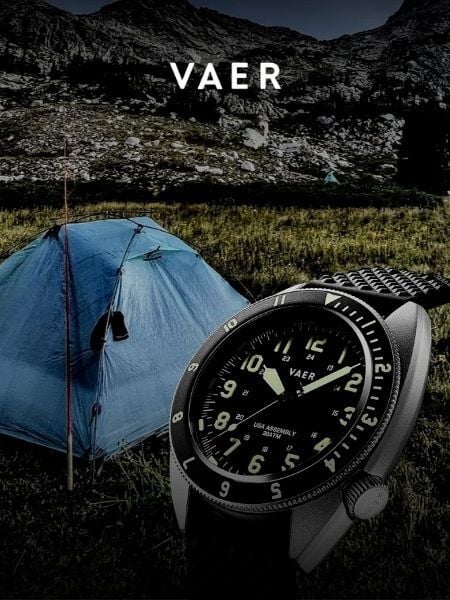 Vaer C4 Tactical Field SolarDurable timepiece for wilderness users - 20ATM (200m) water resistance, 120-click bezel, 316L SS casing, sapphire glass, solar-powered, Epson VS-42 Japanese movement, C3 Lume, USA assembly.
 © Beartooth Media Group Inc.
 Loading...