A smartphone on the trail can be useful.
GPS, phone, lighting, camera, alarm, maps, journal, etc.
Its a multi use tool which makes it the perfect candidate for a trail companion.
However, on a thru hike or longer hike, its not enough to just carry an extra battery.
You could deal with recharging but then you are stuck in town.
I've looked at all the solar options available via DIY and on the market, and the lightest panel which seems enough to charge a phone in any decent time would be a 6V ~800ma 4.5oz panel charging directly to the phone via USB (not all phones will be ok with the panel input). More practical is to charge a lithium polymer battery above 3000mah and when its time, use that to charge the phone via usb booster (3.7 v to 5v usb). This requires the additional battery weight (3000mah 2.11oz, 4500 2.89oz, 5100 3.5oz, 6000 3.88oz) of your capacity of choice, plus the additional weight of the lipo charging circuit, booster circuit, blocking diode, wires, case, glue and solder (1oz total?)
A system like this would weight about 8oz and only cost about $60 to $80 and would probably be usable provided you used the phone sparingly and maybe rested in a sunny spot for an hour or two every few days. However, I did find an unconventional solution that could make it extremely light weight.
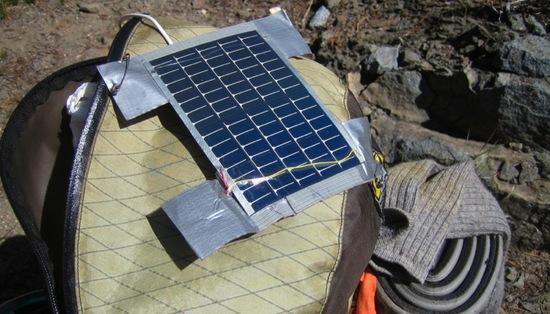
Powerfilm sells their own products, but also the panels directly. Rather, strips of cells. The MPT6-150 is a 6V strip with an output of 100ma and weighs only .1oz. Put a few of these in parallel and you could get the 300-600ma that would make charging much faster so its not a pain in the rear. Well, they roll up and are only .1 oz so you could go up to 1a if you desire. The only problem is cost – like $20 per 100ma.
The whole solar setup minus lipo (if its even used) should only weight around 2oz and give as many or as little amps as you desire, hindered only by cost. If you layed out enough, you would get plenty of juice during breaks.