Topic

Bootmaking theory

  • This topic is empty.
Viewing 17 posts - 1 through 17 (of 17 total)
PostedJul 8, 2013 at 9:36 am

Not sure how to title this post.

I have a ridiculously bad right ankle, which I've sprained at least 12 times in the past decade. Prior to that I'd had a reconstruction done, which was good for all of a year. I am loathe to go through another surgery that may also be unsuccessful, so try to grin and bear it.

What the heck do my ankle woes have to do with boots one may ask?

First, higher ankle cuffs on boots, I've found, don't actually provide enough support to prevent one's ankle from rolling. So, by my way of thinking, ankle cuffs merely add weight and reduce mobility. I have Lowa Banff boots, a heavy duty backpacking boot, and the ankle support is supposed to be fantastic on them, but they cannot prevent my right ankle from rolling. The same is true of several other lighter weight boots I have or have worn over the years. The only boots with the rigidity required to actually prevent a roll over are my double plastic mountaineering boots. Short of those, to actually prevent an ankle roll, the only solution is to wear a robust ankle brace. [Aside: I've spent many years doing balance drills and exercises to strengthen the ankle and proprioception — at some point there's just no structure there so it doesn't matter much.]

Second, I'm no physicist, but it seems to me that the further (grammar police needed: further or farther??) one's foot is from the ground, the more stress is placed on an ankle when instability exists (i.e., walking across loose rock). Hence, I don't think it makes much sense to have a really thick midsole and sole on boots, which, when combined, put you further (or farther??) from the ground. I believe this is exacerbated with heel lift. That's not to say there should be no protection — I'll acknowledge that it is uncomfortable hiking on rock in my NB minimus running shoes.

Third, a stiff shank just makes balancing on loose rocks more difficult. If the sole is fairly flexible, one can sort of wrap ones foot over multiple rocks, creating more stability. A really stiff shank can make for a single, tiny point of contact on that one highest rock. So, one can find oneself doing a lot of balancing and, hence, wasting a lot of energy (and that is before one gets to the energy toll on account of weight).

So, all of this leads to my basic questions: What is the theory underlying heavy duty backpacking boots? What do people say is served by the large heel lift that exists on many of these boots? Why the thick soles? What purpose is served by really stiff shanks? I've only ever been able to discern two explanations: (a) ankle support (which is bogus); and, (b) foot support. On the latter point, I don't even know what that means, perhaps because I've never in my life suffered from sore feet.

In any event, your insights are much appreciated.

PostedJul 8, 2013 at 9:52 am

ankle rolling ?

answer :

when the ankle starts it's little games, it "should" automatically let you drop to one knee.
thusly .. trekkng poles. because poles let you fall with grace.

peter quite prefers PacerPoles.

cheers,
v.

Jerry Adams BPL Member
PostedJul 8, 2013 at 10:45 am

Maybe you have to build up those muscles. Some sort of weight lifting machine.

PostedJul 8, 2013 at 10:51 am

I'm actually not looking for suggestions about my ankle. I'm resigned to an ASO brace and use my trekking poles. When combined with a large degree of caution, I'm able to avoid further injury.

I'm just curious as to the rationale/theory underlying the heavy duty hiking boot.

Justin Baker BPL Member
PostedJul 8, 2013 at 11:04 am

The rationale/theory is the idea that technology can improve everything, even natural human functions that have evolved with us. It's totally wrong.

Marko Botsaris BPL Member
PostedJul 8, 2013 at 11:08 am

Hi Thomas,

I'm with you on this – I had a ankle fusion about 16 years ago on an injured right ankle. As a result my ankle is fused at a slight pronated angle, and my right leg is a bit shorter than my left. I've spend a good part of the past 10 years (and the project is still ongoing) learning about how to adjust my shoes to compensate.

I actually AM a physicist (LOL). It has helped a bit, but I can tell you I have not discovered any really good information on "boot theory". I have several hundred dollars worth of medical books on biomechanics of the lower extremities, but I have never found a book on what you are asking about. I'd buy it in a second if I ever found one.

Even more depressing is I have had some world class surgeons and gone to many podiatrists and none of them has been the least help. The way I describe it is that they are only interested in "functionality" at the level of walking from the couch to the refrigerator, not for hiking 10 miles through the mountains. The usefulness, in my experience, for getting some of these problems solved in the form of adjustments of your footwear, from least to most helpful is (1) surgeons (totally useless), (2) podiatrists (almost totally useless), (3)othodists (19/20 pretty useless, but if you can find one that will work with you in detail they can be very helpful). Most of the above can be useful in telling you exactly what the problem is, but if you can't cut it off or screw it together they don't help much for the long term mechanical issues – at least for the bigger issues such as yours and mine.

The most important detail of course is exactly what is wrong with your ankle. You don't say too specifically, but I take it that the lateral stability of you ankle is shot, that you tend to hyper pronate or supinate (assume the former at it is the most usual) at this point with minimal "encouragement" when you walk, and you have already more or less done everything you can to reinforce your internal ankle strength. Therefore you need some external support to minimize this issue.

Congrats on discovering the truth about high boots for yourself – high boots (except ones that are so huge as to defeat the purpose of "normal" walking) will not protect your ankles. On the contrary, to the extent that the *decrease* your feel of the ground that can make things worse. So the real issue is no shoes can keep an ankle from turning and big boots tend to actually increase the probability of that happening. So the focus should be on prevention, NOT mitigation.

Your second observation I think is also right on. You want to be close to the ground – the leaver arm when you do turn you angle is just going to increase. You may need a stiffer sole on that foot, but you can buy carbon fiber shoe plates (inserts) that weigh nothing that will add all the stiffness you need.

Your third observation of a stiff shank is also right on, withyou issue you may have other concerns. You may in fact want a stiffer sole, but may want to give up on that as an intrinsic par of the shoe to find a good solution for you. There are some other solutions for this.

So… how to solve your problem. I would say find a decent orthodist that can make you both custom insoles (super important in this case) and possibly other orthotics and make custom modification of your shoes if necessary. Make sure he or she is willing to work with you to tweak things, and is willing to let you tell him what you need and what works for you. There are places online where you can have some of these things modified if you can't find anyone close by.

That said, here is one way you could analyze your things if your main problem is that you have bad lateral ankle stability you want to support this. As you already noted even a large leather boot is not going to stop your ankle from turning. So short of putting on some kind of heavy brace are talking about measures to *prevent* things from getting that far. The naive and uninformed point of view, which you have already partially shot down would be simply to support the ankle in the lateral direction. This doesn't work by itself. You need to prevent, to as large a degree as possible, the over pronation or supination in the first place.

To start you probably want to get some custom insoles made – the ones where you get casts of your feet made. These will tend to stabilize your ankle when your heel strikes, and that is the absolute first thing you need to get that pinned down. If your insoles do not fit your heel (at the very least) like a glove then you need to fix that. Second buy shoes with a wider heel. Get a cheap micrometer and bring it with you to the store to measure this.

Thirdly, the way the foot works is that it rotates (pronates) as you go from heal strike through to push off. So every time your ankle flexes while walking it will naturally want to pronate. Depending on the terrain, and other physical things happening on a particular step this natural pronation can easily turn in to hyper-pronation (turned ankle). So provided you have already done the easy steps above of custom insole and wide heel, the next step is the less intuitive more drastic one of stabilizing your ankle motion in the perpendicular direction – the less you ankle has to bend the less it will also have to pronate. Short of using a custom brace, which depending on how bad it is you may want to do after all the other things are tried, minimizing the flexion of that ankle means either a stiffer sole or a rocker bottom, or better a combination of both. You can stiffen a soul using very thin, very light carbon fiber plates (about $50-60). These are like insole that go under you regular insoles. You can get the soles on your shoes modified to have more rocker style bottoms, and these can lower the about of pronation during a normal stride, and possibly lower the tendency to hyper-pronate. These modifications can allow you to walk with less pronation in your stride,

All of the above said, remember the following. Tweak things lightly, one step at a time. Remember to follow the advice of using the modified footwear only for a few hours at a time until you feet get used to them. Lastly keep in mind that there is a price to pay – what you are doing is knowingly altering the way you foot works, and will be playing off some other forms of flexibility and stability to fix you specific problem. The important thing is to test at each stage, and then tweak some more. You want to find a balance point between trade offs that works for you. Unfortunately you are going to have to be the driving engine to get this done – long before you get to the end you are probably going to be *telling* the orthodists what you want them to do, rather than asking them. Don't do anything you doctors thing is just wrong, but when they start to shrug you will know it is time to be proactive.

BTW, trekking poles another *essential* addition to the mix here. If you are't using them with what you describe as your problem, then that is thing number one. A very good idea. At this point I just assume people who wear trail runner use them. LOL

Hope this helps a little and good luck.

ps. you are going to get a bunch of advice on here from the standard groups. People who say the foot is perfect as it is and you should wear less (total bull for people like us who have some permanent damage and DON'T have a normal foot). People who say you can train or strengthen you way out of it (good advice but also bull for people who have permanent damage) and so on.

PostedJul 8, 2013 at 11:26 am

Pedorthist – often someone who just wants to make a cast of your feet and then sell you custom othotics.

Sometimes though, you can find one who is a runner or backpacker, is "function" oriented, and will work with what you've got, along with selling custom orthotics. This person will put you on a treadmill, watch what happens, grind off some foam, add some foam, etc. until things look good. And two weeks later after things have settled in, take another look and make some adjustments.

Like all things body-mechanical, finding someone Good is the challenge.

Marko Botsaris BPL Member
PostedJul 8, 2013 at 11:28 am

"I'm actually not looking for suggestions about my ankle. "

Ah, ok. You posted that when I was writing my big post. LOL BTW I use an ASO brace periodically. I can tell you making the other mods can help in addition, but if it completely solves your issues then great – and also I am jealous.

"I'm just curious as to the rationale/theory underlying the heavy duty hiking boot."

I've been looking for this for years. All of the reason they tell you in the shoe store – all of them – are bogus. Ankle support – no. Protect feet from water – until they actually hold the water to your feet for longer. And so on. So I can only assume the "theory" behind it is that the profit margin is greater on large boots.

I think you can safely write off that whole area of theoretical knowledge. Over the past decade or so on this site, more so in the beginning as it was not established "dogma", some very detailed analysis as been done on why trail runners are better than boots. I think possibly you can find the negative arguments in those posts. I think basically it come down to a mitigation (boots) versus prevention mentality. Mitigation is fine if it works, but in the case of boots it does not in most cases.

dan mchale BPL Member
PostedJul 8, 2013 at 11:36 am

Custom boots may be the way to go. Get some without to much of that forward/aft stiffness. Get some with above the ankle support (but not too stiff up there) but have them made with a low to the ground and as wide a base as you can get away with. You might even experiment with this by screwing wider platforms to the base of a boot heal – some strong thin material. I have wanted to try this but have not gotten around to it. I have a bad left ankle. You won't be making a fashion statement. Have the footbox made tall enough that you can put a variety of insoles inside and still have room above your foot. One of the big changes I have made in recent years is wearing thin sock even in big boots to get more room. It's amazing how little sock a person needs even in a heavy boot, if it fits well. Like Peter said, use poles, walk softly, and act like your ankle is messed up!

Most stiff boots are for kicking steps in snow or for wearing crampons. The tall narrow stiff boots can magnify the forces that you want to minimize. Thick soles can be likened to what you see in cross-country skating skis; They are tall and narrow so that is easy to tip them over to get on the edges. Old style diagonal stride skis were flat to the ground and difficult to get on edge and more stable in rough tracks.

It is even much easier to turn an ankle in tall running shoes rather than thin ones.

PostedJul 8, 2013 at 12:03 pm

I have found that the higher top of a shoe (boot, high top shoe, etc.) provides feed back when my ankle starts to roll much sooner and more intensely. I can feel my ankle starting to roll and correct it (such as "going to a knee") before it becomes a problem. Additionally, I can feel the orientation of my foot better as I am walking. This helps me "pay attention" to how I am walking before anything becomes a problem.

As for stiff soles, I absolutely love them. With stiff soles I feel as if the show is walking for me. They also protect my feet from sharp rocks.

As for heavy boots, never understood that. In the early '80s I bought a pair of the "standard" heavy hiking boots with the vibram soles as "everyone" said that is what you should use. They are still in great condition as I only wore them a few times. Once I weighted them I never wore them again!

PostedJul 8, 2013 at 1:19 pm

"As for heavy boots, never understood that. In the early '80s I bought a pair of the "standard" heavy hiking boots with the vibram soles as "everyone" said that is what you should use."

Oh yea. And I bought the Heaviest pair I could find.
I mean, if sturdy is good, massive Must be better.

Jerry Adams BPL Member
PostedJul 8, 2013 at 1:33 pm

Maybe too heavy boots are derived from mountaineering boots

If it's cold and you're using crampons on glacier ice you want heavy boots

Then they advertise to regular hikers that these are the boots Hillary used to climb Everest so the must be good enough for you

A gripe of mine, that the gear that extreme hikers use is advertised for regular hikers

Like I can use the lightest boots. My tent doesn't need to endure a hurricane. I don't need the insect protection that would be appropriate in Alaska…

Roger Caffin BPL Member
PostedJul 8, 2013 at 3:14 pm

Hi Thomas

> What is the theory underlying heavy duty backpacking boots?
A very good question. herewith a potted history in a very brief nutshell.

In a nutshell, there is no underlying theory. Boots started off as Army footwear in Europe. An Englishman organised the major bootmaking valley in Italy a few hundred years ago into a co-op, out of which sprang Scarpa and Asolo. Then Vitoli Brahmini in Italy invented rubber soles which he called Vibram from his name.

From there the use of boots expanded – it was all you could buy that was robust enough for outdoor use. Companies were built and profits were made. The meat industry found a valuable secondary profit line in tanned hides.

Then some rotten beggar invented the jogger with the injection-molded sole. The costs of footwear plummeted. They moved manufacturing to Asia, and the costs plummeted again. The sales of these cheaper joggers ate into the profits of the boot companies, who fought back with lots of scare-based marketing.

The retailers like boots: they are expensive and have a high profit margin. They don't like joggers as there is no profit margin, so they don't sell them. But given that New Balance for instance sells 7 million pairs a year, joggers are not going away.

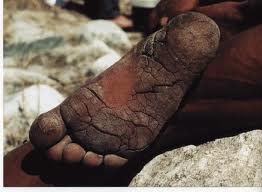
Meanwhile, about half the world still goes around barefoot, giving the complete lie to the claims of the boot companies. And Nepali porters sometimes carry huge loads up mountains either barefoot or in cheap Chinese tennies.

Cheers

PostedJul 8, 2013 at 3:41 pm

My father used to work at a steel mill in the early 1970s. He wore steel toed boots with steel shanks to protect his feet from heavy stuff falling, and hot stuff burning through his soles.

He still wears steel toed, steel shanked boots around the neighborhood "to protect his feet." From what, I still don't know.

PostedJul 8, 2013 at 3:55 pm

"…And Nepali porters sometimes carry huge loads up mountains either barefoot…"

Just because you can, doesn't mean you should…

barefoot Porter

Viewing 17 posts - 1 through 17 (of 17 total)
Loading...