Topic

Wet Weather Shelter Philosophy

  • This topic is empty.
Viewing 25 posts - 26 through 50 (of 65 total)
PostedJul 2, 2013 at 3:27 am

Re: Peak vents.

I think peak vents help with the ventilation by venting the warm air up and so drawing outside air through the bottom.

But at what cost? It always seems that the top vent lets some spray in during strong wind blown rain, unless you can close it very tightly.

Oware pyramids, or at least my Alphamid, can be zipped down partially from the top and so basically has an adjustable top vent that is fully waterproof when zipped shut.

J-L BPL Member
PostedSep 30, 2013 at 3:53 pm

I wanted to thank every one for their input. Since posting this, I have gone on multiple backpacking trips with several days of rain including:

Rio Grand NF, CO: we had rain for almost 12 hours a day for 3 days straight
Black River, AZ: 2 nights of heavy monsoon rain and hail, lots of wind
Mt Hood NF, OR: 1 long night and morning of rain
Uinta Wilderness, UT: I got rained on for over 12 hours the 1st night and then rained, hailed, and snowed on my last night

After the posts here, I picked up an SMD Haven (a two-pole mid design) which I used for most of these trips. Its large interior size allowed my dog and I a fair amount of room to dry off and keep things dry. The relatively drip-free entrances were also handy when entering the tent in the rain and when packing up in the rain. The fully-enclosed nature of the Haven was comforting when the wind started to blow, however, I wish I was able to have some views in light rain with little wind.

On all these trips, I packed along a large tarp (8.5×11) to use as a group shelter. This tarp sheltered 2-3 people and 1-2 dogs very well. Having a way for the group to hang out and cook in the rain, shelter dry wood, and even play cards really made these trips great; they would have been totally different if we all went into our own tents once it started raining. I am very impressed at how dry a flat tarp pitched in an A-frame was able to keep us even in heavy rain. Some spray got in from the wind at times and some hail bounced under it, but the tarp was often pitched several feet off the ground to provide headroom. In cuben, this tarp weighs 8 oz and I think it is weight well-carried.

Seeing how effective the tarp has been, I am now tempted to try using one as my primary shelter. I think the views will be great in the rain. My only concern is the wind, but I imagine that could be (mostly) negated by site selection and pitch.

Derek M. BPL Member
PostedSep 30, 2013 at 8:36 pm

John,
Your experiences are in line with mine in that a flat tarp pitched in an A-frame can actually keep one dry in a surprising amount of weather conditions.

When I lived on the east coast, I would spend my summers backpacking in the Appalachians where it rains quite often. Windblown rain was a common occurrence. Back in those days, I was single, and did all my camping in a 9' x 7' flat tarp coupled with a hammock. This setup weathered everything from light rains to the remnants of tropical storms (literally) that had made landfall.

I never got wet, and the ventilation was unparalleled in comparison to more "closed" shelters. If it was really rainy when I got into camp, I would set the tarp up at a low-angle pitch and cook under it and relax (there are usually almost no flying bugs to pester you while it's raining hard). Then I'd lower the pitch to a steeper angle to weather the night.

I think that using a flat tarp while sleeping on the ground would be much the same, but with a bit less ventilation because there isn't a big opening under you at all times.

Since my younger days rambling around the Appalachians all summer, I have gotten married and thankfully have a wife that always wants to go backpacking with me. While wonderful in it's own right, it has been a challenge for me to go from sleeping solo in a hammock to now trying to figure out a two-person sleeping system that works for both my wife and I (spoiler: hammocks are not it).

We currently use a TarpTent Double Rainbow, but we haven't had to use this setup in very rainy weather yet (PNW summers are wonderfully dry).

I am tempted to try going back to a single flat tarp for both of us. The challenge for me is to figure out a system that keeps my wife happy and away from the bugs, while still leveraging the lightweight, ventilation, and flexibility of a flat tarp.

I still haven't settled on anything. The SMD Haven Tarp + NetTent looks like a good option, but you sacrifice the flexibility of a flat tarp for the convenience of a single, optimized setup. I haven't made up my mind on whether this is worth it or not.

Let us all know how you like the Haven after some more use!

PostedOct 1, 2013 at 2:38 am

Derek,

I prefer tarps myself, and in fact tried a 10×10 tarp with my wife in late winter.
She was uncomfortable not being enclosed in a bug net, even though there were no bugs that time of year.

We now almost always take the SMD Haven when we hike together and I like the flexibility of having the fly and the net tent being separate.

The Haven is much more flexible than other tarptent style shelters I've used, especially for hot summer use where both long sides of the fly can be rolled up for better ventilation. And the net inner works great when cowboy camping or in an AT style shelter or tent platform.
But, the Haven isn't as flexible as other tarp/bugnet combinations.

I think if I were in the market for a two person setup, I'd probably look into a large tarp with separate bug inner like the BearPaw Canopy 2/Net Tent 2 combination, or even just a 10×10 square tarp with large a-frame bugnet.

The Haven and other tarptents tend to be a bit limited in how they can be pitched.

A tarp can be pitched in many ways, so as an example pitched as an a-frame for rain while sleeping and raise one side high as a kitchen, lounging in drizzle or shade/ventilation in hot summer.

You can also pitch a tarp with three ends tight to the ground to block strong blowing rain/snow and/or reduce a cold breeze. Most tarp tents, including the Haven are difficult to pitch this way.

Phillip Asby BPL Member
PostedOct 1, 2013 at 6:30 am

I have to say this has been a helpful thread! Lots of approaches with no one solution being best for every one – other than a pretty universal position on having a tarp even if you have a tent (double or single wall).

My first backpacking trip ever was in 30 degree weather with snow/sleet/freezing rain that lasted from the trailhead to camp until late in the afternoon. A couple guys had brought some larger tarps and it made a world of difference to just be able to stand up or sit in a spot without being pelted by the rain or giant drops – rain gear or not.

J-L BPL Member
PostedOct 1, 2013 at 7:21 am

I plan on using my flat tarp with a bug net for my dog and I (just ordered a Yama 2.0 bug shelter), so we will see how it works out. As Steven mentioned, this setup should provide good flexibility – there are a multitude of pitches that I will be able to use. My only hope is that setting up the tarp and bug net together won't be too fiddly.

Regarding the Haven and net tent, I've used mine for about 20 nights so I feel pretty comfortable with it (I just returned from taking 3 weeks off work to go backpacking). Feel free to ask me any questions. Maybe I will write a review about it here.

Phillip Asby BPL Member
PostedOct 1, 2013 at 9:17 am

For those whose wet weather strategy includes a shelter of any flavor that does not include a floor – I presume site selection is critical to avoid sleeping in a puddle? Do you still use some sort of ground cloth? Probably rudimentary questions but I am still a bathtub floor double walled tent kind of guy…

Trying to figure out how you stay really dry when you're setting up on wet ground and only sheltering it from additional rain – deal with runoff and puddling, etc..

I have to admit really nasty wet conditions make a hammock seem pretty attractive despite my concerns about being able to, you know, actually sleep in one not to mention weed through the numerous hammock options, tarp options, lines toggles buckles carabiners straps clips webbing orings ridgelines insulation, etc…

PostedOct 1, 2013 at 9:25 am

That reminds me of the time that I was camped in one of those well used campgrounds.

I was floor-less, with only a groundcloth.

I was the only one who pitched on an elevated spot.

We woke up in a flood zone after a torrential downpour.
Everyone else had bathtubs full of water and wet sleeping bags.

I was dry and had no problems.

Brad Rogers BPL Member
PostedOct 1, 2013 at 9:25 am

Polycro floor from gossamer gear. Site selection is of course very important.

PostedOct 1, 2013 at 9:44 am

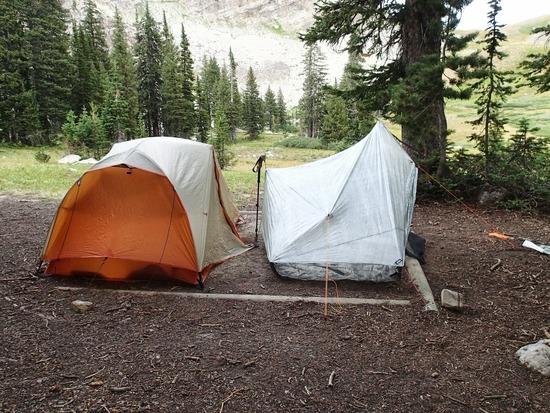
Marion Lake, Grand Teton National Park

What drives me nuts is when you have no choice but to use the designated pads. This is from last month at Marion Lake in Grand Teton NP. It rained that evening pretty steadily for several hours. Those tent pads do NOT drain all that well.

PostedOct 1, 2013 at 10:20 am

@Jeff, yes, those kind of campsites suck in the rain.

I usually pitch away from the potential pond and if people complain, I explain I why can't pitch there.

Buck Nelson BPL Member
PostedOct 1, 2013 at 10:28 am

"What drives me nuts is when you have no choice but to use the designated pads."

I'm with you. I absolutely love Glacier National Park but they were dropping the ball on some major issues when I was hiking thru. For example, campsites right in the midst of a sea of large dead trees. Major tree-fall hazard. I camped a short distance away in a green area. At another site there was a backcountry food-storage locker that let mice right through. Destroyed much of my food in one night. At a third camp my designated tent pad that was a shallow tub, dry at the time but with rain threatening. I took a photo of the pad just before I set up my tent on designated high ground right next to it. The next morning I took another photo of the flooded tent pad. (I sent photos, and a letter, to the park concerning these issues and got a nice, respectful reply to all my concerns in response.)

Ben C BPL Member
PostedOct 1, 2013 at 10:37 am

I think site selection is really important regardless of whether you have a floor or not. I generally look at the debris around a site to see if it looks like water has been pooling in or flowing towards the site. I also look at all positions higher than the potential site to try to visualize where water will flow. Between the two of these methods, I can usually get it right. The surface you are on can make a big difference too. Water moves much faster over solid rock slabs than it does through dirt and forest duff.

I thinks its generally easier to keep your gear and space drier using a tarp than using a tent with a separate inner.

I'm currently using a trailstar and I like how it does in rain. You can keep it low for quick, blustery storms. Our prolonged rains seem to be less windy, and I can set one corner up really high and get lots of ventilation, views, and livability during a sustained rain.

Derek M. BPL Member
PostedOct 1, 2013 at 6:34 pm

"I have to admit really nasty wet conditions make a hammock seem pretty attractive despite my concerns about being able to, you know, actually sleep in one not to mention weed through the numerous hammock options, tarp options, lines toggles buckles carabiners straps clips webbing orings ridgelines insulation, etc…"

Phillip,
I've got to tell you, one of the sweet, sweet joys of hammock camping is hiking through torrential rain all day and knowing that, not matter what, you will be high and dry that night. I sure miss that about hammock camping. I've hammocked in rain so bad that little water rivulets started running under my setup. Again, high and dry… Such a perk of hammock camping.

Anyway, with regards to hammock complexity, I have a dirty little secret: for ten years, I camped with a $20 double hammock (the kind made of nylon netting) and a Campmor 70d PU coated 9' x 7' tarp over me ($22).

Now if were to equip myself today, I'd choose much lighter options, but the point is that I was perfectly warm, comfortable, and dry using a very simple setup costing less than $45. It doesn't have to be complicated.

Don't be intimidated by all the hammock options. I'd suggest just buying or making a very simply 1.1oz/sq.yd. gathered end hammock (no ridgeline) and trying that out first. You've probably already got a tarp that will work. Make sure it's at least 9' long. 10' is better. Just use a simple piece of webbing (at least 10' per hammock side, 15' is better) to gather the ends of the hammock, then just wrap the webbing around the trees as many times as possible and tie a full hitch with a quick release. I've probably slept more than 300 nights like this without one incident.

Hammocking doesn't have to be complicated. Now I just have to stop talking because it's making me depressed that I can no longer hammock camp when backpacking with my wife :(.

PostedOct 1, 2013 at 6:58 pm

I think Henry Shires newer tents have "venting done right". i.e. Lower AND upper vents.

As mentioned above, this helps with airflow (better when a warm body or two are inside to creat warm air for increased air flow).

ANY tent these days W/O upper and lower venting is a tent to be passed over.

ANY tent these days W/O a vestibule and shielded door is to be passed over.(Frikkin' wedge tents are the worst offenders. -> "Open the door, rain & snow on the floor.")

ANY double wall tent these days must be able to be pitched FLY FIRST and struck FLY LAST or should be passed over in your search for a decent tent.

NEVER let a camel get his nose in yer tent. (Bedouin wisdom.)

Here endeth my "venting etc." tent sermon.

Roger Caffin BPL Member
PostedOct 1, 2013 at 11:28 pm

> I've hammocked in rain so bad that little water rivulets started running under my
> setup. Again, high and dry…

And I have tented in rain so bad that the bucket groundsheet was floating in an inch of water. We too were 'high and dry' inside. The secret – good gear.

Cheers

PostedOct 2, 2013 at 6:49 am

I'd like to thank all participants for this excellent discussion: As a long-time backpacker and tent camper who's just now branching out into tarps and UL, I'm looking for information on alternatives to tents. (a) The various tarp setups and tarp-tent configurations are going to save me a lot of trial-and-error. (b) I've never seriously considered investing in a hammock, since we live in an area with minimal rain, ergo, with practically no trees. But the diy possibilities in this discussion have piqued my interest, and I just might try to make my own and take it out to the mountains.

PostedOct 2, 2013 at 7:49 am

In warmer wet weather, I prefer a tarp or mid/tipi with a lightweight bivy. In colder wet weather, I prefer a floorless tipi with a wood stove. The wood stove dries it out inside a lot. I will add a liner sometimes to make it effectively a double wall tent with a wood stove.

Derek M. BPL Member
PostedOct 2, 2013 at 8:49 pm

Hey Kenda,
Check out some of the very easy to follow hammock plans over at DIY Gear Supply. That should get you started:
http://www.backwoodsdaydreamer.com/diy-guides/hammock/

Kevin,
Could you talk a little more about your use of a wood stove inside your shelter? I have a few burning questions (I know, bad pun, but I couldn't resist):

1) What kind of wood stove are you using (I'm trying to get an idea of the magnitude of the fire in there)?

2) Do you run into any ventilation issues with CO2 and smoke, and if so, how do you deal with them?

3) Are you at all concerned about lighting your shelter material on fire?

When it's raining, I have often made small cook fires under a PU coated tarp, but I've never done this with a silicone impregnated tarp. I know silnylon will burn quite readily if given the chance, and I wonder how much of a potential issue this has been for you?

Thanks!

PostedOct 3, 2013 at 5:25 am

It is a fully enclosed stove, so no issues. Sometimes, there may be small cinder holes but it is rare. Overall, I can keep a tent very warm when it’s cold out. I normally keep the tent 70 degrees or more, when outside temperatures are 20 and below. You can also use them for cooking. If you are really bad at starting a fire, sometimes it can get smokey, but it dissipates quickly

Full Disclosure: We produce these stoves.
Wood Stoves
Gallery

Roger Caffin BPL Member
PostedOct 3, 2013 at 4:59 pm

Hi Kevin

'Full disclosure' – good, thanks.

However, both links gave me a 'database connection error'. Oops!
But fixed later in day.

Cheers

Anton Solovyev BPL Member
PostedOct 5, 2013 at 12:51 am

I have very fond memories of a multiday winter ski trip with a canvas tent and a wood stove (in a different epoch and different locale). A wood stove can make it very comfortable inside a tent when it's -20C or less outside. Having a saw and an ax and more people to feed the stove through the night helps too. Very different experience from cold winter camping.

If I could only figure out a way to scan old color slides, I'd post pictures.

PostedOct 5, 2013 at 1:29 pm

"1. Take a single large shelter: this will provide room to live, spread out gear, and cook. Examples: large mid or tarp"

This is my solution for use in Scotland, which has a very high rainfall much like the PNW.

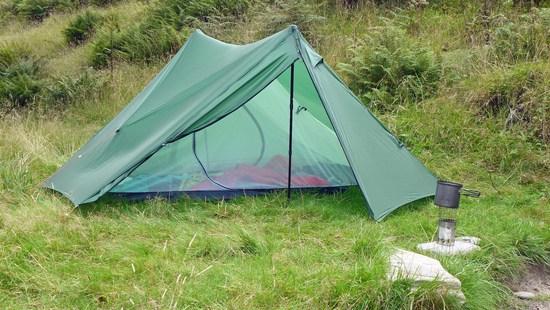
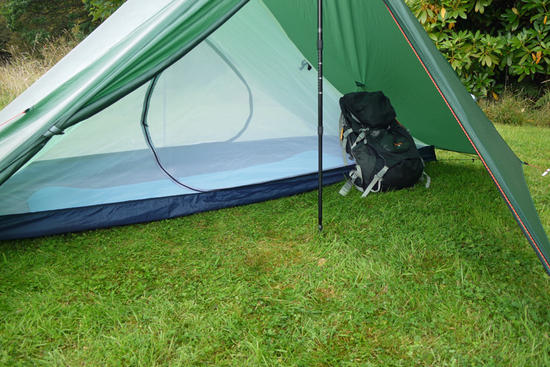
I take the flysheet from a 2 person tent, but fit it with a 1 person inner tent. This gives me a lot of space to spread stuff out, cook and change out of wet clothes before entering the inner tent. The overhang is on the horizontal of the roof, as well as the sloping sides, which makes this easier.

The rain here is often windblown. Having a tent with an entrance either side usually allows one side to be open for views and ventilation. If the wind changes through 180 degrees, I unclip the inner tent from inside and move it to the opposite end, then open up the opposite doors.

Tent with 2 person inner;

dr1

Same tent with 1 person inner;

dr2

PostedOct 5, 2013 at 2:17 pm

SS2 camping

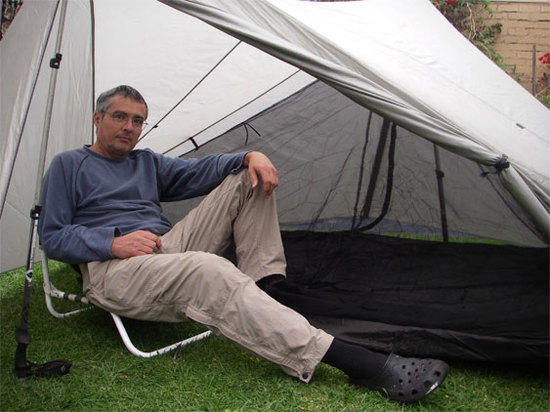
I took this photo sometime ago just to illustrate the space inside the TT StratoSpire II.
I am inside the drip line so if I closed that vestibule door I would not have to move.
(Standard inner unclipped on one side ).
With the 2 person inner in place :
SS2 vestibule space
You can get a lot more room than that and without unclipping the inner simply by staking the inner floor in a foot or so.
franco@tarptent
Just noticed that I already posted a similar photo…
Looking at Marc's photo reminded me of my set-up.

Viewing 25 posts - 26 through 50 (of 65 total)
Loading...