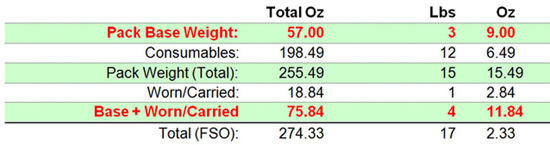
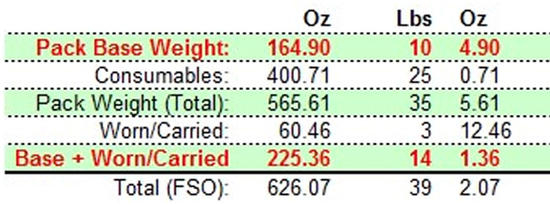
Base weight is a good number to throw around to give an idea of how much weight someone is carrying at any given time. But often this weight is deceiving. For instance, in the realm of the backcountry kitchen, ULighters and SULighters will often brag about how light their cooking setup is, without accounting for the weight of all the plastic they carry for freezer bag cooking, and without accounting for loss of stove efficiencies which entail larger fuel consumption.
I ran across a post on a blog here which is pretty telling:
http://www.mountainultralight.com/2011/01/heavier-is-sometimes-lighter.html
In the past, I've always done freezer bag cooking, but never accounted for the weight of all that plastic in my base weight. And I'm probably safe in assuming that no one else does either. But one has merely to weigh all their trash at the end of a trip to know that it adds up.
Here's some basic math: A boil-in-bag from packitgourmet.com
http://www.packitgourmet.com/CookIn-Bags.html
weighs 13 g for a large, which is the size I use for an entree (for my wife and I). 13 g = 0.46 oz!
Now Mike Clelland has posted before about the use of produce bags from the grocery store to package his food:
I'm assuming he used his pot to cook as of writing that article, but I'm not sure).
I weighed a produce bag the other day and it clocks in around 1 g(!). That's a 12 g (0.42 oz) weight savings per large entree!
Here's some basic math that applies to the style of hiking my wife and I do:
Breakfast: Couscous, oatmeal, grits, etc. = medium bag = 10 g (0.35 oz)
Lunch: Hot meal = medium bag = 10 g (0.35 oz)
Dinner: Entree + side = large bag + medium bag = 23 g (0.81 oz)
TOTAL / DAY: 43 g (1.52 oz)
Now let's say we skip a hot lunch. Then we are still at around 33 g (1.16 oz) of plastic per day. On a 3 day trip, this is 99 g (3.49 oz). Note that this doesn't include the weight of water and excess food particles trapped in each bag. I'm guessing that this is easily equal to the weight of the bags themselves. So let's say 3.49 x 2 = 6.98 oz. This is 7 oz of base weight that goes unaccounted for on a standard ULighter's base weight list.
I think an additional story could be told with regard to UL water treatment systems. For instance, an ULighter utilizing ClO2 tablets or AquaMira instead of a lightweight gravity filtration system will publish a lower stated base weight (but do they include the weight of the dropper bottles or tablet packaging in their base weight?). Now I personally use (or have used) a homemade gravity filtration system using a Sawyer Point One filter that weighs in around 6.25 oz. But while I'm carrying around that extra 6 oz or so over a chemical treatment system, I'm also carrying less water.
Here's some basic math:
1 L of water = 1 kg = 35.3 oz.
Using a filtration system, I'll usually filter (which takes all of 5-10 minutes), then drink about 0.5 – 1.0 L, and then carry around 1.0 L. Were I using chemicals, I'd likely carry 2.0 L and wait for a considerable bit of time (perhaps 4 hours, depending on what you want to kill) to drink.
Assuming I'm carrying an extra liter of water, that equates to an extra 29.0 oz of carried weight over the filtration system I use. That's 1.81 lb! With my 6.25 oz filtration system, I only need to carry 0.18 L less water to break even. That's 180 mL of water, about one big gulp.
I think a more informative number rather than base weight (or perhaps in addition to) is average pack weight carried per day. Being a ratio, this number won't change from day to day on any given trip, and will remain relatively constant regardless of trip length. Just some food for thought…