


For those of you who travell overseas:
What stove do you use?
What stove can you pack in your carry on luggage?
What fuel is available?
Topic
Become a member to post in the forums.
For those of you who travell overseas:
What stove do you use?
What stove can you pack in your carry on luggage?
What fuel is available?
Since nobody has answered this post I’ll take a stab at it.
I kinda doubt any stove could be packed in carry on luggage!
I don’t think I’d even try because if it was confiscated you might be out some significant coin.
I’m not a world traveler and have been on only one overseas trip where I needed a stove, but I can indeed recomend the right fuel to use.
I flew out for a cycle tour of Iceland in 2010. All my gear went into the checked luggage, including a boxed bike and yes, my stove.
I had no idea what the fuel availability would be upon landing in a foreign country.
I was quite certain that at least the big steel propane compressed gas cartridges, alcohol and white gasoline would be available somewhere, but I did not speak the local language, did not have a car to go driving all over town to look for supplies, and didn’t want to waste the time bothering with it all.
At the time I owned an MSR Whisperlight that runs on white gas, a few homemade soda can alcohol stoves and – Are you ready for this? – An Optimus 8R.
I thought about the problem for some time before I realized I’d be cycling right past fuel stations all along my way, and that I simply needed a stove that could take advantage of the most widely distributed and cheapest stove fuel in the whole world by far – Automobile gasoline.
I experimented a good bit and came to the conclusion that my Optimus 8R ran just fine on low octane car gas. It burns hotter on it than on white gas and yes, popping the safety valve can be a concern, especially with big pots and long cook times, but I’ve been messing with gasoline stoves for decades and the small risk didn’t bother me.
Before my flight I cleaned the stove very well, and cleaned out the gas tank and my ancient Sig fuel bottle with alcohol. They did not smell of gas.
I plastered a big “water” sticker on my Sig bottle as well, and I left the caps of the stove gas tank and the fuel bottle loose so they would not swell and be damaged by low air pressure in the cargo compartment.
In country I came across liquid stove fuels of various types being given away by other travelers. I had no idea what these fuels were ( didn’t smell or look like white gas, could not read the label ) but my trusty Optimus digested it all just fine. Buying auto gas by the quart can be a fun experience, and a funnel is not a bad accessory to have on hand. A credit card is perhaps the best way to accomplish such a purchase and if the pump has a minimum sale amount ( some do, but it isn’t much ) simply give the remaining fuel to the next car in line.
Out in the interior deserts of Iceland I ran low on stove fuel because I neglected to top off my quart bottle at the gas last station I passed. I figured there would be more stations down the road ( wrong ) and I underestimated the amount of fuel we were going through ( we were cooking very large and rather elaborate meals from ingredients purchased locally ).
Cycling along I noticed an abandoned gas can tossed away out in the desert. I stopped to collect it and sure enough, it contained two cups of nasty foul stale flammable liquid, which my Optimus 8R ran quite well on for another two days of cooking!
Got Gas!
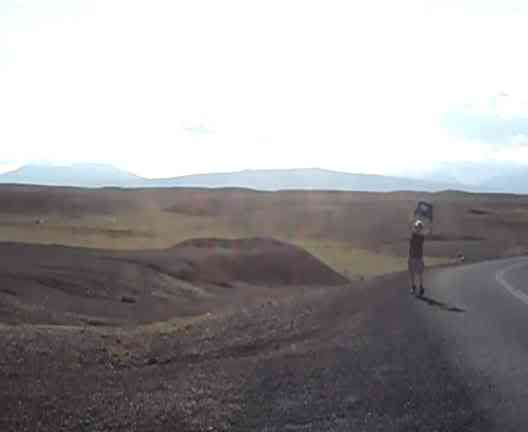
Now, I'm not saying the old Optimus 8R is a lightweight or ideal stove, but perhaps an old Optimus 99 or a new Svea 123 ( which should also run quite well on auto gas with some care ) or if you don't mind the fiddle factor an MSR multifuel stove would be ideal for overseas travel.
I know for a fact the old Optimus stoves don't really care what they are burning and everywhere you go there will be car gas for sale somewhere – Certainly it is more readily availible than fancy little gas cartridges, white gas, esbit tabs or denatured alchohol.
My flights with my stove have all been domestic, but…
I have never had a problem flying with my pop can stove in my checked bag and I have flown with it quite a bit. Once I forgot and had it in my carry on and still didn't have a problem. If it would be confiscated it is pretty easy to make a new one. Some types are easier to make in the field than others so, if the one you like isn't easy to make in the field, it is good to know how to make a simpler one as a backup plan.
Oh and if you are really worried take a brand new one on the way to your starting point. Most of the pop can stoves would probably not even be recognized as stoves by TSA personnel.
I bet I could make a decent enough pop can stove or cat stove anywhere!
One of the nice things about alcohol stoves is how simple they are.
But finding fuel could be a pain, especially if you don't speak the language or have a car to zoom all around town looking for supplies.
I should perhaps add that during the course of my Icelandic cycle tour I came across one gallon cans of white gas for sale in some N1 gas stations and the standard steel one pound propane cylinders could be had in some stores.
I saw no solid or alcohol fuel readily availible.
My companion was running a tiny butane/propane stove of the kind often used these days by backpackers that favor these kinds of things, and was forced to run it on a big one pound cylinder that he paid 3,000 Ikr for! That’s about 25 dollars right now, was closer to 30 bucks USD at the time. A heck of a price for a one pound propane cylinder, and I’m not sure tiny backpacking butane stoves should be run on straight propane?
He used up about 1-1/2 pounds of propane on that trip.
White gas by the gallon wasn’t very expensive, but who wants to carry along a whole gallon can?
Gasoline was cheaper in Iceland than it was in the US of A at the time.
My Optimus did pop it’s safety valve once on that trip. My companion was cooking a big fancy meal and had a one gallon steel kettle on my optimus with the stove going full blast, turned up as far as it could go. He was cooking in a very exposed spot in the wind, and had piled stones around the stove, so I wasn’t surprised when the tank overheated.
We simply removed the pot and blew out the flame sprouting from the tank safety valve, let the stove cool off a bit then carried on cooking, with the stove turned down a bit!
On the whole, I’m sure it was the right stove for the trip, but gasoline stoves are generally safest with experience operators.
Become a member to post in the forums.
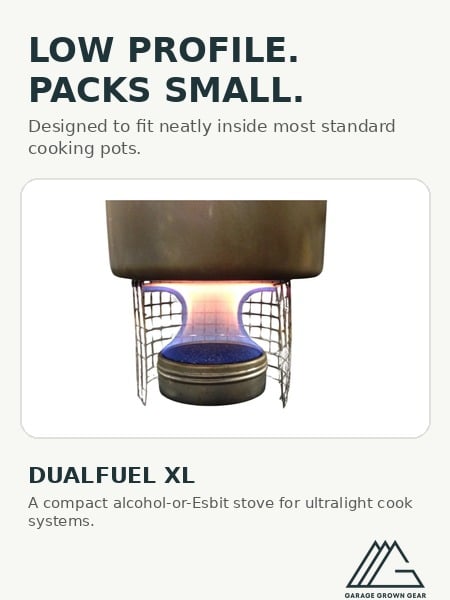 DualFuel XLCompact alcohol-or-Esbit stove with a low-profile design that fits inside most standard cooking pots.
 © Beartooth Media Group Inc.
 Loading...