


No posts yet about the new Ti Cookset? It's not like the email came through only second ago, it's been at least a few minutes… ;)
Seriously though, look promising (though pricey)
Topic
Become a member to post in the forums.
No posts yet about the new Ti Cookset? It's not like the email came through only second ago, it's been at least a few minutes… ;)
Seriously though, look promising (though pricey)

Looks like it might be good for melting water in the winter too. I was thinking you could add an aluminum tape handle to the lid so you don't burn your fingers without adding any significant weight.
The design is almost perfect. I think BPL should make a smaller version however, say 1 liter. I also wonder if they could make the deep frying pan out of aluminum.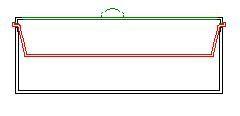
Not a lot of excitement for this offering.
I like the way the skillet stores, that's a good system. I'm using the BushBuddy this year, so this setup would leave me with the problem of protecting the little stove from damage in my pack. Currently, I'm using a Snow Peak bowl for a skillet. Works well.
I'll probably have to pass on this one, but I do like it.
The "skillet" will be useless since it's titanium and too thin to cook with. So, functionally, it's little more than a lid. Maybe this fills a niche for someone but not for me–I can't think of any practical benefit to this design. The price is exorbitant for what it offers. No thanks.

Jason – can you articulate why a Ti skillet doesn't work for you? I do believe that it requires some different approaches to (1) something thicker and (2) steel.
But –
Relative to thin aluminum, like the light skillets that ship with the BSA kits and that are about the same weight as this one, the Ti has worked great for me. Lower heat and some oil/fat has proved great, especially the lower heat.
I used this pot/skillet combo for testing on a Bushbuddy, canister stove, and Esbit, and have been able to fry trout rolled in cornmeal, eggs, pancakes, sauteed veggies/sausage, fried pasta, and, when used in "double boiler" mode over the pot (inverted) which contains a little water, as a steam-heated fry pan with a foil lid for a crepe recipe.
This is not a teflon-coated steel pan with a lot of thickness for heat distribution, but ti certainly reacts with foods less than Al, and I've generally been more successful with it than with my Al pan. The vast majority of my experience has been a few narrow meals: fried veggies, onions, mushrooms, and fish.
I think this looks great for a small group. You can certainly poach or fry a fresh salmon, stir-fry vegetables, or make quesadillas in it without concern for aluminum or teflon in my food.
One of my favorite dishes on the trail is crab cakes. The recipe is VERY light and you feel like you are eating like a king when you make them. A good friend of mine gave me the recipe. They are very lightweight. Anyway, I always somehow manage to make them in a pot. They are fried in olive oil and have to be carefully turned so they are golden brown on both sides. Then I take a bagel and fry it face-down in the olive oil as well. The end result is sort of two open-faced sandwiches and as I am typing this I am starting to get really hungry… but I digress. I am constantly teased for cooking the things in a pot because I refuse to carry a fry pan. Somehow I manage to flip them (sans spatula which I likewise refuse to pack) but it's always a huge pain. My only gripe (and it is minor) is that really in my mind a fry pan is something I have gone without for a great long time and some I have convinced myself I really don't need it. Then again how many delicious things have I robbed myself of enjoying… like trout rolled in cornmeal, etc. :)
The last time I made these was at the Grand Canyon on my hike out. I picked up the bagel at Phantom Ranch, packed it up to Indian Garden, and like I said… ate like a king. After a week in the Clear Creek zone you know these were tasting g-o-o-d good.
Now when I take my kayak out for a multi-day trek I for SURE take a fry pan and eat like a king. I don't talk about these adventures here because this isn't a kayaking forum. My point is that my style of eating doesn't preclude a fry pan just habits built into my style of hiking.
I never pack eggs on a hiking trip but I'll openly admit that bacon and eggs is a favorite of mine. When I kayak I'll take bacon and eggs, wrapped in newspaper, in a collapsible cooler and they will stay cool for a few days. I'll still eat them beyond this point but have been told this is not very safe. I find this hard to believe. I mean the bacon is fried to oblivion… how could you get sick. The eggs, I figure, sit under a chicken in conditions of incubation far longer than I have them unrefrigerated. Hey, don't use my logic on this one. Still, I have never had a problem.
Eating has become a big part of backpacking for me. I used to be in the "enertia meals are the lightest" camp, and I do eat these styles of meals from time to time. Now, however, I spend more effort rolling my own backpacking meals and learning how to cook. The expanding of my culinary horizons means expanding the tools I cook with. I still pack my aluminum cup, homemade Red Bull stove, and foil windscreen at times, but generally I am eating Thai Curried Chicken or Crab Cakes.
So I welcome additions like this fry pan. That said, it only comes with a little pot that I don't need (just bought a FireLite for my Bushbuddy) and if my wife sees another invoice for one of these I'll have some answering to do… not really. She is used to my antics. Still, you get my point. I can't justify buying the entire setup just to get the fry pan. Modularity and being able to nest/combine components is a key benefit I have found in lines like Snow Peak. Lightest for my mess kit might mean the lightest combination of goods for the meal plan I have worked out for my trip. Right now "lightest" for my crab cakes means cooking them in a pot and I would gladly pay the price of the added weight for something that doubles as a lid and works like a fry pan.
>fried veggies, onions, mushrooms, and fish
Dang, now I'm hungry again.
Ryan,
I admit to not being the greatest cook in the first place when it comes to cooking with a frying pan, even under optimum conditions at home, but my attempts at frying with the snow peak three piece cookset frying pan was pretty ineffective. It's not a non-stick surface, so that did not help as well. I was using a nion stove and I still had difficulty avoiding burning pancakes. I've become better at backcountry cooking so I might be able to pull it off now, but it was easier when I attempted it with an aluminum frying pan. The pan was thicker and heavier however, than the titanium.
The still would buy a smaller version made out of titanium though :-)
Hey Ryan,
Sure–I can elaborate. One factor you already mentioned was the lack of heat distribution. I suppose it depends on what kind of stove you're using but even if you have a stove that can regulate output, you'll still never be able to distribute the heat evenly. If you're using an alcohol stove, you'll have to hold the pan above the stove which will require a pot gripper–which is going to add weight. I've tried using titanium skillets before just for fun and could not avoid scorching.
But mostly, I wonder how many people that are going "light" actually carry things that need to be fried like eggs.
Can you tell us how you hold the "skillet" one the 1300 while frying?
>> have been able to fry trout rolled in cornmeal, eggs, pancakes, sauteed veggies/sausage, fried pasta, and, when used in "double boiler" mode over the pot (inverted) which contains a little water, as a steam-heated fry pan with a foil lid for a crepe recipe.
Ryan-
You amaze me again. Just when I figured you for a "gravy pouch over ramen" kind of guy, we find out you're really a backcountry Gourmet! Those NOLS guys didn't seduce you into a 10 pound kitchen with some fresh baked muffins did they? ;-)
Cheers,
-Mike
I often joke that the Snow Peak GigaPower is appropriate for soldering, but not for cooking. But it heats water fast!!!
A Ti skillet is useful if your heat source is broad and less intense. I would not use a Ti skillet with the GigaPower.
A Ti skillet will work with a little care with the Trangia burner, the Coleman Exponent Fl or 442, or the Bushbuddy.
Most of the Snow Peak Ti skillets are too small to be useful. The Skillet needs to be big enough to fry bacon or trout.
One of my barriers to SUL is that I refuse to eat from a plastic bag and I like to fry. I hike above 10,000 most of the time and the cook in the cozy does not work well because of the lower boiling point. My stove must be able to simmer.
The Snow Peak GigaPower with it's windscreen works very, very well with the JetBoil pot. The simmer is the best I have ever used and I have cooked perfectly golden-brown pancakes and fried crab cakes in the pot (wishing the entire time for a proper fry pan). I just can't figure out how to flip things easily and there certainly isn't enough space to fry fish unless cut into smaller pieces. Overall weight aside, one of the other petty complaints I have is that the stove burns faster as it warms up so I am have to tweak the gas down to it's "lowest" setting a few times as I am cooking a stew/pasta/etc.
Yep, The GigaPower is a fine stove. It is possible to work around the pin point heat source.
The GigaPower windscreen in Ti would much lighter.
Pots do work well to do things like brown bagels in olive oil. Try improvised chopsticks.
James,
I have also spent some energy paddling eggs around the wilderness and lived to talk about it.
We use the unwashed, chicken house fresh brand, which apparently last up to thirty days without refrigeration. We have always stayed conscious of temperatures, direct sun exposure, and we have never waited more than nine days to eat them, but we have included "unsanitized" eggs on mid-summer trips without incident.
There is a risk of bacterial, I think salmonella, transfer from the outside of the shell, so we wash the eggs carefully before cracking and cooking.
Regarding the double boiler mentioned above, unless we are in a hurry, which is rare, we seldom prepare a meal without double boiling. The method reduces scorching, clean up, watching/stirring, and broadens our meal menus. With a cannister stove the height appears precarious, but we've managed to avoid major mishaps. Alcohol use averages just under two and a half ounces per meal (for two), so compared to others, there is a clear weight penalty. However, if we prepared our typical meals without pot and foil lidded twenty-four fluid ounce bowl above, fuel use would increase markedly.
I love how all threads converge to food, regardless of the initial topic.
Mike: If I'm fishing on a trek, I add spices, fresh peppers, and try to scrounge around for wild onions, which are common in most of the places I like to fish around here (Beartooths and Yellowstone). Something about sauteed trout and veggies over a bed of rice that's a nice break from the norm. Usually if I have time to fish, I have time to cook a decent meal.
If I'm not fishing, however, in which case I'm usually hiking all day…it's back to the grind of potatoes and ramen, I just don't want to deal with fancy meals at night when I'm tired.
Pot lifters for any pot with an outward rolled edge (like all of BPL's) are easy to make with some aluminum sheeting from a hardware store, some tin snips, and a vise for bending the sharp curves. For a model, check out the one supplied with the Trangia cookset.
My famous Three-Cheese Chicken Ti
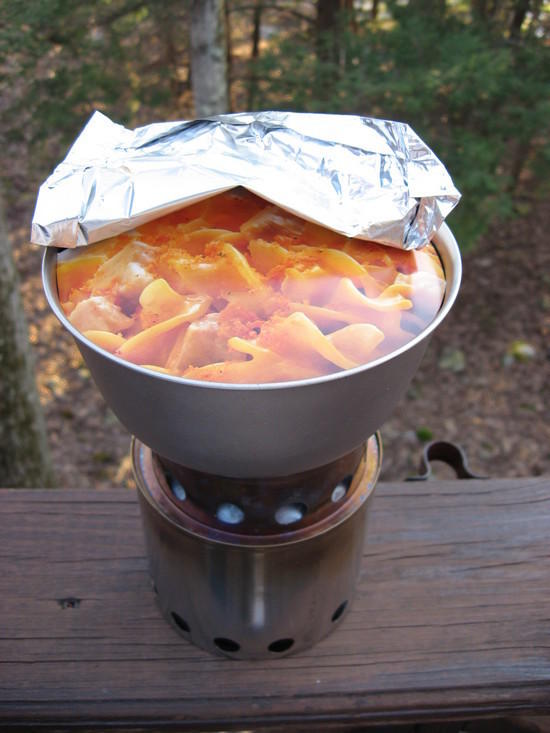
Oops! Dang wind!
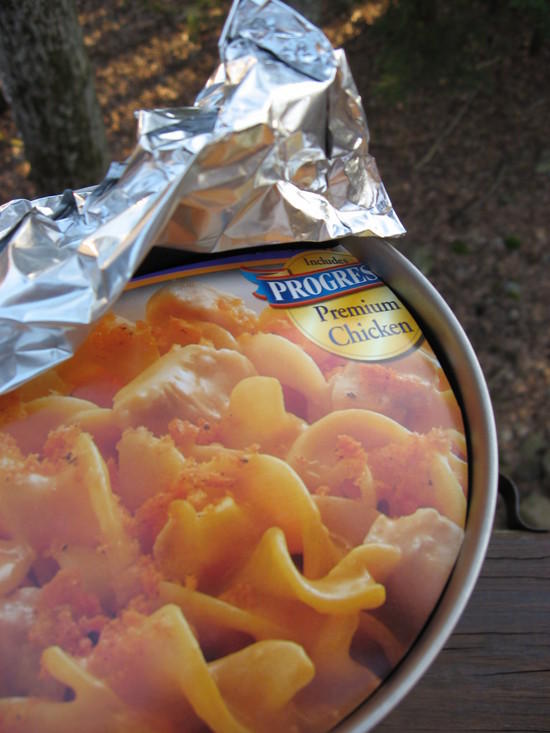
Seriously, good eating to me means fried or a saute. Fragrant foods make my outdoor experience memorable. I have a grungy Snow Peak Ti bowl in the dishwasher that I use for frying. Granted, I move the skillet around a lot while I'm cooking. But, I do that on the stove at home too.
Whatever your style is, enjoy the experience.
Ahhh, I see fiddlenecks! And I have olive oil! See ya.
LOL! I didn't see that. This is pretty much an instant buy for me. Thanks!
Become a member to post in the forums.
 New Ultralight GearSee the latest releases in ultralight cottage-brand gear from small makers.
 © Beartooth Media Group Inc.
 Loading...