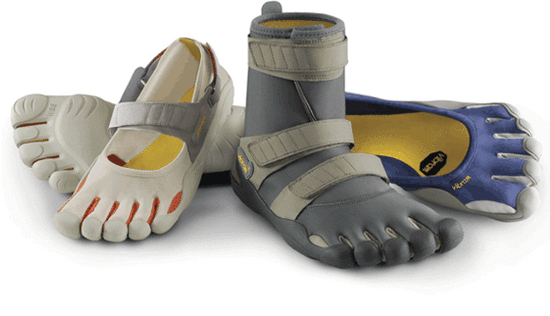
Our local shop reopened today after burning down this winter and as I was casually looking around I spied the answer to all my foot confusion, vibram fivefingers. A step above going barefoot, kinda of a five toed water sock.Imagine no more endless worrying whether you've got the right shoe for the job or how many pairs of socks you need, you just cut your on the trail weight by 3-5 pounds.
So I've bagged up all my boots,trail runners, and other misc. footwear, tossed in all my socks [take that darntough] and I'm heading to my local charity.
A pair of size 43 weigh 316 grams,11.25 oz. http://www.vibramfivefingers.com
Topic
throw away your boots and socks
Become a member to post in the forums.
- This topic is empty.
These might be good for summer surfing… once the water gets above 8C. Pretty neat. They don't seem to sell an ankle high… weird. I wonder if they feel all bunched up between the toes. I've tried reef boots on at the surf shop with split toes… and I often don't like them for that reason. Let us all know if you try them on trail.
And I always thought they used plywood to make those Big Foot foot prints :)
I've heard of a few ultra-distance runners actually using these- I know one has completed the Angeles Crest 100 (100 mile race) with them. I'd love to try some but fear they'd be an expensive experiment…
Ooooooh I love toesies. Larry, I had to go back and check your location and wasn't surprised that it is PNW. Last time I went to Seattle, I came home with the first toe socks I ever had seen, of course found at Owajimayas in the Oriental district. That was in 1990. Hafta see if some of these show up in staid New England. Hee hee.
I have Vibram's original Five Fingers (size 43: 13.0 oz). They felt comfortable while hiking, although not as much protection underfoot as a regular shoe of course. But I had a hot spot on my front pad after about three miles, which ended up as a deep blister after four miles. (The blister didn't really heal until I lost the entire pad callus a month or so later.) They also weren't as sticky as I hoped, so they didn't work very well for climbing (no better than my Montrail trail shoes).
They're an interesting experiment, and I'm sure they work well for some folks. I'm keeping them around for river trips, although the Aquatics by Sprint mesh shoes (2.0 oz) are much lighter if the crossings are not demanding or frequent.
I basically ran barefoot for the first 13 years of my life.
I went for a short run in these this morning.
I believe my feet have undergone some major anatomic changes in the past bunch of decades.
Going to have to build up to this …. .
I tried a pair of these for a few miles when they first came out. I was impressed overall. For any kind of serious moving around, I would recommend a pair with straps.
When I was looking into similar solutions, I read that there is a good bit of training and conditioning involved when going barefoot or using shoes like these in order to avoid injury on serious excursions.
http://www.runningbarefoot.org/ is a great resource for these shoes in particular, but i also found chi running to be helpful.
http://www.webmd.com/fitness-exercise/guide/mindful-chi-running
I'm not completely sold on all the spiritual stuff chi-running says, but the form and practices it teaches were very helpful in developing cardiovascular fitness, hiking technique, and the ability to do distances barefoot. Good luck with the shoes, but I wouldn't toss all your other stuff away just yet.
I have a pair of the original fivefingers. The ones to the right in the photo. I am a huge fan. It definitely takes a lot of time to get used to running in them after your feet have been coddled by conventional footwear for years. Walking in them is fairly easy to get used too. If you can walk barefoot you can walk in the fivefingers. They aren't terribly uncomfortable between the toes. I was worried at first but I forget I even have them on, its great.
I personally think Chi running is bull. All you need to know is run in them in a way that feels comfortable. Basically this comes down to don't heel strike. Heel striking is bad anyway, it is the reason shoe companies spend so much money on cushioning, you feet are not supposed to hit that way, the leg is locked out and loses all of its shock absorbing properties. When you jump do you land straight legged on your heals? No you flex you legs and land on the balls of your feet. Same idea applies to running and walking in these shoes.
Dave
Larry, maybe you can answer a question Ive been pondering, since you went barefoot for many years. Do a person's arches 'fall' after years without support? And if so, is it bad? I mean, we did not evolve to wear shoes..
In my heart I would say kids should go barefoot until the authorities strap something on them, I ran like a little coyote in the Mojave when I was young and treated myself like a mule ever since, pursuing way too many ballistic sports and such.I would be deemed overweight on a height/weight chart and other then a bout of plantar fasciitis haven't had any feet troubles. I have a co-worker who has fallen arches, normal weight, normal lifestyle.
I know genetics plays a part but I'm sure overuse and abuse must also. Somewhere I heard a trainer say people with flexible feet suffer this more then people with rigid feet but this is just an anecdote.
This is a really good example of typing a lot of words and not admiting to knowing an answer, which I believe is also genetic.
Hi Brett
> Do a person's arches 'fall' after years without support?
Arches don't fall. It's a marketing spiel.
What can happen if you mistreat your feet and never excrecise them is that the tendons under the arch get weak and can stretch a bit. This could look like 'fallen arches' I guess. It does not happen to a fit person.
The idea of 'arch support' is actually a complete nightmare. It was dreamed up a decade or so ago by a deranged fashion jogger marketing exec at his desk in America to promote that company's sales. Before that the concept DID NOT EXIST! Have a look at European boots: a dead flat inner sole. Have a look around the world: outside America the concept is ignored, or unknown.
Good sports doctors and athletic trainers are revolted by the idea. Pressure from under the foot damages the tendons under the foot. Pressing on a working muscle or tendon leads to Repetitive Strain Injury. Olympic-level trainers do NOT allow their athletes to use them.
Humans have spent hundreds of thousands of years living and evolving without shoes, let alone 'arch supports'. Even today, the Olympic Marathon gets won by bare-foot athletes (Kenyans). People from the rest of the world, outside America, ignore the concept all their lives – happily.
This thread is well timed with some changes I've been making in my life. The gear shop I work at part time got in a dozen or so pair of Five Fingers and they are quickly moving off the shelves.
I've worn stiff Superfeet arch supports in my shoes for the past four or five years because you might say I "believed the hype". The notion of the Five Finger shoes as a simple pad for the foot got me to thinking that humans weren't meant to have an arch support, and that the arch is probably a bit of a suspensioning system for the foot.
I did twenty miles with the Superfeet in this weekend and the arch of my left foot hurt significantly. It hadn't occured to me to take them out and replace them, but yesterday I did just that. I replace them with a simple, flat pair of cushioned insoles from a pair of XC ski boots I have. I did seven miles with those insoles and didn't feel any of the discomfort. I'm looking forward to putting some miles on them with my backpack this weekend.
I threw away TWO pairs of Superfeet after last summer. I realized that part of the reason I was getting so many blisters was how they forced my toes into an unnatural position. They also caused my arches to feel tired after a couple miles.
At this point I either wear my heavy old school Raichles or my light trail runners, depending on where I am. No fancy inserts.
And the son? Back to light trail runners for him 9 months of the year.
I had seen the toe shoes a couple months ago, and I have to say, they are indeed cool looking!
The sole purpose of a custom or cut to fit foot bed is to stabilize the foot in a neutral position. Foot beds are not arch supports nor can they force toes into unnatural positions unless they are ill fitted (foot beds are sized heel to ball & heel to toe) and should be shaved/tapered to reduce the foot bed volume/thickness towards the front of the boot. Foot beds do prevent elongation of the foot with each weighted step, reduce pronation/supination, and stabilize fatty pads in the feet. As an example only, SuperFeet as other brands, come in various sizes and supports, all the way from supporting a person with virtually no arch to a high arch. Not provide an arch, but support the existing arch. If one is putting a foot bed in your boot designed to support a higher arch than you have it’s not the foot beds fault when your feet hurt. If you do need an arch or specific foot bed needs, see a podiatrist or orthopedic doctor. One would like to think all shoe stores use the Phil Oren Fit System, but alas very few do. Those of you on this site lucky enough to be fitted by someone who has undergone that training understand what I am talking about.
I disagree politely. Since tossing both pairs, my feet feel way better. I had walker and hiker models. Both were fitted to shoes/boots I own. For three years I walked with them, and had sweaty feet, with bunched up toes. Basically, the deal I think is that they took up too much space in the shoe! They were not flat enough! Most shoes have thin insoles inside.
Last summer, I ended up hiking in Chaco's due to those &^%$(*& S.Feets in my lightweight boots. My feet were chewed up, my toes were forced together too tightly. With them gone, and the factory ones back in, my toes lay where they should! And hence, no toe blisters. Had I tossed them in 2004, I'd not have suffered in 2006.
Ironically, my trail runners cost me $25 at Kohl's. And they do fine on 10+ mile days with factory insoles.
"The idea of 'arch support' is actually a complete nightmare. It was dreamed up a decade or so ago by a deranged fashion jogger marketing exec at his desk in America to promote that company's sales. Before that the concept DID NOT EXIST! Have a look at European boots: a dead flat inner sole. Have a look around the world: outside America the concept is ignored, or unknown.
Good sports doctors and athletic trainers are revolted by the idea. Pressure from under the foot damages the tendons under the foot. Pressing on a working muscle or tendon leads to Repetitive Strain Injury. Olympic-level trainers do NOT allow their athletes to use them.
Humans have spent hundreds of thousands of years living and evolving without shoes, let alone 'arch supports'. Even today, the Olympic Marathon gets won by bare-foot athletes (Kenyans). People from the rest of the world, outside America, ignore the concept all their lives – happily."
Although I agree that %90 of people with healthy feet should not wear a shoe with arch support because it allows the tendons as you point out to do what they naturally do, and thereby strengthens the foot.
I disagree with the idea that any olympic level distance runner spends more than %5-10 of there training time not wearing shoes. I've never heard of anyone running a marathon barefoot and being near the top %10 in the last 5 – 10 years.
Exactly my point, a properly sized and fitted cut to fit or custom foot bed is first trimmed then shaved on a grinder at the shoe store to taper the volume (thickness) towards the front of your shoe so that your toes are not cramped in the toe box and your foot still receives the full benefit of the insert, ie, neutral position, less elongation and pronation. That was inexcusable oversight by the salesperson who sold it to you and I am sorry it happened. Weather or not you need a foot bed the one inserted was not trimmed and shaved properly. Unfortunately most stores are not set up to alter foot beds or make adjustments to shoes. Be that as it may I am glad you and your son are out hiking on happy feet and having a great time. I'm just defending how a foot bed is supponed to be professionally inserted.
and the only barefoot runner to win it was ethiopian abebe bikela in 1960 – he won again in 1964 but wearing shoes
became increasingly useful the more we walked on level hard surfaces (pavement, cement, tile & wood floors, etc.) instead of the uneven variable surfaces our feet are adapted for
however just like a lot of things, too much is as bad as not enough
i've found a soft arch support works great but a firmer arch support is problematic
For what it's worth, I wear boots a half size larger than I would otherwise wear so that my blue Superfeet will do their thing without hogging up needed space for my foot to fit comfortably. The slightly larger boot with the support from the Superfeet are just what my knees need, of all things. The extra support helps correct my knock-knees and lop-sided hips (it's not my fault! I didn't do it!), and my feet can go all day in the boots without wanting out. The knee bone is connected to the toe bone, etc.
Hi Roger,
I am a runner that does long distance and mountain running, I have been using custom made arch supports or orthotics as they are called for the last sixteen years, they were originally prescribed to me by a “sports medicine doctor” because of my flat feet or collapsed arches were causing a lot problems with my ankles and knees when I ran. I have tried running without them several times since and have found that I have I have problems when I don’t use them.
I use arch supports when walking as I find with the extra load of the pack I get blisters on my big toes if I don’t use them.
I have heard the other side of the argument as I have discussed arch supports with my brother in-law who is a Sports Medicine doctor at the Australian Institute of Sport, and he does not recommend arch supports unless there is a major problem with the structure of the feet but he works with young elite athletes not 50+ year old that are not elite and never will be elite. His advice was to use better quality running shoes which I do anyway. I know a lot of runners, elite and ordinary joggers that use custom made arch supports.
I am user and a believer in that arch supports do make a difference although the last pair cost me A$600.
Tony
I agree totally with Tony's comments. I used to get alot of knee and ankle injuries and have chronic shin splints after running for only 10 minutes until I was 14 and was prescribed orthotics. All the problems instantly cleared up. Luckily I got them young and they moulded my feet somewhat, so I now get away (the last four years) without them. I find I still need to wear the right runners-I need a runner designed for severe over-pronation, but other than that I am now fine.
My sister wasnt so lucky with her feet;although she got her orthotics at a younger age, her feet were flatter than mine and she has never managed to do without them.
I have noticed recently that the level of support in my shoes is quite critical in supporting my feet with extreme pack loads (in excess of 50kg-training only guys!). My shoes have been waering quite quickly with these loads, the posts get crshed, and as such dont support my feet on the correct angle. With this, I can really feel the added stress on my ankles. I would call it painful, although anything is painful with 50-61kg on your back.
Bear in mind I often go for walks around here in bare feet to toughen my joints and muscles (have been doing it last couple of years) and do weight training in bare feet. So my lower body is strong. There are limits to it though that can really only be rectified with the right supporting shoes.
I'm currently trying to find a runner that will do the job for me without wearing out in three weeks. Its a pain, I tell you.
Adam
> I have been using custom made arch supports or orthotics as they are called for the last sixteen years
But that is the biggest myth of all! Proper custom orthotics fitted by a podiatrist are totally different from the so-called 'arch supports' promoted by some of the jogger manufacturers on a one-size-fits-all basis. They are utterly different things!
I have no argument with professionally-fitted custom orthotics. If you need them, get them. But call them 'orthotics', not 'arch supports'.
But just sticking the same lump of foam under the arch of every customer's foot, the way some jogger compamies do, and calling it an 'arch support': that is what gets me a trifle volatile! Yuk!
Cheers
Scott,
I agree with your assessment of the Phil Oren Fit System. I live in South Florida and drive 200 miles to Orlando to Travel Country Outdoors in Altamonte Springs which is the nearest Phil Oren certified store. I won't buy shoes from any other place. For me, it eliminates the guess-work and the trial & error of trying shoes. Especially, since the "error" usually shoes up 5 or 10 miles out on the trail!
Mike
Become a member to post in the forums.