Topic

Beer Can Performance

  • This topic is empty.
Viewing 24 posts - 1 through 24 (of 24 total)
David Gardner BPL Member
PostedFeb 2, 2013 at 3:46 pm

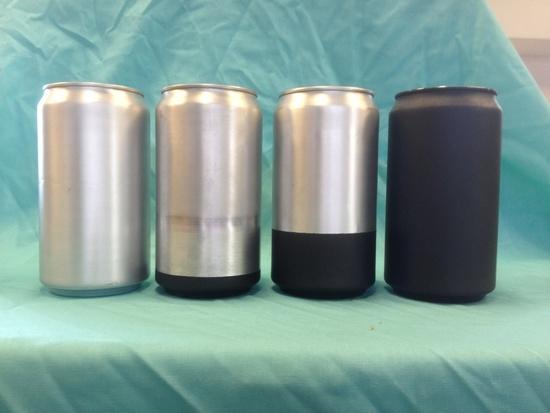
Tested the performance of stock beer can versus black painted cans versus wire-brushed can. Tested the following Foster’s beer can pots (left to right): stock can, stock can with bottom painted black, stock can with lower 1/3 painted black, stock can painted entirely black, and wire-brushed can.

beer cans

All boil tests were conducted with 70* F water, air and alcohol, at sea-level air pressure, using 2 cups of water and 14 grams of KleanStrip SLX alcohol. Stove is my own design, which I have dubbed the “Ramjet.” Windscreen is .003" stainless steel cone. Did four boils with each can and averaged the times.

windscreen and stove

Results:
5:25 (325 sec) Stock can
5:19 (319 sec) Bottom black paint
5:18 (318 sec) 1/3 black paint
5:15 (315 sec) All black paint
4:56 (296 sec) Brushed can

Conclusion: black paint reduces boil time compared to stock can, but brushed can reduces boil time the most. Stock can takes 10% longer to boil than brushed can. Since the stove burns at the same rate regardless of the can, the 10% difference in boil times between the stock can and the brushed should result in similar fuel savings. Will test that hypothesis next.

Dustin Short BPL Member
PostedFeb 4, 2013 at 9:53 am

Just to throw a wrench in the works…have you tried a brushed can painted black? Maybe the smooth anodizing has some effect on the benefits of the paint (probably not, but you're being so thorough as is ;)

Either way, thanks for the effort!

David Gardner BPL Member
PostedFeb 4, 2013 at 10:10 am

Brushed cans painted black are next on the agenda. Will report shortly.

Building a rig to put ridges on the cans too, to see what effect that may have. That will take longer.

PostedFeb 4, 2013 at 10:30 am

Did you do any of your trials more than once or is this mythbusters science? I would love to see some measures of variability and the number of trials performed if you did.

David Gardner BPL Member
PostedFeb 4, 2013 at 1:46 pm

Did 4 boils with each can.

Stock can = 5:29 + 5:21 + 5:27 + 5:23 = 1300 seconds divided by 4 = 5:25

Bottom black = 5:23 + 5:18 + 5:20 + 5:16 = 1277 seconds divided by 4 = 5:19.25

1/3 black = 5:20 + 5:17 + 5:21 + 5:13 = 1271 seconds divided by 4 = 5:17.75

All black = 5:18 + 5:12 + 5:16 + 5:14 = 1260 seconds divided by 4 = 5:15

Brushed = 4:54 + 4:57 + 4:53 + 5:01 = 1185 seconds divided by 4 = 4:56.25

PostedFeb 4, 2013 at 2:53 pm

Despite risking looking like a nerd, I threw this into R and ran a quick one-way ANOVA with a Tukey's post-hoc pairwise comparison. Data violated parametric assumptions by failing normality tests, but I didn't want to spend the time ranking the data to perform a non-parametric alternative. Besides, ANOVA is pretty robust and this isn't a peer-reviewed article. My results show significant difference between treatments (F4,15=43.52, p<0.0001) which are summarized below. All painted cans were statistically the same while just bottom painted and the stock can were also the same. Most importantly, the brushed can showed a significantly reduced boil time compared to the others.

all black bottom painted brushed stock 1/3black
"a" "ab" "c" "b" "a"

David Gardner BPL Member
PostedFeb 4, 2013 at 11:03 pm

If I understand you, the variation of times within a particular can's results is too great to make the averages valid.

So, in order to achieve statistically valid results I need to tighten up my testing protocols so that there is less variation within each can's results, and do a larger number of boils per can.

I'll get a digital scale to measure the amount of water by weight plus/minus .01 grams instead of eyeballing the volume of water in a measuring cup. And measure time to boil as the moment when a digital thermometer reads 212* F rather than eyeballing the moment when a full boil is achieved.

Is there a minimum number of boils you suggest?

Jerry Adams BPL Member
PostedFeb 5, 2013 at 8:21 am

This requires lot's of testing to be statistically significant. To create the cans, it might require a number of nights depending on your tollerance for beer. Or you could invite some people to your alcohol stove testing party : )

Weigh amount of water and amount of fuel. Measure temperature of water before and after. Calculate ( g of fuel / ( g of water * degree C temp difference ) ).

Measure each case 2 or 3 times. Average the samples of each case. Compare the variation between the samples of one case and the variation between averages of different cases. Also, if you have an individual sample that's far different than others, maybe you screwed something up, maybe you have to work on your test methodology.

Dan Yeruski BPL Member
PostedFeb 5, 2013 at 8:44 am

I’m going to do some testing of the brushed can to see what I come up with. First I have to find some SLX. Seems like “sunnyside” has the market locked up around here, good sales people no doubt.

This can weighs 22gr Has aluminum bottom and lid and has the ridges.

<center>

</center>

David Gardner BPL Member
PostedFeb 5, 2013 at 9:01 am

Dan,
Looking forward to your test methodology and results. It's hard work drinking all these beers.

Jordo _99 BPL Member
PostedFeb 5, 2013 at 12:28 pm

First off, awesome experiment David! Very cool to see people really pushing the limits of home DIY (even if you also do it for a living).

I think the accuracy of measuring is just fine considering the purpose of the experiment is not to determine the exact boil times for each type of can but rather to draw conclusions based on the results (if black paint improves efficiency). You don't need times more accurate than even 5 seconds if they show results like David ended up with.

One thing that worries me about the current results is the possibility for the times to improve as you progress due to the stove/windscreen retaining heat but that really only applies to the black paint vs stock as those were actually pretty close…the brushed is clearly more efficient.

I'd love to see results of:

brushed
brushed + paint bottom
brushed + completely painted
brushed + completely painted (but leaving the bottom brushed)

Would be very interesting to see how the last one compares to the rest (as I think that's the only one that might beat out all-brushed)

David Gardner BPL Member
PostedFeb 5, 2013 at 1:09 pm

Thanks JP.

I let the whole set up cool down between burns, and use different, cool ceramic floor tiles underneath each time.

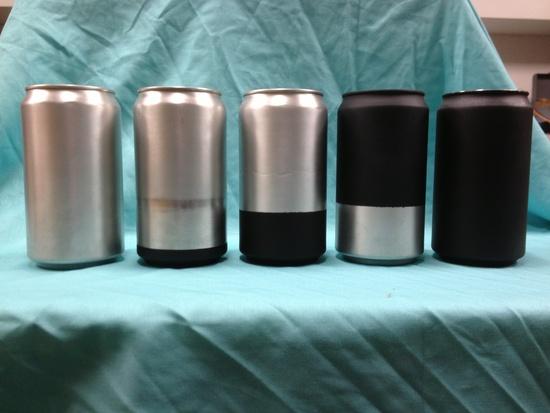
Hadn't thought of brushed but completely painted except for the bottom. Will have to try that too. Here's what I've prepared so far:Next Cans

PostedFeb 8, 2013 at 2:56 pm

Sooo, what happened?!?!

I did something similar a while back, but you are being a lot more scientific, and adding the brushed can instead of the winged can I did.
So far you are getting similar results with a black bottom being better. But now that I see what brushed does, looks like I need to get out the sandpaper!

So how did you "brush" the cans?
Anctiously awaiting the brushed painted results!

If you care to reference it, my slightly less scientific experiment can be found here. My winged cans were made with aluminum tape

http://www.backpackinglight.com/cgi-bin/backpackinglight/forums/thread_display.html?forum_thread_id=58270

David Gardner BPL Member
PostedFeb 8, 2013 at 6:58 pm

Hey Nick,

I've been preoccupied with the day job this week, and waiting for a new digital scale to arrive to hopefully tighten up the testing methodology and results. It will probably be another week until I can get it done.

The earlier results surprised me, and I want to make sure I can replicate them with less variation in boil times per can. I sell the brushed cans, so scientific verification is important.

I saw your fin/wing experiment a while ago and it inspired me to try something similar with aluminum duct tape, but I placed the fins too low and burned them:
burned fins

Still toying with the idea of trying them higher up, after I finish testing brushed/painted/ridged cans. Which reminds me, I need to finish the can ridging machine too.

I have a 6" bench grinder with a medium coarse wire brush wheel that I use to brush the cans. It only takes a 2-3 minutes per can, and can be done with a very light touch. I started by trying sandpaper, but after 10 minutes and being less than 1/2 done I gave up. Sanding also requires more force and scores the cans.

In the meantime I did manage to whip up a brushed bottom/painted top can to add to the testing repertoire:repertoire

PostedFeb 12, 2013 at 7:08 pm

Day job?!
What's more important? Paying your bills or catering to demanding posters on the Internet?
Geez, get your priorities straight…

PostedFeb 12, 2013 at 8:24 pm

It isn't really that important to include statistics, but it seems like so many members here are engineers who like to geek out on gear. I was just surprised not to see more statistics given the membership base of this site. Just reporting the times from all the trials is good enough for me, it had just initially looked like he had had done one trial for each of the pot times and that was og greater concern to me than true statistical significance.

PostedFeb 13, 2013 at 12:27 pm

Are you hiring?
I'm uniquely qualified for the job…
I'll PM you my résumé!

Eric Lundquist BPL Member
PostedFeb 13, 2013 at 12:50 pm

To throw another wrench in the works. Is it possible to test a variant of the brushed can with a polished finish? The brushed example looks matte in appearance as would be expected from a brushed metal.

David Gardner BPL Member
PostedFeb 13, 2013 at 3:29 pm

Eric,

Well….I think I pretty well established that shiny cans don't work as well as matte or painted cans, so it's probably counter-productive. Plus, polishing one of these cans could be a real b***h. But I'll take a whack at it, see how difficult the polishing is. If I can do it without too much time and exasperation, I'll add it to the repertoire.

Viewing 24 posts - 1 through 24 (of 24 total)
Loading...