


Does anyone have a recommendation for a light, freestanding one person tent? Thanks, Jim fowler (Seattle).
Topic
Become a member to post in the forums.
Does anyone have a recommendation for a light, freestanding one person tent? Thanks, Jim fowler (Seattle).
To add to my inquiry, I was looking at the big Agnes fly creek ul1. Thanks, Jim fowler.
The Fly Creek UL1 is OK, but it sure is not roomy in any dimension. I bought one when I thought that I needed a tent at around 2 pounds for a specific trip. Then I discovered that I needed to be at around 1 pound or less.
–B.G.–
Everyone seems to love the Big Agnes Copper Spur.
Here's an extensive thread on 1P tents:
Many are free-standing.
If a tent that needs 6 stakes to stand up more or less correctly can be called "free standing" then most tents are freestanding.
A bearpawwd lair requires 6 stakes and requires only one center pole.
The one advantage that freestanding tents have over non-freestanding tents is that it entertains other hikers when the tent blows away like a kite because someone thought that freestanding really meant freestanding:-)
I have seen many tents do this. One time a whole group of tents ended up in the river with sleeping bags and gear inside.
There are many disadvantages to freestanding tents that I think make them a poor choice for me.
Some disadvantages are weight, inflexibility and restriction in the kind of location you can pitch them.
Around here we've got some nice gravel bars along the creeks. They make great campsites, except when you're trying to use a non-freestanding shelter. As the name implies, the ground is just loose gravel so stakes don't hold very well. Same goes for the glades we have on the hills. A lot of times it can be very difficult to plant a stake. That breeze that would blow a freestanding tent away will just as easily knock over a tarp in that case :D In those places I have to use a copious amount of logs/rocks on top of the stakes to keep my tarp set up. If anything I think a freestanding tent is less restrictive when it comes to where you can set it up, at least where I hike.
Adam
Stakes are obviously not the only choice when anchoring a shelter.
I have camped on solid rock, loose gravel, sand, … and never had a situation where I couldn't/didn't anchor my shelter.
Adam
I think that you missed the intended meaning of my post.
Regardless of how you define a tent design, if it takes six stakes to set a tent up , it takes SIX STAKES to set that tent up…
In fact some of those “freestanding” take 10 or more to work correctly whilst there are “non -freestandindg” tents that are wind worthy with 3 or 4.
Anyway , here is a video clip I shot the other day about setting up a “non freestanding” tent on a rock slab :
And just to make it even clearer…
here is the Fly Creek 1 , note 10 stakes in use :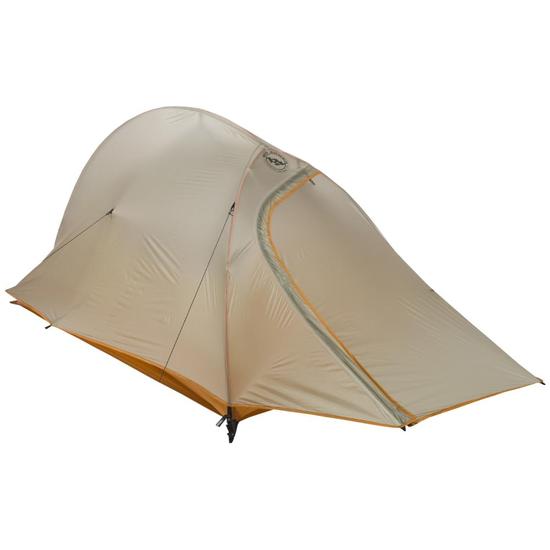
Some great examples in that video.
I have diagrams that I give people as examples, but your video covers lots of good options and is easier to understand.
Now I can just send people a link to your video when the subject comes up:-)
Jim,
You may have looked at these already, but if not, perhaps you'd be interested in:
Tarptent
http://tarptent.com/index.html
or
Terra Nova
http://www.terra-nova.co.uk/tents-and-spares/ultralight-lightweight-tents/
(can be found at various online retailers and used/ebay if you're not in the UK.)
I've never used these brands personally, but sounds like a lot of people like their Tarptent Moment (which has both a freestanding option, and a non-freestanding option if you want to go lighter later) or their Tarptent Rainbow (freestanding with trekking poles or optional poles). The Scarp can also be freestanding but a bit heavier.

As R. Reagan said, "There you go again."
Freestanding means self-supporting, with the possible exception of pullouts for vestibule(s). In other words, if you pull out the stakes, the tent doesn't fall over or partially collapse on the occupant. In more other words, freestanding tents need stakes to be anchored, but are self-supporting. Non-freestanding tents need stakes not just for anchoring; but also for support. So the distinction is between anchoring and supporting.
Someone, think it was Roger C but he doesn't recall, also said that freestanding means that the tent takes on its full pitched shape without the benefit of stakes. I wouldn't go that far, because a lot of weight can be saved by tying out a vestibule, as opposed to using more poles to support it. Even if you carry only one trekking pole, you can also use it with a stake to support a vestibule and save weight.
FS tents have a real advantage in the Eastern USA in many areas where tent platforms are mandatory, and may or may not have a ring or other fixture on the side to attach a line or pull-out that would otherwise go to a stake. I can't even imagine pitching Z-pack's tent on a platform with it's many supporting stakes, but am sure it can be done, with enough exasperation. Bring yo-ah hammuh 'n nails! I can deal with finding rock solid connections for stakes, branches, rocks or what have you for two, or in high winds maybe even four pull-outs or guy-lines, but that's ENOUGH! I want some protection over me from a frame engineered for strength with poles, especially now that we have the much lighter carbon poles.
Your suggestion that tents supported by many stakes are freestanding is a bit coy. Freestanding tents have some definite advantages – Get over it!
"Your suggestion that tents supported by many stakes are freestanding is a bit coy"
I never suggested that, maybe you need to sharpen your comprehension skills .
What I stated is that IF a tent that needs 6 stakes to stand up can be called freestanding, then all tents that can stand with 6 stakes or less are freestanding.
But in case you again miss it , what I am suggesting is that neither of the above are freestanding.
Lets have a look at how for example ,MSR sees this.
Hubba :Our lightest and best-selling freestanding solo tent… looks like this :

Nook :The Nook™ tent offers a unique experience – plenty of livable room in….
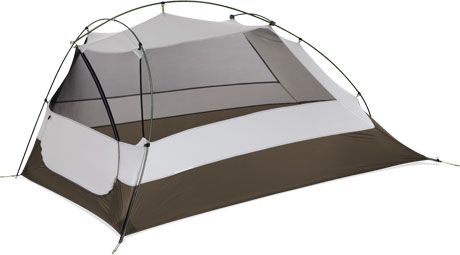
Any mention of "freestanding? Yes :Freestanding Setup: Add a trekking pole to make the Nook™ tent fully freestanding.
(in other words it isn't without the extra pole…)
now compare those to the BA FlyCreek UL1 :
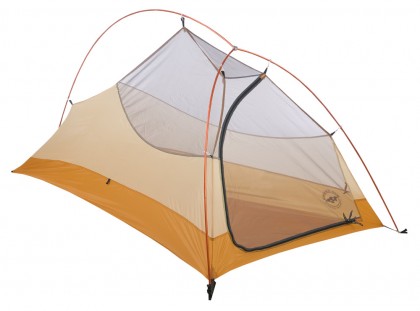
no matter how you twist it , just like the Nook the FlyCreek UL 1 does not stand up holding the shape without stakes…
My point, for the OP, NOT YOU…, is that if he is happy enough using 6-12 stakes than there are a lot of other options….
BTW, again I need to edit to add photos.
"the FlyCreek UL 1 does not stand up holding the shape without stakes…"
I must have gotten a defective one, because mine stands up with proper shape when it is sitting in the middle of my carpeted living room with no stakes in sight.
–B.G.–
Great
Post a photo of that tent with the fly on without stakes in use.
Just to save you some time, it will look like this:
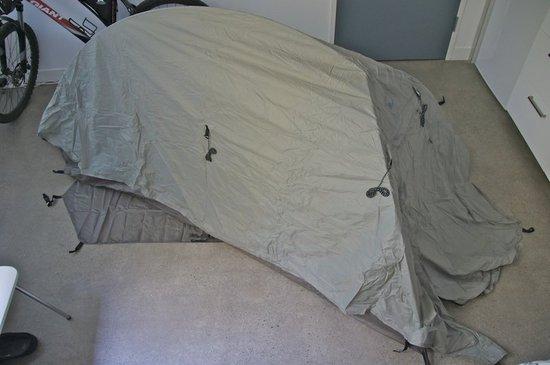
I see you are not going to get over it, so will let it go for now.
Be well,
Sam

Big Sky Soul

Terra Nova Solar Comp 1

Black Diamond Hilight

Check out eastern mountain sports velocity 1.
Thanks to all for your help! Jim
> Stakes are obviously not the only choice when anchoring a shelter.
> I have camped on solid rock, loose gravel, sand, … and never had a situation
> where I couldn't/didn't anchor my shelter.
+1
cheers
PS: swamps are tricky.
Hi Franco
Useful video, but you missed one of our favorites which often use in the Blue Mts with our tunnel tents.
We find a long straight stick – branch more likely, and tie the two corners from one end of the tent to it at the right spacing. Say 2 m long. Then we pile lots (and lots) of rocks along the branch. This way we can use lots more rocks than is possible if the corners are tied straight to a rock.
Another option we have is to use some 'family camping' tent pegs I was sent from South Australia. They are rods of (roughly) 8 mm high tensile steel, they can be hammered straight through concrete and asphalt. OK, large steel sledge hammer required. I wonder what the owner of the asphalt surface would say?
Cheers
As Roger suggests, I find the stick and rock combination better than rocks alone. Rocks are often abrasive and can shred the line in a stong wind from the constant rubbing.
A lot of different sized rocks can be layed along the length of the stick.
There is a point when most of us realize that we don't have to rely on the stakes that we carry and can get by with lighter stakes.
I remember when I carried snow stakes and/or long wide stakes so I would be able to attach my shelter in every situation.
It wasn't long before I realized that even a good assortment of heavy stakes won't work in some scenarios and found objetcs can work much better.
I now carry light stakes and happily supliment with found objects when they don't work well.
One of the many things we learn form experience:-)
Become a member to post in the forums.
 Creamy Dijon ChickenCook-in-the-bag chicken, tarragon, and rice backcountry meal with 2 servings. Net weight 5.7oz | 162g
 © Beartooth Media Group Inc.
 Loading...