Topic

What do you carry for First Aid?

  • This topic is empty.
Viewing 25 posts - 51 through 75 (of 86 total)
Justin Baker BPL Member
PostedFeb 2, 2013 at 4:31 pm

Hatchets are notorious for injuries because of their short handle length. They are like an extension of your hand. Anywhere you hand can go, the sharp edge of a hatchet can go. You can get some really crazy glancing blows that can send your hand towards many different parts of your body like your thigh or foot.
I consider tomahawks to be much safer because of their long handle. Anything with a handle length around 19 inches (like the granfors bruks small forest axe)is very safe provided that you chop while kneeling. It allows a 2 handed group which further limits your swing and the length is sufficient enough that any glances go directly in the ground. 19 inches is probably the safest length for any axe, provided that you always use it kneeling. 10-12 inch hatchets are the most dangerous.
Then there are 26 inch boys axes that are very safe, provided that you always keep the edge of the axe more or less parallel to the ground when bring down crosscuting chops. But really, a 26 inch axe is way overkill for most backpackers outside of winter.

Either way, these tools can be safe to use if you follow certain rules, pay attention at all time, and don't do ridiculously stupid things. 95% of all edged tool injuries are going to be from doing something completely stupid. With safe use you can use these tools for your entire life and a serious injury is unlikely to ever happen. But it still can happen and create extremely bad injuries.

PostedFeb 2, 2013 at 4:34 pm

I only really carry my hatchet (Gransfors Bruks Wildlife Hatchet) in winter and/or cold shoudler seasons when I process a large amount of firewood, other than that I only carry my Mora Bushcraft knife in the backcountry, along with a Victorinox Swiss Army Classic for the scissors (an absolute MUST for my first aid kit) and the small blade is good for food processing. The tweezers are also okay for splinter removal, not super great but better than nothing. I'm a big fan of campfires and splinters are inevitable, at least in my case. I'll also stand by my ACE bandage selection, its not especially light or small but I never see it on first aid lists and I love its ability to bind a wound and keep the area clean.

@ Max,
I'll find my wife's camera and post a picture of the scar. It healed down to about an inch long of visible scar tissue but it's still at least an 1/8th inch wide. In retrospect skipping the stitches probably wasn't a wise decision.

Jake D BPL Member
PostedFeb 2, 2013 at 4:42 pm

lol.. folks on here are carrying knives that are in the 1-2oz range.. people who carry hatchets are on their own.. i'm not packing extra FAK stuff for them.

Rusty Beaver BPL Member
PostedFeb 2, 2013 at 6:05 pm

Just out of curiosity…. I'm wondering why you guys are carrying hatchets?

Justin Baker BPL Member
PostedFeb 2, 2013 at 9:49 pm

Building a frame for your tarp out of wood poles so it can withstand the heaviest of snow, cutting green conifer bows (please, only from naturally knocked over trees) for ground insulation, building a natural shelter, carving tarp stakes, pounding in tent stakes, splitting wood to get dry kindling in wet/frozen conditions, de-limbing dead fallen trees so you can lay them on a fire easier, laying up a big stack of dry wood for an all night fire, splitting a piece of wood for a flat surface to plank cook on, carving things like spoons for fun, and more.

All of the things listed can be done in the right location and right situation without leaving a significant trace or having a negative impact on the environment around you.
I realize that 99% of the users on this forum have no interest in doing the things I just listed. I enjoy doing bushcrafty stuff and it gives me flexibility. Doing more with less.
A folding saw and knife is generally a more practical option and very safe, especially if in the dark.

This got really off topic.

PostedFeb 3, 2013 at 2:53 am

There have been a few comments on Quickclot and Celox. Note that both of these are clotting agents designed to stop beeding. Although they both do the same thing, they are not the same.

Quickclot is a mineral that reacts with blood to stop bleeding. It was released in 2002 and was the first commercial clotting agent. Unfortunately it was not perfect. The reaction generates heat. IF too much of the powder contacts too much blood it can cause burns. If any lands in the eye it can cause eye injury. Also later a doctor may have to reopen the wound to remove it. Due to these issues it was changed twice. The current version, Combate Guaze, uses a different mineral to limit the heat. Also it is only available in a gauze bandage so that removal is easier after the injury has healed. It is no longer used by the military but it is still on the market.

Celox was released in 2006. Is a dry gel powder that is pored into the wound. Blood sticks to it stopping blood flow. It does not generate heat when it contacts the blood and it doesn't have to be removed. The body over time converts it to a glucosamine. A type of suger the body uses. It has been uned extensively in Afghanistan and is effective on people that are on prescription blood thinners. It is available as a powder and in guaze pads.

Celox and Quickclot do not replace the need for direct pressure, elevation and other beading control methods. Use all methods available to stop serious bleeding.

I am on blood prescription thinners and I carry it Celox in my first aid kit. fortunately I have not needed it. I also carry a Personal Locator Beacon in the event medical help is required.

PostedFeb 3, 2013 at 11:37 am

It is no longer used by the military but it is still on the market.

Details? I'm curious, as the (US) TCCC guidelines still list Combat Gauze as the preferred agent. Err… unless you are in the UK, as I think the UK MoD has gone with Celox Gauze for their preferred agent.

Digging more into it, it looks like the Celox gauze performs at least as well, and the Celox powder also looks quite capable. I believe some of the reason for going to a gauze is that powder and high winds don't mix well, plus the wound orientation needs to support pouring.

jscott Blocked
PostedFeb 3, 2013 at 6:01 pm

Max: band-aid advanced blister healing cushions: the cat's meow. One of these over the blister, leukotape over the cushion. Done. Sometimes I add a moleskin–probably with a diamond cut-out in it's center–over the cushion, then leukotape. The band-aid instructions actually advise you to leave the cushion on for several days. I have, and it works for me.

p.s. it's advised that you use the palm of your hand to warm the cushion for a minute or two to help with adhesion to the skin.

Ian BPL Member
PostedFeb 3, 2013 at 8:40 pm

Just took a trauma course from a medic with 3 or 4 combat tours under his belt. Here is what I learned from him:

Yes quick clot can cause necrosis
Combat gauze is still recommended and doesn't cause necrosis
Packing a deep wound with arterial bleeding with ordinary steril gauze is fine
hemostats are impractical in this setting

My background is military and EMS FWIW here is what I carry when I'm solo: Imodium, mucho tape, NSAID, Benadryl, moleskin, Neosporin, and common sense. Anything else I need I can scrounge from my pack. I'll flush any wounds with sterilized water.

If I'm hunting or in the back 40 during the hunting season then I'll carry a GSW kit as well. If I'm hiking with my kids or untested hikers then I'll bring a mac daddy blister kit including tincture of benzoin and alcohol prep pads. If you are a real bad @$$ then you can give the blister a hot shot with the benzoin or superglue. Hurts like heck but that blister will be good to go.

I don't do things 10 hours away from my truck that I would do 10 minutes away from my truck. The summit will be there tomorrow. The snow field will probably soften up once the sun hits it. If I keep walking I'll find a safe place to cross the stream. I make more mistakes once I've hit the wall so I know when to call it a day. I'm older now so I've lost any compulsion to perform back 40 acrobatics. My feet are pretty tough but they are my first priority of work during breaks.

I only worked EMS full time for three years and only applied a traction splint once in that time. In my experience mid shaft femur fractures are not super common but they do happen. You are only limited by your imagination but this is basically how I learned to use a field expedient one in my WFR class:

Youtube video

PostedFeb 6, 2013 at 4:44 pm

Great thread.

I have training and field experience as an EMT-I, WEMT, and some tactical medicine. Bob's post is superb, nobody can tell you just what you should carry. Some tips:

– Improvisation is imperative.

– Tactical medicine techniques can be leveraged for hunting or bushcraft injuries: gunshots, arrow impalements, hatchet accidents, etc. Knowing how to pack a wound for hemorrhage control is good. If I was a hunter I would carry a commercial tourniquet like the CAT or SOFTT-Wide. Learn how to properly construct and secure an improvised tourniquet. It is possible to do it wrong and speed up the bleeding.

– Few LW/UL hikers are toting guns or axes but most have stoves of some sort. Be ready to deal with burns.

– Prevention is huge.

– Environmental medicine matters.

– Injuries from the knee down are serious because they can be (or become) mobility killers.

– I only applied a traction splint for a snapped femur once in the field, but the patient said it improved his pain better than the morphine we gave him.

PostedFeb 6, 2013 at 10:01 pm

I took the advice of everyone who posted. Your comments and insight may very well save my life.

First Aid

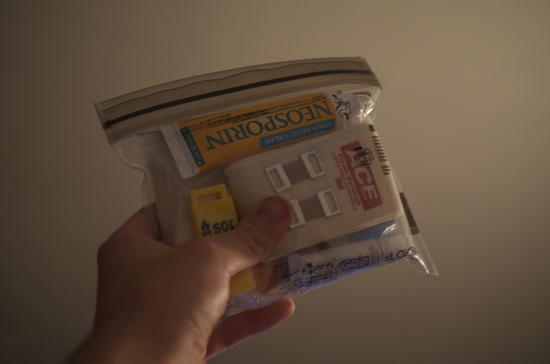
My kit now includes:

10 Band-Aid Flexible Fabric Quilted
2 Sterile Gauze pads
3 Sterile Sponges
3 Alcohol Wipes
2 Antiseptic Wipes
1 Tube Neosporin Antibiotic Cream
1 Sheet Moleskin
6 wound closure strips
8 Band-Aid Advanced Healing Blister Cushions- these are designed to sit on the wound for several days, acting in place of a scab. For bad blisters.
4 J&J Advanced Care Tough Pads- larger cushion pads designed to sit on the wound for several days. For bad cuts.
1 ACE Bandage with two clips
2 tablets of Antihistamine
Aleve painkillers
Papaya enzymes for stomach issues
Medical Tape

Other items also in separate plastic bags within first aid kit:
SeamGrip
Gorilla Glue
Emergency Whistle
2 patches for rain gear

Everything stored in an Aloksak, 6in x 6.75in

Sorry, no weight. I haven't got a scale. If I had to guess I'd say 3.5oz, it's a hair heavier than my Sawyer Squeeze.

I took out about fifteen cheapo bandages that looked like they'd fall off, Insect Sting treatment, extra moleskine, and some generic ibuprofen. I was shocked at how sparse my kit was; I had no way to treat an injury larger than what I might be able to ignore. Now I can cover small wounds to prevent infection and still treat more serious wounds.

Might add more Gauze.

Thanks again for the help!

Susan D BPL Member
PostedFeb 6, 2013 at 10:39 pm

That looks like a 1 oz. tube of Neosporin in your baggie. I suggest you save almost an ounce and put in one or two small packets of triple antibiotic. Triple antibiotic, bacitracin zinc ointment, Blistex, hydrocortisone cream, and so on come in little packets that weigh half a gram to one gram. They can be found in medicine cabinets at some places of employment or ordered online. If you had a couple triple antibiotic packets, your Neosporin weight would be reduced from 1 oz. to 1/16 oz. A little goes a long way – I used it daily on a trip last fall, and one packet lasted me six days.

Last year, I bought a bunch of first aid stuff (and food) online at minimus.biz. Free shipping over $20. They've got small sizes of many of products.

Susan D BPL Member
PostedFeb 6, 2013 at 10:41 pm

Looks like I was writing at the same time Roger was…

Ian BPL Member
PostedFeb 6, 2013 at 11:10 pm

Sounds like you might be interested in some advanced first aid training. I took the WFR course through these guys and would highly recommend them.

http://www.wildmed.com/

Ian BPL Member
PostedFeb 7, 2013 at 8:32 am

"If I was a hunter I would carry a commercial tourniquet like the CAT or SOFTT-Wide."

These are great tools for those who work with/around firearms, chainsaws, etc. While it's easy to improvise a tourniquet, these are hard to beat and are much more effective than using a traditional cravat and stick.

One important thing to remember when buying these off of Ebay is that they are susceptible to UV degradation. Many of them were carried by GIs returning from theater and often times they are worn on the body armor and are exposed to the sun.

If anyone is interested in buying one for a trauma kit, pay a couple extra bucks and buy a new one.

PostedFeb 7, 2013 at 10:23 am

My impression of serious injuries is that you can never have too much antibiotic. At the risk of over-preparing, I can imagine a lot of scenarios where not having a way to prevent infection is a very bad thing, which to me makes it the only thing to bring extraneously. Bandages can be improvised; antibiotics can't.

My worst-case scenario is slipping on a fallen log and getting a gash or impaling injury on my leg. I think I can reasonably prepare a first-aid kit for walking out of that or a similar injury and then count on using my head and staying put for anything worse (and normal precautions like telling people where I'm going.) In the event of that injury, my solution is to use the wound closure strips, gauze, an improvised covering along with the ACE bandage, and a hefty amount of Neosporin to keep the wound clean and infection-free for a few days of travel out of the wilderness. In that case, I might use 3/4 of a tube over two or three days.

My logic; if it's flawed, don't hesitate to say so. This just felt like 1-2 ounces that were graciously accepted to put my mind at ease, but experience could correct me.

PostedFeb 7, 2013 at 10:26 am

Oh, also, I carry the whistle with my winter camping backpack because I don't want to buy a buckle whistle when the bag itself weighs upwards of 5lbs. The ounces saved there could easily be saved through massive cutting and trimming; i'll get to it eventually.

My 3-season backpack has a built-in whistle already. There, I actually care about ounces quite a bit.

John Donewar BPL Member
PostedFeb 7, 2013 at 10:48 am

Hi Max,

I too carry Neo in my FAK. It's in what is referred to as "single use" packs. They are little sealed foil envelopes of Neo that I cannot find anywhere anymore in my area.

"My logic; if it's flawed, don't hesitate to say so."

I won't because it isn't. ;-)

My single use packs have been all that I have ever carried on the trail and have never had to use one of them. What I have used more of from my FAK has been Ibuprofen after straining my knee and some tape for a developing blister.

Just because I've been lucky and have not had to use any of my Neo doesn't mean that I don't see the logic of the 1 – 2 ounces that you carry.

FWIW I'm at that age where the health professionals routinely ask if I've fallen lately. ;-b

Up until last year I had never fallen on the trail. I didn't need any Neo after the fall but as I said before, "I've been lucky…" If it makes you feel more comfortable carrying a larger amount of Neo by all means you should.

As for what I carry my plan was to go lighter, use it if needed, determine if I had enough to continue on or pick some up at a trail town or resupply point. My last option would be to bail if the injury were serious enough.

This will probably make English teachers all over the country cringe but, Lighter Ain't Always Righter! ;-)

Party On,

Newton

Ian BPL Member
PostedFeb 7, 2013 at 10:49 am

I’m not a doctor but I did stay in a Holiday Inn Express last night….

I almost lost my mom to sepsis a couple years ago due to a physician not following needle protocol so infection control is high on my list of priorities. I use the ointment to take care of minor scrapes and cuts. If I have a serious laceration/abrasion, my SOP is to clean the wound the best I can after boiling my Swiss army tweezers and flushing it with sterilized water (which ISN’T boiling!) I would then immediately execute my evacuation plan. Cellulitis/Gang Green is nothing to mess around with.

My line of thinking is that my first aid kit is designed to keep small injuries from becoming big problems and if I’m seriously injured/sick, that I have what I need to di di mau to the trail head to seek definitive treatment.

In a HYOH sense, you are never wrong for carrying it but a whole tube may be overkill.

Viewing 25 posts - 51 through 75 (of 86 total)
Loading...