


Can lithium batteries be used in the Foretrex 101 GPS unit?
If yes, which setting should be used – "Alkaline" or "NIMH?"
Topic
Become a member to post in the forums.
Can lithium batteries be used in the Foretrex 101 GPS unit?
If yes, which setting should be used – "Alkaline" or "NIMH?"
Yes I have used Lithium Batteries on the Alkaline Setting, they lasted about 20 hours in Normal Mode.
John, I remember we discussed which GPS to buy. How is the Foretrex 101? Is it a useful tool for getting a position 'hit' as part of your navigation system?
I recently bought a Garmin edge 205 for its SIRF chipset; Im hoping it will have superior reception to my Garmin Geko 101 when I am in canyons/forests. How is the Foretrex reception when under light canopy cover?
I got it and have been having fun playing with it. I am definitely amazed.
It works reasonably well under light tree cover. I have used it on two day hikes to map the trail. I just turn on tracking, put the GPS in my pocket and start hiking. I set it to record every 10 ft. which provides a nice density of track points which I input to my TOPO program and constructed the trail (which TOPO does automatically). It is interesting that the distance hiked as given by the track points is about 10% more than the distance I get by plotting directly the trail on my TOPO map. I guess that since the Foretrex 101 captures each little zig and zag it more accurately measures the distance traveled. Part of one of my hikes loops back on itself so I plot the trail both coming and going. The map plot is not identical in this region, so this gives me some sense of the error, which is small but still noticeable.
I also have transferred some easily recognizable waypoints from my TOPO map to the Foretrex 101 (like mountain tops). Then when I am at a high point on my hike I read the bearing from the GPS device and check it with my magnetic compass. The results look accurate.
I was at the beach for a few days and jogged several miles with the GPS recording track points. The resulting map showed the elevation profile which varied from the track points plus/minus 20 ft. It should have been flat. So this gives some sense of the elevation accuracy.
I clocked the speed of my wifes car as we were driving one day. This was surprisingly accurate as I could compare the speed from the GPS with the car speedometer.
This of course is all fun and games. But I am reasonably confident when I am backpacking I can use it as originally intended, namely (1) to find my location periodically, and use the coordinates to plot my location on my TOPO map. (2) to get the bearing and distance to pre-plotted waypoints on my map as needed when hiking.
It also would be easy to change your hiking plans to traverse another pass. You could get the UTM coordinates of the pass off your map and input them into the Foretrex 101. Then as you hike toward the pass you could confirm that you are headed in the right direction by checking the bearing and distance provided by the GPS device.
Hi Brett,
I use a Garmin Forerunner 305 with the SIRF chip for walking and running and it has worked in some very deep narrow gullies I have actually been amazed where I have received readings.
Tony
I have the Garmin 76CSx w/ SiRF III, on several hikes in canyon oriented places, it stayed locked 99% of the time. The few times it did lose lock, it was back in a few seconds. This is based at looking at the track data on a PC. Non-SiRF III lost satellites significantly more often.
John, you got reception with the gps in your pocket?! Wow, that would be impossible with my older garmins due to my body blocking 1 or more satellite line's of sight. Your 101 is a generation better than my Geko, and Tony, I am so glad to hear your 305 with SIRF is living up to the reputation of that chipset.. Once on a canyoneering course I had to scramble up a dangerous hillside to get a position fix so my group could bail on the route.. with my 205 I hope I can stay down in the canyon/canopy and get a reliable 'hit'. I can't wait to try it side by side with my old garmins.
To me the issue with any piece of electronics in the bush is that of batteries. Not too many electrical receptacles where I hang out… One of my friends got into wearing a flexible solar panel on his pack to do recharging duty and I don't know how it worked out. But that particular person is anything but a UL backpacker, in fact prides himself on the huge size and weight of his pack. He has been a RidgeRunner on the northern Massachusetts portion of the AT for quite a few years so some of you may have met him. (Hee hee, just thought that an interesting side-fact.) How are others dealing with battery/recharging issues? Anyone have success with solar?
I put the GPS in battery save mode and use fresh Lithium batteries. I also really only use the GPS when I need/want it. I don't generally take tracks or do things that require it to be on for a long period of time. One of the advantages of the new chipset is that it locks on really fast so that helps as well.
I love my GPS and often bring it when I want to bag a few geocaches along some route.
You cannot put the lithium batteries in that GPS unit. I have one and I have tried… many times… fyi
Hi Brett,
I hope you have as much fun with your 205 as I have had with my 305. I leave mine on whilst I am walking to record the route to Google Earth it and to look at the elevation profile. The lithium battery has only a 10 hour life but I have got around this by building a remote USB charger based on a 34063 DC-DC converter, all of the parts for this were available from my local electronic parts supplier. The version (picture below) is relatively heavy as it was put together on vero board if a version was designed on surface mount it would be much lighter ( this is something that I am planning to do soon when I find the time). It and uses 4x 2500mAh batteries which I get 4 full charges out of it. I also have a solar charger for the batteries but I have not used it yet.The 305 weighs 77g and the charger plus cradle weighs 289g.
There are a few things that I do not like about the Forerunner 305, one is the on off button can get bumped in thick scrub, the position reading is only in Lat/Long I prefer UTM’s and I would like to put waypoints into it by interfacing it with a computer.
Tony
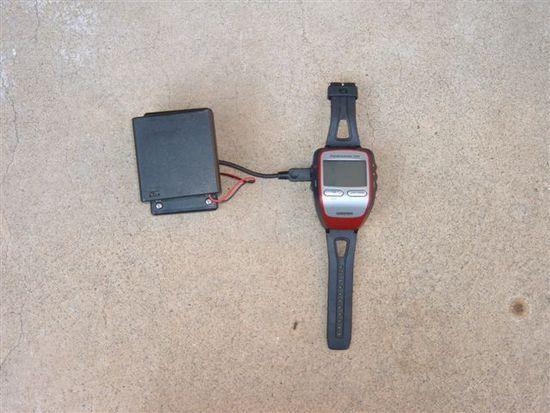
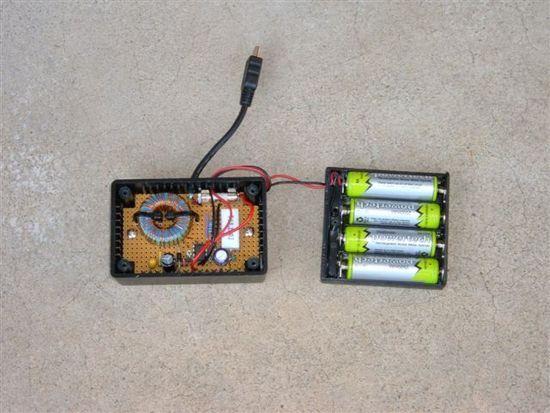
I took an Iowa Thin Film solar panel to Philmont for 10 days, and it worked great. I used it to recharge camera and other batteries. My review of it is here:
I stored it up against the frame stay foam pad, and didn't have any problems. I could charge while hiking but found it more convienient to charge it while stopped.
Tony, excellent work with that converter. You boosted the output voltage to more quickly charge the 305, right? I have a little cellphone charger which I hope will do the same thing. I carry it for my cellphone anyway, so I hope I can just jump the output to my 305 with a stripped USB cord. Do you think an off the shelf cellphone charger works similar to your device?
I usually power up my GPS at decision points, rest stops, position checks, that sort of thing. Just to make a coarse breadcrumb trail to follow back to the train station in an emergency.
A light flexible solar charger is a really cool option as well. Amazing the progress which has been made in that field in the last 20 years or so.
Tony, extremely cool work on that charger. And Mike, thanks for the link to your review of Iowa Solar Film Solar Charger. I cybered right over to Jameco but found they are apparently only carrying a small hobby version now. Then Googled "Iowa Solar Film" and found a couple of really fun articles; one on a solar tent (really an array installed on a sort-of tent, didn't make sense to me but the technology is fascinating) and the other from "WIRED" mag – an '04 article discussing flexible solar panels and the inclusion of them in fabrics.
I've been an amateur radio operator for years, so am familiar with a lot of the technology some of us gals miss, yet not the most tekkie of the gang. I can usually get the guys in the local radio club to help me with any of the little technical details that are beyond me. This set of ideas they might like. We're always into anything that can provide emergency power and most of us are quite involved as emergency communicators (ARES, RACES, Skywarn).
Robert: which GPS unit are you saying can't use lithium batteries?
Ive only used my 101 while dismounted and running around iraq but so far i love it! It dosnt have the ablilty to preplan a course like some GPS units..but when your out and about and have a GENERAL idea of where you want to go its perfect. I love the backtrack mode…used it more than once to lead someone to a point, give them the unit and head back..knowing that they now have the ability to find the way back on their own no matter what. All in all i recommend it..actually on my second one due to a bad incident kicking a door in..lmao! Its light..accurate and easy to use.
Nice pic John is that SEKI in the background?
sorry to hijack the post I just liked the pics of the mountains!!
The shot is taken in SEKI from Monarch Divide across the South Fork of the Kings with the Great Western Divide in the background.
Hi Brett,
I would be very cautious with using a cell phone charger when investigating if I could use a remote charger I read about major problems with the 205/305 with some car USB chargers. USB is 5 Volts I spliced a USB cable and placed an ammeter in the line to measure the charging load which is about 300mA. The reason that I chose the 34063 api chip is that it can convert 3-40 volts input to 5 volts output which gave me a choice of batteries that I could use. I do not have the circuit with me at the moment as it is at work I used the circuit that was recommended on the data sheet whick is available on the web, I will post it to you when I can.
My electronics is very basic if there is any electronics experts out there that would be willing to design a surface mount DC-DC converter and share the circuit that would be appreciated and would reduce the weight considerably. I currently use Ni-MH batteries and I am not up to the latest in batteries I think that a significant weight saving could be gained using different batteries.
Tony
Tony,
there are many plug and play DC-DC converter circuits out there floating around. Maxim and Linear do a great job, one of their ap note sections can be found here:
http://www.maxim-ic.com/appnotes10.cfm/ac_pk/20
I've used there chips in many places, and they make a good product. You can often find actual usable circuits and PCB layouts in these and others' apnotes.
Also, if you google the specifics of what you want, you can probably find additional public domain circuits and PCB layouts.
One other data point on fast charging lithiums: They like to either die or explode (not necessairly predictable which) if you charge them too fast. You need to be careful to observe the maximum charge rate on the battery.
In an emergency, I've see an engineer charge a 1.5V AA with a 12V car battery in a few seconds….. It charged, but got very hot, and probably had about -0- recharges left in it after that. (DTTAH / YMMV / DSAYOR) The faster you charge a rechargable, typically the lower the overall life of that battery. Battery Capacity / 20 or / 40 is common for a charge rate.
MikeB

sounds good.
Hi Mike,
Thanks for the information on chargers I will enjoy looking at it, I think the 305 has a current limiting circuit in it, when I checked the charging rate from flat it did not go above 300mA even though the power source was capable of delivering much more.
Tony
Robert: which GPS unit are you saying can't use lithium batteries?
The Garmin GPSMAP 60CSx ___used to___ not work with lithium batteries but there was a software update to the unit quite a while ago and they work fine now. I use them all the time. I don't know if this is the unit being discussed here but I get this question all the time. This is a great GPS unit (lots of fun geocaching with the kids!) and it's a shame this rumor is still out there.
James: Which version of the software are you using? Although lithium is listed as an option on the screen, it still doesn't work on my 60CSx.
The "official" line I got from Garmim about six months ago was that I was supposed to drain about 25-50% of the charge from the lithium batteries before using them in the 60CSx and then everything would be fine (except battery life of course).
BTW: I love Garmin GPS's. This is my third Garmin and the best one yet!!! The new receiver is absolutely incredible in the heavy woods I usually hike in.
Become a member to post in the forums.
 Magic 100 Sleeping BagMinimalist 900-fill-power down sleeping bag with a 55°F | 13°C comfort rating. Weighs 8.46oz | 240g
 © Beartooth Media Group Inc.
 Loading...