Walter,
Interesting numbers, and if I may, let me paint a bigger picture:
Total power is determined by fuel type, jet aperture size, and fuel pressure (either direct from the canister or by phase change expansion in the generator/preheat loop), but how much of that power gets transferred to the pot has a lot to do with how efficient your set up is. Your numbers describe the first half (power) of the equation of snow melting. Efficiency describes the remainder.
Ways to more efficiently melt snow (i.e. transfer more of that heat to the pot):
-Use a windscreen
-Use a lid
-Use a moderate flame (may not be practical when melting snow, but it is more efficient)
-Use a wider pot
-Use a heat exchanger pot
-Use a darker colored pot (probably less important than the other items on the efficiency list)
On the efficiency side:
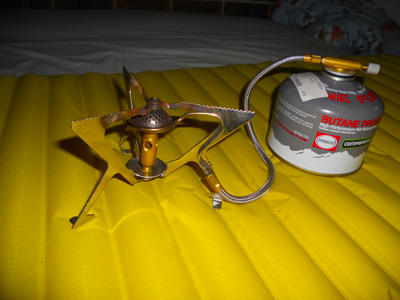
One of the big arguments in my mind in favor of an inverted canister stove (like the Optimus Vega, MSR Windpro, Kovea Spider, etc.) is that you can use a better, i.e. full 360 degree, windscreen.
On the power side:
Another argument in favor of an inverted canister stove in the case where a lot of power is desireable (e.g. snow melting) is the issue of canister pressure vs. pressure due to phase change (going from liquid to gas). In an upright canister, the phase change happens in the canister, and your pressure at the burner is basically determined by the pressure in the canister. However, in an inverted canister stove, the fuel is still liquid when it leaves the canister. The phase change happens at the burner (i.e. in the pre-heat loop). The fuel expands some 200+ times its original volume when it goes from liquid to vapor. A 200 fold expansion gives you a lot of pressure at the burner even if your canister has a fairly low temperature — and low canister temperature is just what you might have when you’re melting snow.

An MSR Whisperlite Universal cranking out big time BTU’s. Yes, it’s running in inverted canister mode
So, the power of a stove matters and thank you for those numbers. In addition, one has to consider how best to make sure that power winds up as heat in the pot. That’s why you might get a person with a lower powered stove (but with a heat exchanger pot) who can melt snow more efficiently than a person with a higher powered stove.
Anyway! Just a few thoughts about power and efficiency. Hopefully it will stimulate some thinking.
HJ
Adventures In Stoving