I agree, the Caldera Cone Comparison Chart (http://www.traildesigns.com/cone-comparison) is very confusing.
This is off the top of my head, so if anyone catches an error, please correct me…
EDIT– I went back and thieved some images from the TD website, probably in blatant copyright violation. Hopefully Rand doesn't mind, since I'm basically pimping for him. (This probably qualifies as "fair use" but if you do mind, Rand, just let me know and I'll remove them.)
All Caldera Cones are fitted to a specific pot, though many pots are close enough in dimension that they share a common cone design.
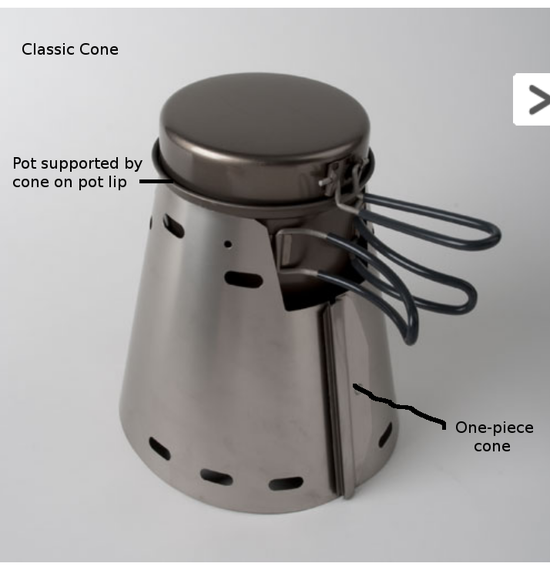
CLASSIC
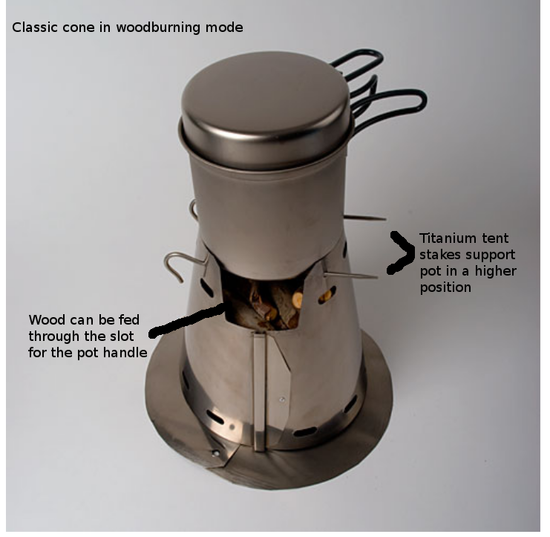
The Classic Ti-Tri Caldera Cone uses a single large cone. It is fitted to support the pot on it's lip with the top of the cone.

These cones will generally NOT fit into their pot and thus must be packed separately and take up extra room in your pack. But the large cone is ostensibly the most efficient of the various cone systems. Several creative ways of packing them exist.
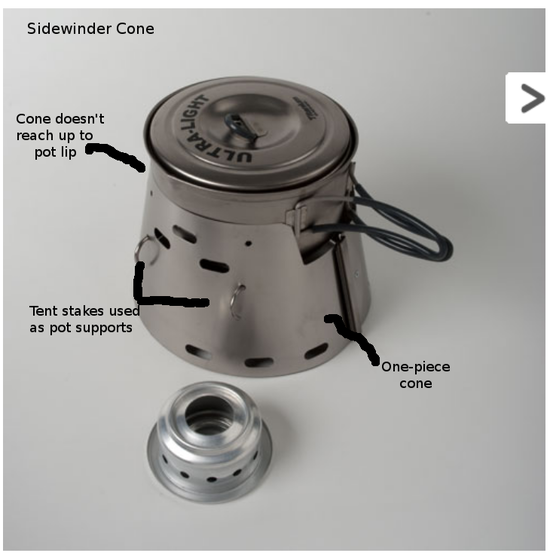
SIDEWINDER
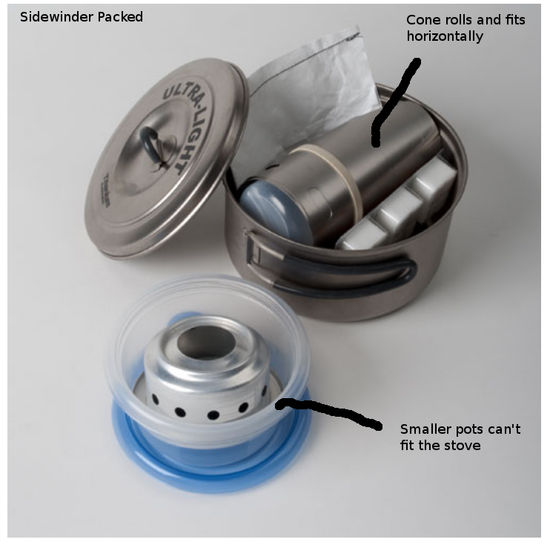
The Sidewinder Ti-Tri is a single cone specifically designed so that the cone CAN be rolled and fit inside the pot sideways, but only certain pots will work- generally wide/short pots.

Specifically, the Sidewinder system is not available for thin/tall mug-type pots. Depending on the pot the supplied TD 12-10 stove might not fit inside the pot with the cone and thus need to be packed separately. For many pots this is solved simply by trimming the priming pan off of the 12-10 stove, after which it will fit (see my link above).

However, the system is more complicated in that the pot is not supported on its lip by the top of the cone- instead, two tent stakes are inserted through holes in the cone to support the pot at the correct height. Since the cone doesn't go all the way up to the pot lip it is ostensibly less efficient than a Classic Caldera Cone.
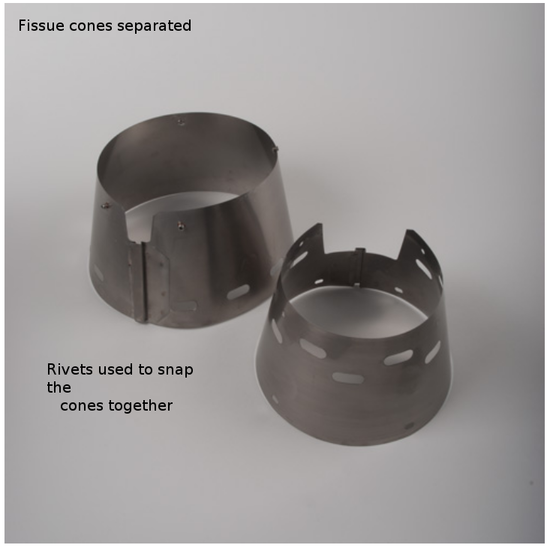
FISSURE
The Fissure Ti-Tri takes a full-sized Classic cone and splits it in two. These two smaller cones will fit inside the pot for which they are designed by coiling along the sidewalls. Because of the way they coil to stow in the pot the cones use up much less volume in the pot that the Sidewinder does, so you can carry more stuff in the pot (fuel, etc.)

But to use the cones they must be mated up together to create a single large cone- pop rivets on the bottom cone mate up to slots on the top cone.

The pot is then supported on the top edge of the cone, as with the Classic Cone- no tent stakes needed.

This is sort of the state-of-the-art in Caldera Cones as the cone packs inside the pot but is tall enough to retain the efficiency of the Classic Cone. This efficiency is offset by the fact that pot options are severely limited- generally to less efficient tall and skinny pots. Another drawback is that it is just a tad heavier than the Classic Cone (probably a fraction of an ounce or so).
FUSION
The Fusion Ti-Tri is a combination of Sidewinder and Fissure.

It uses a split cone like the Fissure but the cones are mated together using tent stakes instead of pop rivets.

Usually, the cone does NOT reach all the way to the pot lip, so it is not as efficient as the Classic Cone or Fissure, but this system can be made for shorter pots than the Fissure (I think).
ALL of the Ti-Tri cones are made of titanium and thus can be used for wood burning. To do so the pot is suspended higher than usual on two tent stakes through holes in the cone. Wood-burning can ostensibly be made more efficient by adding an Inferno insert. Of course, they can also burn Esbit tabs, and a tiny Esbit stove is included as well as the 12-10 alcohol stove.

The Classic and Sidewinder cones are also available in aluminum rather than titanium. This is WAY cheaper but less durable and loses the wood-burning option.
CALDERA KEG
The Caldera Keg systems are also (I think) only available in aluminum. They are designed to use one of several large aluminum beer cans as a pot, and the cone will fit inside the can. They are for the true gram weenies.

Rand did a LOT of R&D while developing the 12-10 stove to be sure that the stove/cone system worked well in as wide a variety of conditions as possible. The people who like to tinker with alcohol stoves can often wring higher efficiencies from a different setup in one narrow set of conditions, but it is hard to beat a 12-10 stove in a Classic Caldera Cone for use in many varied conditions.
OTOH a cat food stove and bit of foil is WAY cheaper than even the aluminum Caldera Cones- almost free, in fact. You can easily make the stove yourself, or even improvise one in the field using a can scavenged from a dumpster if you find yourself in extremis:
http://jwbasecamp.com/Articles/SuperCat/index.html
Really, even if they don't use one regularly any UL hiker worth their salt should know how to make a cat food stove.
But since you asked, yes, cat food stoves (and others that balance a pot on a narrow stove) aren't terribly stable. You have to take care. OTOH the Caldera Cones are wicked stable- you'd almost have to actually kick one and send it flying to tip it over.