


Jim
I don't think I would have thought of that… basically covers all of your needs and you can pick your color!
I may have to give that a try.
Tommy
Topic
Become a member to post in the forums.
Jim
I don't think I would have thought of that… basically covers all of your needs and you can pick your color!
I may have to give that a try.
Tommy
Please pardon the tardiness of my post. I have found the Boker Infinity to be durable, reliable and relatively light. The ceramic blade promises years of razor sharp cutting. One must take note that ceramic blades may shatter if dropped onto rocks or other unforgiving surfaces. Additionally, the blade does not lend itself to slicing certain types of food items, although ceramic blades are generally promoted as inherently anti-microbial. I could not say for sure, but it appears the blade is not prone to rust and the manufacturer claims years of use prior to renewed sharpening. I have used the knife for a variety of cutting purposes on both short and extended expeditions and have found it completely satisfactory thus far. Though pricey, it may be worth a look.
I recently stopped carring my Leatherman Juice Xe6 at 7oz and switched to the Spyderco Delica with a serrated edge at 1.5oz. I found that, so far, I've yet to use anything but the blade or serrated blade on the Leatherman.
I carry a Benchmade 530 (with the serrated blade). It’s a 3.25″ blade and weighs only 1.75 ounces. It’s a great knife!
It's true that the swiss army knife approach often leaves you carrying various weird tools that you don't or only rarely use, but I nevertheless carry a Swiss Army Minichamp II,
http://www.amazon.com/Victorinox-Swiss-MiniChamp-Pocket-Knife/dp/B00005ML8D/ref=pd_sbs_sg_1/103-9802660-9635004
54 grams, 1.9 oz. While I like a longer blade in theory, in practice I very rarely need one — about a 2" blade will cut most things I want just as well as a longer one. This model indeed has things I don't want, but it's pretty small and light for something that offers not only a blade but a scissors and tweezers. I can cut my big toenails (if soaked first) with those scissors, and the nail file actually comes in handy to then finish off the toenails — something useful on a longer trip.
For a really long trip, I want a can opener of some sort (resupply in local stores, repackage can contents), but that can be in a bounce box rather than carried on my back.
I disagree that a knife blade is as good as scissors; scissors offer more control in various situations, whether cutting moleskin, field repairs of gear, trimming facial hair so bears don't smell too much of my food on me at night …
The ideal backpacking knife for me would lose a couple of the blades on this one (cuticle pusher …) and add a fid and a little can opener, for about the same overall size and weight.
Just an FYI.
I saw D2 tool steel mentioned in this thread. Fine grade. Holds an edge like nothing else.
Down side. Will snap and break long before it bends. Could shatter if dropped or struck. While a bent blade is dangerous, a broken blade is useless. It's an excepted fact that D2 can only be effectively sharpened with diamond hones. Diamonds are not readily available in my neck of the woods.
YMMV
About D2…..
I know many people like to use diamond hones on D2 steel, especially course stones that leave a toothier slicing edge. However, D2 can be sharpened using ceramic rods (Spyderco Sharpmaker), oil or waterstones, and even wet-dry sandpaper. The custom knife-maker, Bob Dozier, uses D2 steel in many of his knives with a convex ground edge. Most collectors recommend sharpening his knives using wet-dry sandpaper mounted on a mouse pad.
This leaves alot of options for field sharpening almost any steel knife.
I should have stated KABAR says:
Knives made with D2 steel require diamond or ceramic sharpeners.
I do own D2 blades. The trick steel is, I quote "CPM 3V, which at HRC 58/60 provides impact toughness approaching that of S7, while still offering wear resistance higher than D2." There's a few knives out there with 3V. It's a better option than D2.

Knives I like:
Victorinox Trekker: heavy compared to most ultralight gear, BUT, on the survival side, a very handy tool. It has a 3.5" locking blade, a saw, can opener, bottle opener, large flat locking screwdriver, awl, and phillips head, as well as the usual tweezers and toothpick. The price is good too– $25-$35 Ebay or on-line vendors. Victorinox makes another large frame model, the Outrider that has a similar tool set with the addition of scissors, weighs more and and costs more like $35, and is harder to find.
Swiss Army knives in general are cheap and you can find just about any combination of tools you want. A blade, awl, and scissors top my list of wants for field repairs. The little Victorinox Classic is a great grooming tool and fine for small repairs, but, as with the Leatherman Micra, I would pair it with a larger fixed blade for all round coverage. The Classic works great on a neck lanyard too.
I found when looking at knife options, and geting hung up on scissors, I could add a pair of Fiskars embroidery scissors for less than an ounce. And I got them at a flea market for $2. They have far more utility than any multi-tool scissors.
Frosts of Sweden and Eriksson mora knives. Fixed blade Swedish work knives that are dirt cheap and light– about 3.5oz with sheath for a 4" stainless mora and I paid a whopping $7.90 for it at a commercial fishing supply. The Mora 2000 is a larger and more expensive model if you have Rambo stirrings and want a bigger knife.
Buck Hartsook. This is a tiny neck knife (it is worn on a neck lanyard). 0.5oz without the sheath, S30V steel, about $30. This is a perfect tool to have with you all the time, on a lanyard with a micro LED light, a firesteel and a backup keychain compass. It's about the size of your forefinger and I think it is the ultimate ultralight dilettante's knife. Yes, I have one :)
There is a long tradition of neck knives for outdoorsmen and the tradition continues. They tend to be small and light and meant for utility. That's a prefect criteria for ultralight hiking. I mentioned the Buck Hartsook, but it's a little small. AG Russell sells a knife called a Woodswalker (see http://www.agrussell.com/customer_appreciation/fixed_blade_knives/a_g_russell_woodswalker_in_leather_hip_pocket_sheath.html) that is basically a heavy duty paring knive. It is 1.2oz and sells for just $20 with a Kydex sheath and neck chain. Becker Knife and Tool designs were being produced by Camillus, who just went bankrupt. They made a neck knife called a Becker Necker that is a perfect knife for hiking. You can still find a few for sale. Columbia River Knife and Tool offers a couple neck knife models. They are inexpensive, but the steel is inferior. I would buy a Swiss Army knife first.
Boker Subcom and Trance. These two knives were both designed by Chad Los Banos and share look and feel. Reasonably light, great utility and low cost. I carry the Trance as my everyday pocket knife. They have a good flat profile and good quality stainless steel.
Multi-tools have their uses. The Leatherman Micra is a great tool and has good horsepower for the weight, but I see it as an accessory to a larger knife if really heading into the backcountry alone. A Micra and a mora make a perfect pair. From the Micra and other small multi's, the weight jumps up to about 6oz (Gerber 400) and there are others that break the 12oz mark. I can hear those with a 5 pound base weight screaming outrage at the mention of a 12oz tool :)
If you want a really big cheap knife that can be abused without guilt, the Cold Steel Bushman is the one to get. It has a handle like a shovel socket and can be turned into a spear. Destruction tests prove it to be tougher than some $300 tool steel Rambo monster knives. It can be used to baton firewood and shelter poles in a survival situation. This is a knife you can dig a hole with and then sharpen it with a smooth stone! Not an ultralight, but light for its size.
Paring knives. If you want a good cheap lightweight knife, you may need to go no further than your kitchen. Paring knives have blades in the 3"-3.5" range and can be found in stainless and carbon steel. Finding or making a sheath will be the biggest challenge. Victorinox makes a stainless steel serrated paring knife that is used by commercial fishermen for a utility knife. The cost about $3 and weigh less than an ounce. The blades are thin and flexible, so they aren't a good heavy cutting knife, but they will shure take care of your camp chores– add a Victorinox Classic or a Micra and go. They come with a plastic envelope that is adequate if you carry it in your cook kit or you can buy cordura or kydex belt sheaths for them too.
The only bladed tool I use on SUL trips (and indeed, most trips) is a Wenger Esquire w/ an aircore leash—21 g.(3/4 oz.) 1 3/4" main blade and much better scissors than can be found on the Victornoix Swiss Army knives. I don't mind having the nail cleaner for backcountry grooming, either.
I generally have no need for a large bladed knife on the backpacks and climbs I take, w/ the exception of group trips where a longer blade is useful for group cooking. It's amazing the amount of woodcraft that can be done w/ such a small blade. Scissors, as was said by someone earlier, are invaluable for field repair, 1st Aid and goatee trimming—we want to keep going and we want to look pretty.
I have used somewhat larger bladed knives in the past—-my faves being the Gerber LST and the Columbia River Knives P.E.C.K.
Dale spoke of paring knives.
I have the LL Bean Trout Knife. It's kinda a cross between a fillet knife and a paring knife. Pretty darn sturdy and has a really nice leather sheath. The knife just slides into the sheath with no retention strap.. but seems to stay seated well. Has a 4 inch blade and a rosewood handle. Very classy!
Not a survival knife, but a good non-threatening utility blade. AND LL Bean will stand behind it forever!

Dale,
I keep a Victorinox Trekker in my Jeep. I like the locking blade AND saw. Hard to find a locking saw.
It's always seemed like the blade was ungainly long for it's thickness. It's not that long, just feels odd to me. That being said, it's cut up bushels of lime and opened a warehouse of Coronas!
Sam wrote: " have the LL Bean Trout Knife. It's kinda a cross between a fillet knife and a paring knife. Pretty darn sturdy and has a really nice leather sheath. The knife just slides into the sheath with no retention strap.. but seems to stay seated well. Has a 4 inch blade and a rosewood handle. Very classy!
Not a survival knife, but a good non-threatening utility blade. AND LL Bean will stand behind it forever!"
If you are in a survival situation and that is the knife you have, it is a survival knife :) The rest of the tool is between your ears!
There's not a thing wrong with that knife, provided it is used within the design parameters. It would be fine for repairs, making fuzz sticks, cooking chores, peeling roots and tubers, and cleaning fish or small game– just exactly what it was made for. Many, many traditional knives were carried in a simple sheath like the LL Bean. Unless you are jumping out of airplanes, it is fine. Those with a guard or other protuberences were kept in place with a leather thong and toggle. You could drill the handle and add a lanyard to do the same.
IMHO, the whole "big knife" thing is based around losing your gear and the need to adapt natural materials for shelter, fire, hunting tools, etc. A 4"-ish flat bladed knife is about all that is needed– one like the Doug Ritter designs and the Benchmade Griptilian line. A folding saw would probably be of more use than a 7"-9" knife. I have a Gerber saw that slides into its own handle that weighs just 3.5oz. If you want to carry a lighter knife, it could be supplanted by a wire saw for emergency/survival use. BCB carries the best I've found (http://www.bestglide.com/Wire_Saw_Info.html)
I forgot to mention that I tape a couple razor blades in shipping tape and add them to my emergency kits.
"And while I am rummaging through my little stuff trimming weight… what about a little plastic trail whistle? is it really a needed pack item… honestly around her(southeast) I wouldn't mind being "lost" for a few days."
It might be less appealing if you were injured, etc. The book says, "Thou shalt have thy signaling devices on thy person, ALWAYS." It's just too easy, too light, too cheap not to do it. A little ACR whistle could be offset by trimming one excess strap.
Read accounts of people who became wilderness statistics. They all broke the rules– no essentials, and no one knew where they went or when they were due back. A handful of the right items can keep you alive until help comes. If you want to cut weight, buy some lighter underwear!
America is presently in its "Golden Age of Knifemaking".
Wealthy people all over the world buy high ticket American made custom knives.
That said, as an American, I buy some very nice custom or semi-custom knives when I can. I also buy American production knives because they are well made ane well designed.
Gerber, Buck, and many other very good American knives can be had for not a lot of money starting with a neat little $29. Gerber stainless LST lockblade up to a nice $70. self-opener Spec Ops knife or others of its type.
I guess it depends on what you think you'll encounter. Canoeing in Canada I'd take at least a 3" lockblade as well as My Spyderco blunt point life vest knife for emergency use on the river.
For UL backpacking it would be my Gerber LST.
Eric
>Gerber, Buck, and many other very good American knives
Does Gerber still make a knife in the USA? I thought they were made under license in Asia somewhere.
Edited to add that I did a little research and the LST is still made in the USA. I know I bought a fixed blade Gator for my son, and it was not. So… some are and some are not made in the US. Guess it depends on which model you buy.
i use the CRKT Pointguard. its got AUS6M stainless, holds an edge quite nicely, is cheap, and best of all it only weighs 2.3 oz.(tested), and it performs just about any task i demand of it!
The following single blade, folding knife has served me well. I like the idea of packing a large enough knife to "get the job done." I salivated over a Benchmade 530 (1.5 oz.) but found this Gerber much cheaper for $25 on sale.
Gerber EVO Serrated Edge
$30 regular price
Finger flip opening
nitrade-coated blade
aluminum cut-out handle
Overall Length: 7.95"
Closed Length: 4.61"
Blade Length: 3.43"
Weight: 2.8 oz.
Blade Material: High Carbon StainlessNitride coating
Blade Style: Clip
Blade Type: Serrated
Handle Material: anodized Aluminum
More info at GerberGear.com
I like Benchmade.
Here are all their knives from 0.5-2 ounces (14):
http://www.benchmade.com/products/product_list.aspx?weight=0.5-2
Here is 2-3.5 ounces (54):
http://www.benchmade.com/products/product_list.aspx?weight=2-3.5
I'd second the Benchmade as well. Top notch! I have a mini griptilian and love it. However, I've been keeping my eye on the 530…
Just saw this Spyderco at 0.56 oz and under $30:
http://www.prolitegear.com/pl_376546_x.html
Cheap ($2-$3) made-in-China lock-blades that I pick up at the swap meet or surplus store. I have several: serrated, straight, hooked. I just grab whichever I like best at the moment. Typical weight is 0.7 oz. They seem to cut as well as more expensive knives, and I don't care if I mistreat them. I also carry a Leatherman Squirt S4 (1.9 oz) because I like having scissors.
For price, it's hard to beat WalMart's $0.98 Ozark Trail 3-inch lockblade.
Sam Francis asked, "Does Gerber still make a knife in the USA? I thought they were made under license in Asia somewhere."
Gerber was bought by Fiskars and in some folk's opinion, has fallen in quality and marketing, and they have moved a lot of manufacturing offshore. IMHO, their steels have fallen behind and I have seen a couple examples of their quality control needing some serious help. Many knife collectors look down on Gerber as they hold that Gerber has copied a number of designs, but I'm less concerned by that issue. I did have a transaction with Gerber customer service that was excellent on all facets– world class.
The LST's are light, but the ones I've seen had no metal liner in the handles, which saves a lot of weight, but makes a major difference in the strength of the knife. If you are going to use it for cooking and occasional repairs, it would be fine, but if you are going to push it, it is not a high performance design.
I own two Gerber Parabellum knives. No metal handle liners bur VERY hefty engineering grade polymer handles and a Blackie Collins designed lock system. ALso the special sheath lets it be carried folded or as an open sheath knife W/ a Bianchi military wire web belt attatchment. Thus the name Parabellum.
These knives were made by Gerber when it was Gerber, not a division of Fiskars. One version of the Parabellum is a real collector's knife. It was a special camo Cordura sheath and the handle is green, not black as in the originals. A.G. Russell made these changes and had Gerber make a run for him. My buddy and I each have one, with a letter of authenticity from A.G. and his signature engraved on the blade. Likely worth is around $400. based on the price of good regular Parabellums selling on e-bay for $250..
Eric
Become a member to post in the forums.
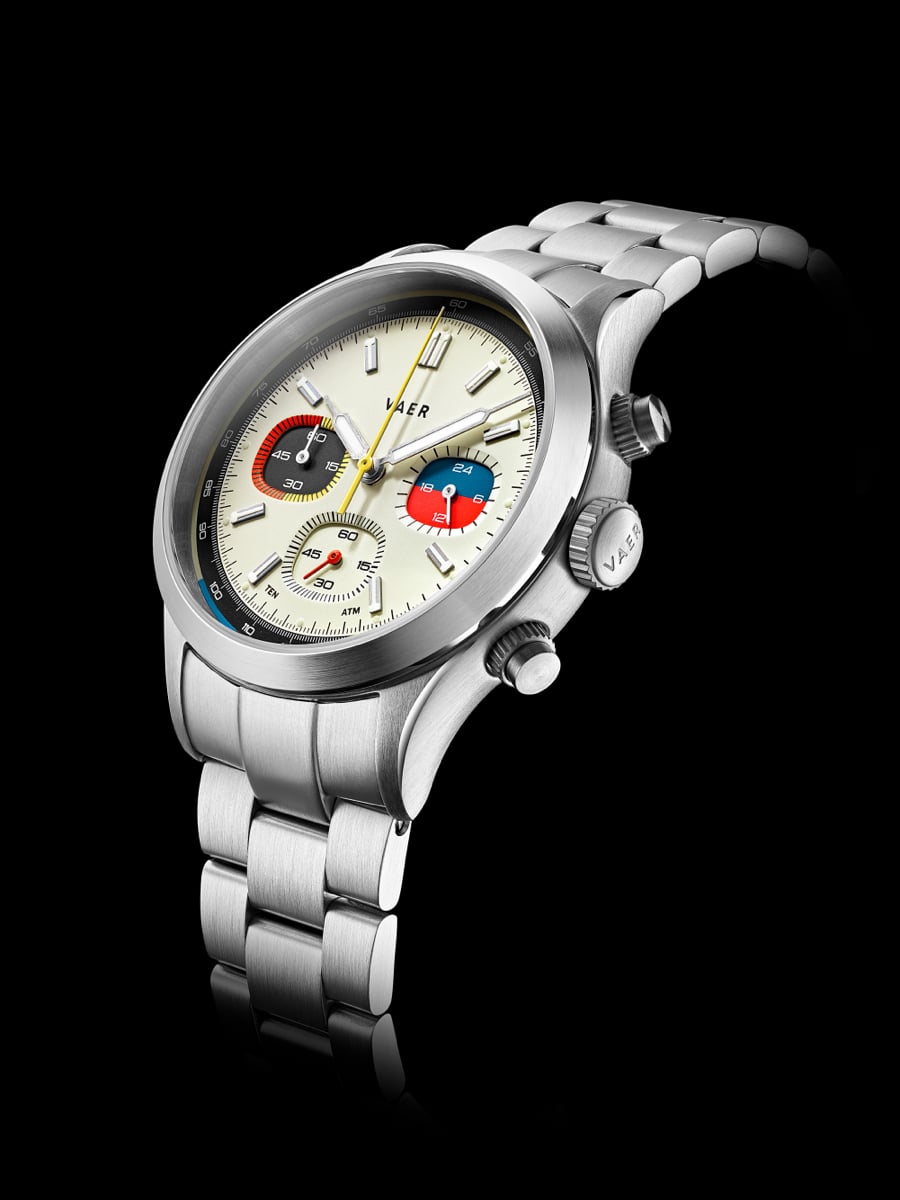 Retro Racing Character, Built for Everyday WearDrawing on the colorful racing chronographs of the 1960s and '70s, the RS1 Rally pairs vintage motorsport style with the durability expected from a Vaer. Its 40mm case houses a Japanese VK63 meca-quartz chronograph movement, complete with stopwatch functionality and an integrated tachymeter scale, while contrasting subdials give the watch its distinctive retro character. Sapphire crystal, 100 meters of water resistance, a screwdown crown, and strong BGW9 lume make it far more than a style piece. At under $300, it's an easy pick for the car enthusiast or chronograph fan.
 © Beartooth Media Group Inc.
 Loading...