Topic

I would like to make a cuben packraft

  • This topic is empty.
Viewing 25 posts - 1 through 25 (of 42 total)
Gregory Nelson BPL Member
PostedOct 31, 2012 at 12:24 pm

Has anyone made a Cuben fiber raft? I could use some assistance with cuben glues? Would double sided tape be sufficient for a packraft or would you need glue? If so what kind? I looked into valves and don't know if I would be better off with a Summit 2 or a Thermarest air mattress valve? Does anyone know where to get a pattern?

Luke Schmidt BPL Member
PostedOct 31, 2012 at 12:28 pm

I am no expert on cuben but here is what I know.

1. It is very tear resistant
2. It is much less resistant to punctures and abrasion damage.

For these reasons I would argue that a cuben packfraft would have limited utility while being very expensive and difficult to make.

Ben C BPL Member
PostedOct 31, 2012 at 1:52 pm

Interesting idea. The highest abrasion areas are on the bottom surface. You could pretty easily reinforce that with a higher abrasion material. It could result in a pretty lightweight raft/kayak.

PostedOct 31, 2012 at 2:40 pm

I have to agree with Luke. When inflatable rafts fail, they don't burst, they get punctured. Cuben has high tensile strength, but lower puncture resistance than the materials already in use for packrafts. Cuben not only gets punctured easily, but it also develops pinholes from flexion. Further, because cuben has no stretch, you would need a very large number of panels ("gores") of very precise dimensions in order to produce a raft with a smoothly curved surface when inflated. Bonding those pieces together would take months and you would need to do it over a sacrificial form (like a full-scale styrofoam model raft that you dissolve out from the inside with solvent once it is done). Heat sealable nylon is used for the lightest packrafts (the late Curtis rafts and the Flytepacker) because it has a bit of stretch (which gives the raft a smooth, round shape and aids in resisting puncture), it has decent abrasion resistance, and it is easy to make secure seams. Cuben is the wrong material for this job.

The 30D heat sealable fabric from Seattle Fabrics (http://www.seattlefabrics.com/nylons.html) is lighter than anything currently in use for commercial packrafts. There are also 20D heat sealable nylon fabrics now in use by some sleeping pad manufacturers, but it might not be easy to acquire a small amount of it.

If money is no object, you could also contact cubic tech to inquire about a custom run of cuben with urethane instead of PET film. That would increase the weight and erase much of the tensile strength-to-weight advantage of cuben, but it is the only way anything inflatable will ever successfully be made with cuben fiber.

Luke Schmidt BPL Member
PostedOct 31, 2012 at 2:58 pm

If building a cuben raft doesn't work here are some things you could do with cuben to minimize pack weight.

1. How about a cuben spray skirt? I think that would work and save a bit of weight.

2. Cuben Tarp, pack, and cuben sleeping bag (custom made)

These ideas would not be cheap but they could save a lot of weight and would be a much better investment then a cuben raft.

PostedOct 31, 2012 at 5:22 pm

All due respect to everyone here.

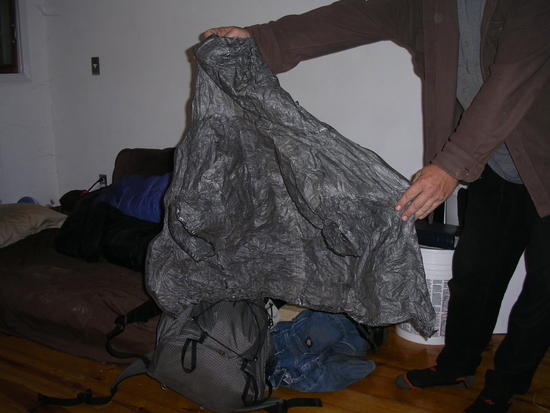
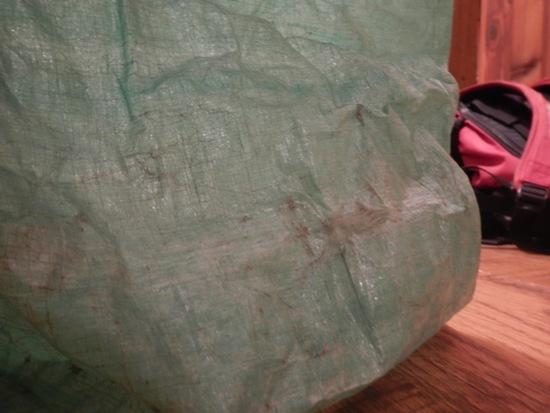
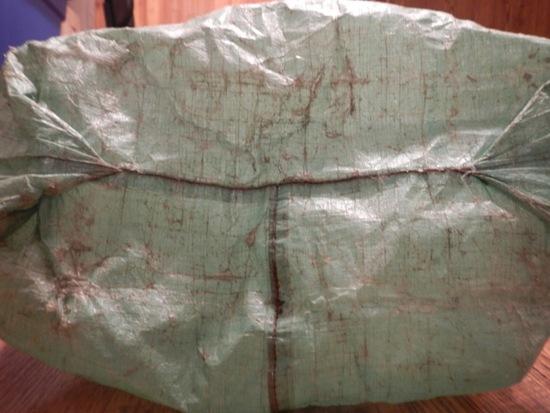
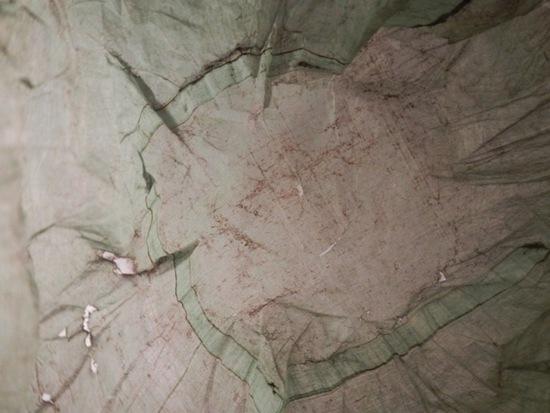
I present you with a black cuben Trail lite designs cloud cape i used as a ground sheet along the entire 2,180 mile Appalachian trail. I also packed and unpacked it into the grit filled bottom of my pack for 100 days.
Yes, i get that the AT does not have huge stickers and cacti but if you have ever been to Pennsylvania, New hampshire or Maine you will know there ain't no shortage of sharp rocks.
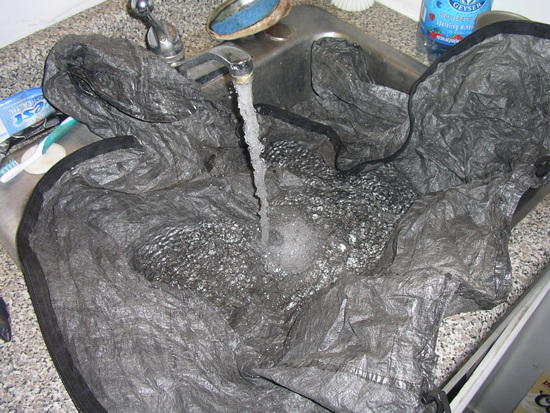
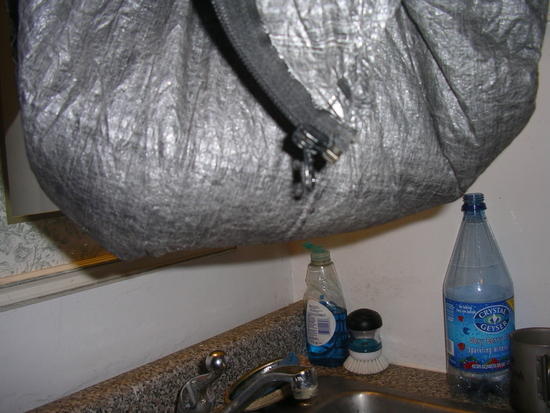
Below are pictures i just took this very minute of it's continued water proofness.
I don't see any holes or seperation or any defect what so ever.
Not even one drop of water escapes despite the obvious abrasion and continuous wrinkling.
The cloud cape was not as useful for rain gear as i expected so i found another use for it.. I stood on it in the dirt to change my socks and clothes each day.
I sat on it in the mud and on wet rocks to keep my bum dry as well.

This is the thicker cuben fiber at 1.26 oz per sq yard.
My cuben fiber patrol at .75 oz per square yard is also similarly water tight after the same time period but i did not use it as a ground sheet.

I am not saying you could make a raft out of this stuff.
But judging from my experience with actually using it in rough conditions i can say with certainty it is far tougher than is commonly thought.
Take this for whatever it is worth.

Here i give you actual physical proof of cuben fiber used on bare ground.
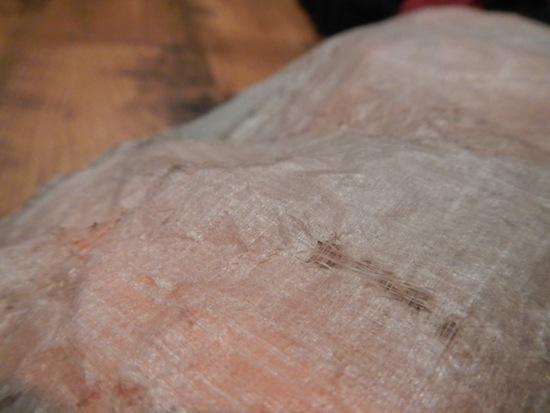
.1.26 oz/yard cuben after ground sheet use on the AT for 100 days
.Trail lite designs cloud cape of 1.26 cuben filling with water
.Not one single hole after 100 days used as a ground sheet on stone, soil, sticks, and leaves.
.
I honestly thought about making a cuben packraft myself.
Gregory, i hope you give it a try and it works.
I can't guarantee anything obviously, but in my opinion it could work provided the seams would hold.

BUT I AM NOT A RAFT BUILDER!

You might be on to something big here but before sinking a lot of cash into a full scale model, why not build a small scale ballon of cuben and sink it to the bottom of a pool to test your seams.
Heck, rub it with sand and try to make it fail.

Of course, you can also repair cuben with duct tape unlike silicone and urethane coated nylon.

As for "pinholes under flexion".. i really have no idea where that comes from. I have two pieces of cuben gear and both have been stuffed, crammed, stretched, and generally abused by me for an extended period of time and neither has a single pin hole.
Another advantage of cuben is that is absorbs no water weight.
Easy repair, no water weight penalty, extreme strength.. these are the exact qualities i want in my gear and why i thought about making a raft with the stuff.

I am not sure you would neccesarily save weight though if you use the heavier cuben so i concede that point.
That is a big unknown.

I tend to think the .75 version would be too weak for rafting but since i am a novice rafter and have zero experience building rafts i can't say anything meanigful yet on those points.

Like i said at first, all due respect.
My experience could be the exception and if so i apologize if i sound like i am debunking here.
I just have to call it like i have experienced it and here it is.. in living color.

This is all i can offer.

**Edited to add the last paragraphs and because i am a bad typist… speeling.. ugh!

PostedOct 31, 2012 at 9:47 pm

"As for "pinholes under flexion".. i really have no idea where that comes from."

Below is "where that comes from". These are some of the reports of measurements of cuben leakage through pinholes:

http://www.backpackinglight.com/cgi-bin/backpackinglight/forums/thread_display.html?forum_thread_id=45026

http://www.backpackinglight.com/cgi-bin/backpackinglight/forums/thread_display.html?forum_thread_id=44516

These are some of the discussions about the well-known propensity for well-used cuben to get pinholes:

http://www.backpackinglight.com/cgi-bin/backpackinglight/forums/thread_display.html?forum_thread_id=56307&startat=20

http://www.backpackinglight.com/cgi-bin/backpackinglight/forums/thread_display.html?forum_thread_id=37914

http://www.hammockforums.net/forum/archive/index.php/t-47942.html

http://www.backpackinglight.com/cgi-bin/backpackinglight/forums/thread_display.html?forum_thread_id=45333

http://www.backpackinglight.com/cgi-bin/backpackinglight/forums/thread_display.html?forum_thread_id=55794

http://www.backpackinglight.com/cgi-bin/backpackinglight/forums/thread_display.html?forum_thread_id=51435&startat=100

http://www.backpackinglight.com/cgi-bin/backpackinglight/forums/thread_display.html?forum_thread_id=40075

http://www.backpackinglight.com/cgi-bin/backpackinglight/forums/thread_display.html?forum_thread_id=57466

These observations suggest to me that flexion (not just abrasion and puncture) might be a contributor to pinholes in cuben:

1. Richard Nisley's micrographs show that the bond within the reinforcement layer of a cuben laminate is riddled with bubbles between the UHMWPE fibers. Over these bubbles, which are small but appear to account for a substantial fraction of the area of a piece of cuben, there is only thin layers of mylar with nothing but air (or some gas from the adhesive) in between. Anything that can cause tiny tears in both layers of mylar will cause a pinhole.

2. Mylar, and PET in general, is prone to flex fatigue. If you bend a piece of PET repeatedly, it turns white and breaks. Many other plastics don't do this (ie, polyolefins).

3. The pinholes in my 0.48 oz cuben flat tarp all lie on crease lines. Others have observed this as well.

Many people have reported pinholes and many others (like you, a b) have reported none. I'm glad your groundsheet held up so well. It seems clear that the 0.08 mil mylar styles are much more prone to leakage than the 0.18 mil mylar styles. Cuben is great for many things, and I'm very pleased with my cuben gear, but it seems obvious to me that it is a poor material for inflatables.

PostedOct 31, 2012 at 10:02 pm

Interesting Colin.

As to your comment "Not suitable for inflatables"

Upon which evidence cited do you make that particular assertion.?

Further, which particular cuben gear have you used (weight per cubic yard) and do you have any physical evidence(duration and type of wear) as i have shown?

In other words.. lets see it.

Gregory Nelson BPL Member
PostedOct 31, 2012 at 10:31 pm

I don't want to use the .51 oz. I was thinking the .75 oz or 1.43. I wish I could use the .51 but just by looks alone, it looks awfull thin. I just want to use it on mountain lakes. What I like is not having to sew and tape seams. I have never taped a seam but sounds like it might be a pain. I think I am going to build a tent and then try the left over pieces for testing. Thanks for imput.

PostedNov 1, 2012 at 9:28 am

a b, if someone told me they had a cuben groundsheet that had been trampled every night on sharp rocks for the entire length of the AT, and it was still waterproof, I would believe them without demanding photos. I don't need your photos to believe your assertions about your groundsheet. People seem to have very different experiences with cuben. Some people observe leaks in a tarp after only a few nights of use, and others find no leaks after several seasons of hard use.

You, on the other hand, are demanding proof that cuben can leak. Really? The reports of cuben leakage by others hasn't convinced you, but photos from me would?

Imagine that you provide 100 cuben tarps to 100 people to use for a year, and fifty of them later report leaks and fifty report no leaks. The fifty who experienced leaks assert that, given their experience, cuben can leak (there is a risk of leakage with cuben). The fifty who reported no leaks assert that it cannot leak (there is no risk of leakage with cuben). Who is right?

PostedNov 2, 2012 at 8:17 pm

@ Gregory, I just stuff the cuben without a stuff sack. It gets wrinkled a different way every time.

@ Colin, I will admit, I am trying to stir more conversation rather than re-hash the same old arguments.

Kinda like the Giardia thread, where old evidence keeps getting cited time and time again but nothing new is ever presented.

I am trying to keep it real by giving real experiences.

Anyways, why can't you and others post pictures of your leaking cuben?
I can show you how to post pictures if that is the problem, it's really easy on here.

You know my motivation for this "challenge"?
When i first heard about cuben fiber i was a skeptic. I read everything i could find online and singled out the information that supported my skeptical views.
I met other hikers on the PCT using cuben and shared my skeptical comments with them.
I watched them hike 2,654 miles using cuben and none of them told me anything about leaks nor did i see any.

Now i have used cuben for an extended hike myself and found all of the skeptical claims to be groundless.. at least in my case.. and everyone i have personally met that uses the stuff.

Well, i understand your skepticism.
I wont try to change your mind because i know, if you are like me, you will have to see it for yourself.

That is also why i am asking to see your leaking cuben gear.

Cheers Bro.

PostedNov 7, 2012 at 1:59 pm

My opinion:

This could be done, but you'd have to understand that it would be a very niche/special use gear item with likely a fairly limited lifespan if pushed outside that. Abrasion with rocks of any sort would quickly harm this raft, so you'd have to avoid all contact IMO. Even for just lake use, you'd want to be very careful when getting in/out of the raft so the floor isn't pinched between your foot and rocks. A vinyl raft gets holes pretty easily if this happens, and cuben likely pinholes easier than the vinyl used in Walmart rafts etc.

The other thing you need to avoid is torquing/twisting the cuben excessively. Cuben that is torqued a lot (ie. the top few inches of a roll top sack) will eventually delaminate/bubble after a while. This is likely only an issue if you're trying to pack it into an undersized stuff sack repeatedly.

To actually make one, I'd strongly advise using at least 1.2oz cuben, which has the double thick mylar layers. Bond all your seams in sheer rather than peel. Make a very long tube of a cuben – around 20 feet, and then cut that tube on angles to form the pieces of your walls. I'd go with 8 pieces likely (ie. quadrilateral + angled corners) but 4 would be okay – especially if tapered. Bond the tube pieces together, and then go over the seams again with an external one sided tape.

While this could be done and it would be a neat/geeky project, I encourage you to consider making it with 30D heat sealable nylon instead. I think it would hold up a lot better and it's not much heavier. Go with a heavier material for the floor than the tubes (like how Alpacka does). If I was trying to make a radically light packraft, I'd go 70D heat sealable nylon for the floor, 30D for the tubes and 1.2oz cuben for the spraydeck. The nylon-cuben hybrid stuff at ~2.9oz would be sweet too.

i am asking to see your leaking cuben gear."
I'll try to post some pics of worn out, leaky, delaminated, bubbling cuben tomorrow. I've got lots of items from .3oz to 1.5oz cuben. All of it is moderate-heavily used, so I'm not saying cuben isn't great. Just that it can pinhole or delam after moderate use.

"What I like is not having to sew and tape seams."
Keep in mind you don't need to sew heat sealable nylon either – just a household iron will do.

PostedNov 8, 2012 at 12:10 pm

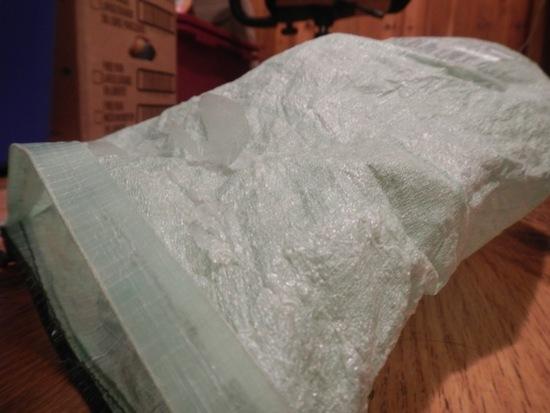
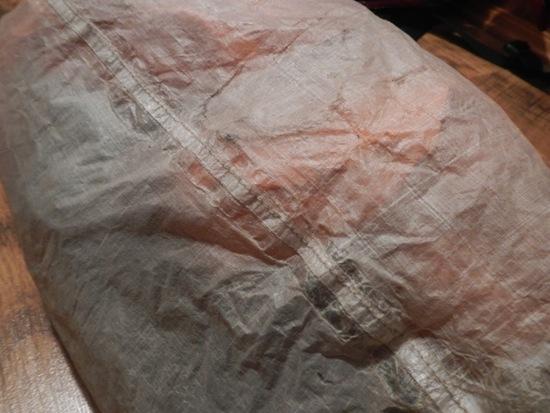
Here's some pictures as promised of "leaky" cuben.

All of this stuff has seen a lot of use, and the only item that I feel a bit let down by is the roll top dry sack. >1.2oz cuben might be up for the task, but the lighter weights of cuben delaminate pretty early on in a roll top application because of the twisting/torque. I've had two that have done this. I have a 1.2oz cuben Zpacks roll top dry bag now for my sleeping quilt, so we'll see if that holds up longer.

1) – Granite Gear 'Uberlight' Cuben drysack. I believe it's 0.51oz cuben. It delaminated/bubbled and then peeled in the top few inches near the roll top from the torque/twisting strain of it being rolled. I think I was using it pretty normally. This is maybe 50 days of use.

Uberlight Drysack

2) Zpacks Blast Food Bag – 1.5oz cuben. Used a lot for 3 seasons. Not babied at all, but not really used recklessly besides one marmot chewing incident which led to a coin sized hole (not shown). Damage shown is not from Marmot. While not really obvious, it leaks heavily.

Blast1

Blast 2

3) MYOG 0.7oz cuben 'ditties' bag. Used for 3 years and lots of life left, since I don't need it to be waterproof.
Ditties Cuben

4) This last one is actually pretty impressive. I bought this stuff sack on BPL Gear swap and the sellers said it was .33oz cuben. It looks more like .48oz to me, but either way it's lasted for 3 years now without getting any visible holes until this season. It's getting a bit worn now, but still up to the task of holding clothes for a long while yet. I hope to use it through 2013.

.33oz

.33oz 2

Randy Martin BPL Member
PostedNov 11, 2012 at 11:49 am

I think the abrasion from a raft would be far more likely to fail than abrasion from a ground sheet. More importantly, failure of a raft is much more significant consequence than failure of a section of groundsheet. A Raft is simply a bad application of a good material in my opinion

PostedNov 11, 2012 at 3:55 pm

A couple years ago, I tested a cuben (0.7oz) stuff sack by filling it with water during it's first season of use. I thought it would be waterproof because it looked fine, but actually had tons of pinholes and leaked readily. So in my experience cuben does leak long before it gets to the point of visible damage.

PostedNov 12, 2012 at 9:28 am

I admire your curiosity and determination, a b. I think your perspective on the feedback you've recieved seems right. Discussions like these can get tense when people disagree, but the result is often productive.

To be realistic, you haven't busted any myths yet, and you're not going to be able to commission Ron Bell (MLD) or Tim Marshall (Enlightened Equipment) to build a cuben raft. If you want to prove that it can be done, you'll need to do it yourself. And I'm not shooting you down. I actually think that we all could learn from it.

Richard Nisley BPL Member
PostedNov 12, 2012 at 3:39 pm

The US Air Force did a test to see if any of the existing Cuben (Mylar) materials would reliably hold air. Their application was portable recon drones. AB concluded Yes and they concluded No. We will soon know who is "All Wet".

Luke Schmidt BPL Member
PostedNov 12, 2012 at 4:40 pm

I don't want to shoot the idea down but here are some thoughts.

I really think it comes down to how much money you are willing to risk on a project that might or might not work out well. If you want a light packraft for flat water I'd suggest a feathercraft. On the other hand if you really want to try a cuben raft and are willing to pay for it go ahead. Here are some ideas.

1. Try making a nylon version first. There are several advantages to this
-You make any mistakes on cheaper material
-You can try the nylon raft out and make sure you are happy with the design
-You have an extra raft so you can invite a friend along.
2. I'm not sure I'd bother with hybrid cuben. My understanding is the outside absorbs some water which means the raft will be a lot heavier as soon as you get it wet. I doubt there would be any advantage to hybrid cuben over regular nylon.

PostedNov 12, 2012 at 5:36 pm

I was not aware of the feathercraft raft until Luke mentioned it. These are the specs of the lightest rafts from each of the current packraft manufacturers (according to the manufacturer's websites):

1. Supai Adventure Gear Canyon Flatwater 2: 1.5 lbs, $300
2. Flyweight Designs Flytepacker: 2.2 lbs, $300
3. Alpacka Scout: 3.2 lbs, $525
4. NRS packraft: 4.8 lbs, $525
5. Feathercraft Baylee 1: 6.5 lbs, $1200

Does anyone know of any other manufacturers making packrafts? All vinyl (non-fabric) boats (like the Sevylor Trail Boat) are omitted from this list. The venerable Curtis raft is excluded from this list because it is only available second-hand.

A 30D nylon packraft, although very fragile, could come tantalizingly close to the 1lb mark, I'd wager.

Edited to add a couple boats to the list.

Viewing 25 posts - 1 through 25 (of 42 total)
Loading...