Topic

Solar chargers?

  • This topic is empty.
Viewing 21 posts - 1 through 21 (of 21 total)
Kevin Burton BPL Member
PostedAug 23, 2012 at 11:59 am

I'm considering packing in a solar charger for my iphone.

Right now I pack a kindle and an iphone but the kindle is redundant if I can get a solar charger which weighs LESS than the kindle.

I would also be able to take an MUCH larger number of pics and videos this way which would be a big win.

Do you have a solar charger you would recommend? How has it performed for you in practice?

This would also work out well for my niece and I as we both can read on our phones.

Thanks!

Jim L BPL Member
PostedAug 23, 2012 at 12:32 pm

Kevin Burton said:

Right now I pack a kindle and an iphone but the kindle is redundant if I can get a solar charger which weighs LESS than the kindle.

I would add

AND reliably charges my iPhone in the time I have available under the clouds and tree cover I'm in, etc, etc.

Jim

Kevin Burton BPL Member
PostedAug 23, 2012 at 12:35 pm

This is the key issue. It has to actually WORK.

There are a number on the market that are apparently complete crap.

REI sells ones that DO NOT work.

They sold me one for $150 which was literally flat out defective.

I think for it to work it would have to:

– trickle charge my iphone during the day with the solar panel mounted to my pack

– charge a battery throughout the day which I could then attach to my iphone to get a near full charge every evening when I'm in camp.

Kevin Burton BPL Member
PostedAug 23, 2012 at 1:04 pm

> http://www.suntactics.com/USBSolarChargerMoreDetails.html

Ironically … that one weighs EXACTLY what my Kindle weighs :-P

so I wouldn't get any weight savings.

Though having infinite iphone battery would be nice and I could invest MORE into my smart phone since I have infinite power (more storage capacity , take more videos, photos, etc). It would also be lighter than carrying another camera.

Kevin Burton BPL Member
PostedAug 23, 2012 at 1:13 pm

Also, they're saying this can charge your phone in as little as 2 hours and weighs 200g.

I am usually exposed to sun for at LEAST 15 hours a day 6AM to 9PM so if I were to get ONE charge per day I would be fine with that. I suspect I could probably get away with a solar charger that was in the 25-50g range if I can keep it connected to my iphone all day by maybe routing the charger cable to the iphone if it were mounted to my shoulder strap.

I just need to find one!

Manfred BPL Member
PostedAug 23, 2012 at 1:32 pm

We have used the Powerfilm USB + AA charger for the last three years on our JMT through hikes. The last two years we used it only to supply us every day with charged AA batteries for our GPS, Canon Powershot cameras, Zebra Headlamp and SteriPen Classic. This year we used a SteriPen Freedom and we brought an iPod Touch to work in conjunction with the Delorme inReach (which we brought instead of the SPOT in order to have two way communication). The SteriPen Freedom and the iPod Touch were charged via USB. Despite all the rain this year and limited hours of sunshine we kept all our devices going for two weeks. In order to charge via USB it is necessary to have the AA batteries in the charger and they need to be at least partially charged. I mention it, so you don’t forget the two AA batteries in your weight calculation (4.95 oz for the charger + 1.8 oz for two Eneloop NiMH batteries)

Manfred

Robert Blean BPL Member
PostedAug 23, 2012 at 3:14 pm

I assume you have done the calculation and it is not lighter to just take one or more spare batteries? Spare batteries do not care about how much sunlight there is, and in many cases are the lighter choice.

Kevin Burton BPL Member
PostedAug 23, 2012 at 3:32 pm

I haven't yet … I would need to figure out how to get the batteries to recharge my phone.

I need to spend a day taking lots of videos and reading lots of pages to see how much battery % I use per day.

Then I can figure out the weight of the iphone battery packs to see if they make sense.

The nice thing about a solar charger is that in theory I can use TONS of power and just easily recharge.

… or I can pack in a little steam powered generator :-P

PostedAug 23, 2012 at 6:47 pm

I think you might be better off with a battery pack that doubles the life span.

Then depending on how long the trip is bring a lightweight wall charger and plug in to recharge both.

How long are you planning on being out at a time? Definitley try and go as minimal as you can…

Tom D. BPL Member
PostedAug 23, 2012 at 6:55 pm

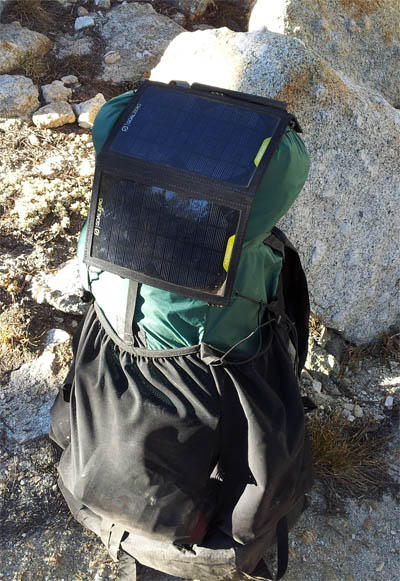
I used the Goal Zero Nomad 7 on my JMT thru-hike. It kept my smart phone charged even in overcast weather, but my battery still went nearly dead after 3 consecutive days of thunderstorms and I had to really go into power conservation mode. It charged nicely over the passes and above the treeline where direct sunlight was plentiful, but much of the JMT was forested other than that. Even in the mornings, I usually had up to an hour or so during which I could place it in the sunlight between trees and do some charging, but if you are an early riser you might not. I used the phone as my still camera, video camera, GPS, had 2 JMT guidebooks on it in Ebook form, and had I my Harrison maps scanned into it (I brought the hard copies as well). I also carried a small external battery for charging when the day was spent under the treeline.

The Nomad 7 weighs 13 oz, not exactly UL but does put out 7 watts which is more than most small solar panels and is somewhat weather resistant. Mine was rained on several times but it kept on working. I saw 2 others with them on their packs as well. In direct sunlight, it seems to charge as fast as the wall charger, with the rate dropping from there depending on the sunlight levels.

As Michael L said, you really have to determine if the weight is worth it to you. You have to take into consideration the distance between wall charging opportunities, what devices you are carrying, how much you use them, how shaded the trail is, and other factors. I feel it was worth it to me for the JMT, but other trails maybe not.

Nomad 7 Solar Charger

PostedAug 23, 2012 at 8:32 pm

If you are doing this already then please feel free to ignore this suggestion ;)

I take my phone along with me mostly for the Nook eReader app (my phone is lighter than my Nook). Rarely I use it for photos (I usually take a compact camera) or music (I prefer the sounds of nature), but I have watched a film on it once when backpacking when it was so cold I couldn't sleep! Anyway, since I'm almost always hiking where there is no cell service or wi-fi, and I don't use the GPS feature on the phone, I switch it to flight mode. That saves a massive amount of battery power… after spending around 3 hours reading, the battery on my Samsung Galaxy was still around 75% last time I went backpacking. If you read a lot, another thing that helps conserve the battery is to change the page to black and the text to white in the options… that way the screen only has to light up a small bit of white.

Having said that I'm interested in the solar chargers for my hubby, who likes to listen to music and watch TV on his phone when he's backpacking.

Kevin Burton BPL Member
PostedAug 23, 2012 at 9:38 pm

Thanks Dowser.

I've been thinking about it a lot today.

The external battery packs can give you about 12 days standby… so I'm not sure how much additional usage this would be.

I think I could probably get somewhat near 4-5 days with a secondary battery if I'm using the phone for photos, maps, books, music, etc.

I was ALSO thinking that if I can get much more storage that I could add videos. Not that I want to watch videos in the wilderness but educational material might be very productive. When away from civilization I can focus on just enlightenment.

A charger would be more weight BUT I can get much more usage out of my iphone while I'm out there.

You bring up a good point about being under trees. If I were to stay in camp longer I could charge quicker by keeping the solar panel in the shade.

Kevin Burton BPL Member
PostedAug 23, 2012 at 9:40 pm

> If you read a lot, another thing that helps conserve the battery is to change the page to black and the text to white in the options… that way the screen only has to light up a small bit of white.

I think any power savings you found here was placebo … unless you have an OLED phone (do they sell them yet?)

http://en.wikipedia.org/wiki/OLED

> Better power efficiency
> LCDs filter the light emitted from a backlight, allowing a small fraction of light through so they cannot show true black, while an inactive OLED element does not produce light or consume power.[55]

with the LCD in your phone there is one light behind it which puts out power whether you use it or not.

This is why when your phone is 100% black there is still light.

David Thomas BPL Member
PostedAug 23, 2012 at 9:56 pm

I'm really hesitant to open up my iPhone to exchange batteries, but for compact cameras, I learned long ago to look on eBay, find a Taiwan vendor of extra batteries, and order however many I need – 2, 4, 6 – whatever for $2 to $3 each. Unless you're thru hiking for 3 months, that's a cheaper and far lighter way to go. And you don't have to babysit a solar panel or change your schedule to keep it in the sun.

For my iPhone, I haven't found really cheap external batteries, but I have 4 that I use mostly for business travel at 33,000 feet that I sometimes bring on a hike or BP trip for extra capacity. Each one gives me about one full (10% back to 100%) charge. I can use and hike with the iPhone while it is charging.

But mostly, I turn the phone off unless I need the camera or GPS.

Robert Blean BPL Member
PostedAug 23, 2012 at 10:05 pm

I have been interested to see the things that people want to do out in the wilderness that are requiring more battery power — such as read books, listen to music, and watch videos.

Perhaps one alternative to more batteries or a solar charger is to stop and think about just what is driving that need, and how important each is (or is not) to you when out in the back country. Like a lot of UL planning — do you really need that?

Light — not much — as someone noted, with 12+ hours per day of sunlight, you won't be using your light a great deal

GPS — not much — if you navigate primarily with paper maps and (possibly) compass, turning the GPS on only as needed, then it should not consume a lot of battery power either. (You are already carrying the paper maps as backup for you electronic gadget, aren't you?)

Camera — the Big Pig — depending on how many pictures you take. I recall Tony Wong saying he took about 2,000 pictures on a 9-day trip around the Tahoe Rim Trail. That's about 220 pictures per day! He must have needed about 7-9 camera batteries (or recharges). I'll bet most of us do not take anywhere near that many pictures, though, and would not need over a battery per week. One in the camera and one spare would then be plenty.

PostedAug 23, 2012 at 10:43 pm

> If you read a lot, another thing that helps conserve the battery is to change the page to black and the text to white in the options… that way the screen only has to light up a small bit of white.

I think any power savings you found here was placebo … unless you have an OLED phone (do they sell them yet?)

http://en.wikipedia.org/wiki/OLED

> Better power efficiency
> LCDs filter the light emitted from a backlight, allowing a small fraction of light through so they cannot show true black, while an inactive OLED element does not produce light or consume power.[55]

with the LCD in your phone there is one light behind it which puts out power whether you use it or not.

This is why when your phone is 100% black there is still light.

Yep, my phone has a Super AMOLED display (Samsung Galaxy). Not sure about iPhones as I've never owned one… I think maybe they have IPS LCD displays? The battery savings made from switching the page/text colours are significant on my phone, but may not make any difference on yours if that is the case. Either way though, I find it much easier on the eyes, especially when reading at night in a dark tent :)

Tom D. BPL Member
PostedAug 23, 2012 at 10:44 pm

"Camera — the Big Pig — depending on how many pictures you take. I recall Tony Wong saying he took about 2,000 pictures on a 9-day trip around the Tahoe Rim Trail. That's about 220 pictures per day! He must have needed about 7-9 camera batteries (or recharges). I'll bet most of us do not take anywhere near that many pictures, though, and would not need over a battery per week. One in the camera and one spare would then be plenty."

Very good point about assessing usage. The camera was very important to me, and I have many memories of the hike to share with my family as a result. The GPS not so much, nor the guidebooks, and I could have done without them although they were nice to have's. I took just over 1400 still photos and shot roughly 2 hrs of video over my 21 days on the JMT. The longest stretch (and the only section that I struggled with battery power) was the 9 days after MTR, as I was able to recharge from outlets at 2-3 day intervals up until that point. Had I not encountered the thunderstorms, I would have had no trouble, but I did, and that's the limitation of solar chargers that can never be ruled out. In addition, I struggled with power even with a 5200 mAh external battery (I used the phone that much). Another lady had the smaller Goal Zero solar charger. She said that it was basically just maintaining her phone's charge, but not really bringing it up fast enough to allow her much luxury time with the phone.

The other option was to carry a separate camera, and I would like to eventually redo the trail with a real camera. Separate cameras and batteries mean weight also, so I had to take that into account as well. I initially justified the solar charger as my son was also bringing a digital camera that would need charging, a point that was rendered moot after he accidentally took it for a swim with him in Lyell Canyon on day 3. I just didn't want any worries about power, and for the most part accomplished it, using the phone for whatever pics, video, and GPS usage I wanted while keeping my base weight at just over 12 lbs. The only question was whether or not it was worth the additional 13 oz of weight. I still think so for this trip, but it might not be for other trips.

Robert Blean BPL Member
PostedAug 23, 2012 at 11:02 pm

> The only question was whether or not it was worth the additional 13 oz of weight.
> I still think so for this trip, but it might not be for other trips.

Those who take a lot fewer pictures than you did might decide that they can take a lot of spare batteries for less than 13 oz.

You bring up one thing I have wondered about — CIPA figures for digital camera battery life are often about 300 still photos. I have no idea how that translates to minutes of video. Do you have any thoughts about that?

Bob Gross BPL Member
PostedAug 23, 2012 at 11:23 pm

I had to look up my own camera's battery rating, 800 still shots or else 1 hour 20 minutes of video. That would last me just about forever on a backpacking trip until I would run into good wildlife to shoot. On my last trip, over five days, I shot only 245 stills, so I was still running on the first battery. Even if your battery holds up, shooting Full HD video really eats up memory cards. Fortunately, they are lightweight.

–B.G.–

Kevin Burton BPL Member
PostedAug 23, 2012 at 11:32 pm

Actually this might be a significant protip…

Switch to an Android phone for OLED … I bet the iPhone 5 will have one though!

Could significantly extend battery life.

Viewing 21 posts - 1 through 21 (of 21 total)
Loading...