Do yourself a huge favor and make a genuine prototype with real materials, assume you will mess up, because you almost certainly will. The prototype can be ugly and poorly sewn, or nice looking and fully functional, the important thing is that the straps and dimensions of body and pockets are what the final will have, so you can actually test it and make sure it does what you want.
My first attempt, for example, I followed the dimensions given I think on the thru-hiker ultralight pack, and that pack is absurdly and ridiculously huge, which was lesson one: make sure the volume fits your gear. I ended up ripping that pack apart and chalking it up to experience.
Straps are much harder than you think, when prototyping the pack, make sure you make it fully functional,and make sure the pack is tested on a 3 hour hike, minimum, to make sure the stuff works. You cannot judge certain things just by wearing it around the house. If the pack is noticeably illfitting on a test hike, you have to scratch the design, and figure out what went wrong.
Good and cheap prototype materials are: 200 or 210d oxford for pack body, 500d for pack back, bottom. Cheap 3/8" foam from outdoor store, sleeping pads, is good for doing prototypes of shoulder/hip straps.
I did my first failed pack, then I did a rough prototype, then I did my real pack,. realized the straps were wrong, did 6 strap prototypes on the prototype pack, until it seemed like it would work ok, then ripped the top of the real pack, and redid the shoulder straps. That pack is not perfect, but it worked fine on a 5 day trip that could have been 7 easily.
For front pocket, if you are thinking of using one, go deeper, I did mine 2" and that's not deep enough to carry big wet things, go 3-4" and you'll be happy. If using side pockets for water, make sure the pockets actually fit your water bottles, mine are a bit, just a touch, too tight to hold enough water, even with tall narrow bottles, these are things you just don't think of until it's far too late. Remember, the fabric weight difference between making the pockets big enough and roomy and a bit tight is negligible, and not even worth a second's thought, far better to have room. Last trip I had to carry extra water on the top y strap because the side pockets are just a bit too small, so close, yet so far, heh…
I also at the last minute added tubes for carbon fiber tubes along the two back seams, that was the best decision I made, my final version uses those, and a delrin rod to support the straps, and it carries up to 25 pounds pretty nicely, even if you don't use the tube channels, it's way easier to add them in early than after it's assembled.
I did a rolltop too, and while briefly flirting with the idea of using silnylon, thank heavens I came to my senses and used well coated 70d nylon, which is perfect for the job. What brought me to my senses was the idea of the sun beating down on my pack top and slowly dissolving my 30d silnylon, plus the way silnylon breaks down over time.
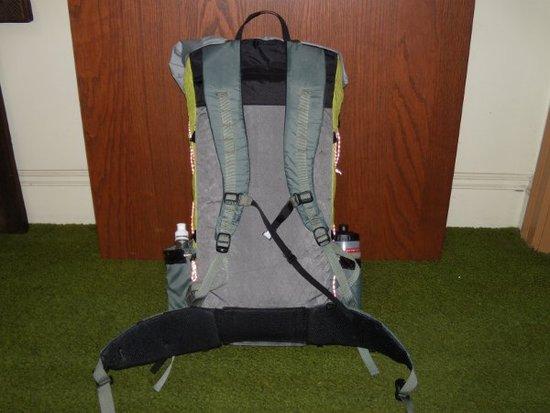
Here you can see the way the straps worked, those are still not totally right, will take a few more revisions on next packs to get them better.

pack in use, carrying starting weight of about 24 pounds, carried fine, 18.5 oz for pack.
making packs is hard, I read people here say that expect to make 4 or so before you have it right, I'd say that's right, this one is close to right, but has some glitches, though it's fully functional, it's fine for a week trip, which is better than I set out to do.
My conclusion is this: to make a pack, make a true, real, prototype, but using cheap materials. Make it so that everything works, a pack good enough to lend to someone for example, but not with all the small complicated stuff that takes a lot of time to do, but functionally the same. Then make the real pack. Do this for every major pack you try, until you really have it down.
I was personally glad to have read the advice that it takes about 4 packs to get it down, that helped me accept junking my first pack, which I'd done with weird fabrics that I am VERY glad I ended up not using, they sucked in my opinion, too light and too flimsy. But I was glad to learn that too, so it's not a loss to make something that doesn't work as long as you learn from it.
This pack is actually version 2.5, since I cut off the top of the back panel and replaced the entire assembly there, glad I did that too, turned out good.
Materials:
needles, univeral 14 worked fine, that pack is vx21 and vx07, with 200d pocket panels and strap backs. I used 12s for the 200d pocket assembly, the 70d top rolltop, and I think 14s for everything else.
1" hip belt/double sided adustable, that is a nice one. Check out both z-packs and zimmerbuilt for plastic stuff, the zimmerbuilt ladderlocks are way nicer than most other people's, he sources the stuff well.
I can't remember who has the 1/2" ladder locks, I used those too, either zpacks or maybe owfinc, one of those has them I think.
There's a big difference in webbing quality, make sure to get the medium grained stuff, the rough grained stuff I don't like, I find it starts slipping over time.
I used gutterman thread too, the tera stuff for any weight bearing seam, and the mara regular for non critical seams and areas. Remember, the gutterman you see at fabric stores is useless for backpacks, you need the heavier stuff, owfinc sells the mara, diygearsupply.com has the best current selection of good quality mara and tera, and sells it on the useful big rolls, which you want, since you will use a lot of thread on a pack.
Important things, if you have a real sewing machine, make sure it's lubed up well, the difference is stunning between a well oiled sewing machine and a dry one. If you have a plastic or nylon geared one, my condolences. I used a 25 dollar machine I got used that needed some parts replaced, nothing expensive, now it sews great, perfect, an old kenmore from the 70s. Doesn't sew silynlon well though, but sews backpack materials very well, it amazes me how many layers it goes through easily, I thought it would choke on 8 or 10 layers, but it worked fine at those points. Remember, layers add up: the shoulder strap lower connector, folded over, is 4 layers, plus the webbing at the edges, the place where it connect to the pack is those 5 layers plus 2 or more.
Don't be afraid to throw away dull needles, with a 10x jewelry magnifier you can actually see the tip of a sewing needle, and after a while you can see that it's dull, and you can also feel it as you sew.