


This thread was sparked by another thread I recently read.
Where does High Country begin ?
in my mind its around 10,000 ft.
but for others it seems to be as low as 7,000 ft.
Topic
Become a member to post in the forums.
This thread was sparked by another thread I recently read.
Where does High Country begin ?
in my mind its around 10,000 ft.
but for others it seems to be as low as 7,000 ft.
Who is asking?
It's a state of mind more than an altitude or climate zone. It implies getting above and away from it all.
I tell flatlanders I've been in the High Sierra when I've car camped in Cedar Grove (4500').
I tell my ranger buddies I've been in the High Sierra when I've been off trail to Volcanic Lakes (10,000+')
For BPL, I would say the High Sierra starts shortly after you leave the dayhiker zone, which can be 6,000' (Little Yosemite) or over 10,000' (Horseshoe Meadows). I say shortly after because it depends how fast one can get above and away from it all.
I kind of imagine 'high country' as the point where the forest turns to alpine or tundra.
Nathan – I like your answer, except what you are referring to I would probably call the " Far Country ".
For me it's at or above timberline, the alpine tundra zone.
Seriously? Not a single pot joke yet?
I call "High Country" anyplace that is at or above timberline. My favorite place to be!
Here in the Oregon Cascades, timberline is close to 6,000 feet. In the North Cascades of Washington it's a bit lower, nearer 5,000 feet. In the northern Colorado Rockies it's about 11,000 feet. In Wyoming's Wind Rivers it's about 10,500 feet. In the Rockies there's a low level timberline, which is the altitude below which there is not enough precipitation to support forest. Below that hat it's open country but not high country! We don't have that problem out here on the wet coast!
Of course the exposure of a given location has a lot to do with just where timberline is, which is why I stress the "about."
I consider 'High Country' to be the subalpine/alpine zone, which has the greatest observable change and variation in flora and soil composition relative to the high desert elevation (4,000-7,000') that makes up the majority of my state.

Saddle below S. Truchas Peak, Pecos Wilderness, ~12K'
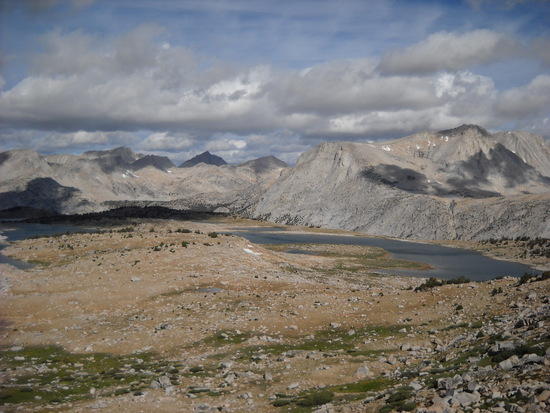
Roget Lake Pass 11,760 ft.(XC) Are you high? I know some have been higher.
Above treeline….
My favorite place
I understand it's quite a bit lower in the Appalachians and related ranges than it is in the Rockies, Sierras and Cascades.
I cut my backpacking teeth in the Whites (New Hampshire)
Though treeline is only ~4800' IIRC, it certainly felt like the high country up there.
Here's the famous Franconia Ridge

And here's the Knife Edge on Katahdin a bit further north.

(Old scanned in photos..but you get the idea!)
As with others, my own personal definition of 'high country' is roughly tree line.
Depends on where you are, I guess. We have towns over 10K in Colorado so numbers alone don't mean anything. I never use that term myself. I don't have any particular preference for being above or below tree line so maybe that's why.
In Australia our "alpine" area is referred to as the High Country. Given our highest mountain is 7310 feet it's pretty obvious it's not very high really. It's all a matter of perspective I suppose….
:-)

You should check out the coffee growing region in Colombia – great parks there with ranches grandfathered in that serve as hostels.
This is called Parque los Nevados and is in the central range of the Andes. You can definitely get to high country here!
The states with this park are Tolima, Risaralda and Quindio.
I forget which outdoors writer said it but the quote is something like;
"The number of hikers in inversely related to the cube of the distance from the trailhead and the square of the distance above it."
Moral of the story: To get away from crowds go to high country.
Become a member to post in the forums.
 How to Plan with Decision GatesKeep going, change your route, or turn back? Watch how decision gates help structure these choices in our YouTube video.
 © Beartooth Media Group Inc.
 Loading...