


What's your rule-of-thumb for number of iso-pro canisters for a trip?
1 oz.per person per day for just boiling water twice a day?
8 fl. oz net ( 12 oz gross bottle) per week on the trail per person?
Topic
Become a member to post in the forums.
What's your rule-of-thumb for number of iso-pro canisters for a trip?
1 oz.per person per day for just boiling water twice a day?
8 fl. oz net ( 12 oz gross bottle) per week on the trail per person?
Isopro fuel canisters are measured by weight — not by volume (such as fluid ounce you mentioned above).
A small canister (7oz. or 110g gross weight) can fire up a MSR PocketRocket stove AT FULL BLAST for approx. 42 minutes. Note that canister stoves have different maximum BTU's and fuel consumptions. Also, in real life, you will likely be operating your stove at some level below the max. — meaning that your fuel should last longer.
It takes 4-5 minutes to boil a pint of water. Hopefully, this will help in your estimation. But if in doubt, just experiment with your stove and a full can of fuel.
Finally, not that you asked, but REI sells a small Snow Peak Canister for $2.95 but the same size JetBoil fuel costs $4.00. The only difference is the brand.
An 8-oz (net) canister can boil approximately 16L of water. This is based on intelligent use of a windscreen, running at less than full blast, and of course lidding your pot.
If it's very cold, very windy all the time, or your windscreen is less effective, reduce this number by at least a quarter.
For extensive discussion of the calculation of this number, type "canister" into the Search BPL box at the top-right of your screen. The performance and fuel efficiency have been evaluated extensively for the various brands and configurations of canister stoves under varying conditions.
So if you boil 2 pints twice a day, that's 2L a day. Meaning that an 8 oz (net) canister will give you about 8 days of cooking, roughly. That assumes that you simply bring water to a boil and then shut the stove off instantly. (Actually if you just heat it until it almost-boils you will save a lot of fuel. When you can see bubbles on the bottom, it's hot enough.)
As with anything that you could be staking your life on, work in a safety margin. i.e. take 1 canister per 7 days rather than 8. Also, test your with your pot and your windscreen. Hike out to a cold stream when there's a mild breeze blowing, and find out how many litres of water *you* can boil. There's a bit of skill involved, too.
Finally, there are three stoves that are significantly more efficient: JetBoil, MSR Reactor, and Primus EtaPower. They weigh a lot more, though, so whether or not they will be an advantage depends on the size of your party and the length of your trip! (Chances are that the answer is NO, though…)
"An 8-oz (net) canister can boil approximately 16L of water. This is based on intelligent use of a windscreen, running at less than full blast, and of course lidding your pot.
If it's very cold, very windy all the time, or your windscreen is less effective, reduce this number by at least a quarter."
Accurate advice in my experience. Follow all four suggestions.
But use a reasonable safety margin if you have not calculated this for yourself. Only you can find what you use based on your cooking and camping style (How much water do you actually use? How efficiently do you cook?). Do it a few times and weigh your canisters.

I had the same questions, so I did some experimenting.
Stove for the test was a MSR Pocket Rocket. Canister was a 110g Jetboil.
At a BTU rate hot enough to bring 16oz. of water to a boil in 5:00-5:30min., (read- not full blast, 1 1/2 rotations of the fuel knob) my canister lasted 97 minutes. This was MUCH longer than I thought I would get.
An intersting side note. I left the fuel knob in exactly the same place for the entire test. The first 10-15 minutes, I had a blastin' flame and 4 min. boil times. After the first 15min. the flame settled down and I had constant boil times around 5:30min. the remainder of the canister's life. So don't use your fresh canister's boil time to judge fuel amounts needed for a long trip. You might come up short. Course you could always turn to wood fires if your canister runs out…
I always get at least 12 liters of boiling water per 3.53 oz (net) canister with my Jetboil. I plan on 2 liters per day per person, but typically really only boil about 1.5.
Like Brian says, you have to do the math to see if the fuel savings Jetboil provides makes it the lightest option for you. By my calculation, after adding for fuel, the MSR Pocket Rocket/Titanium kettle is 3 oz. lighter (19.3 vs. 22.0) for a two person weekend (2-3 day) trip, but 2 oz. heavier for a week long (5-6 day) trip.
I typically take a few more weekend trips than week long trips per year, but weight matters more to me on long trips, and I like the speed and ease of use of the Jetboil (especially in the rain), so it's my choice.
"By my calculation, after adding for fuel, the MSR Pocket Rocket/Titanium kettle is 3 oz. lighter (19.3 vs. 22.0) for a two person weekend (2-3 day) trip, but 2 oz. heavier for a week long (5-6 day) trip."
The rub is that you have to decide whether you are counting *maximum carry weight* or *average carry weight*. For maximum (=initial) weight, the Jetboil kicks butt. But for average weight, a standard canister stove is usually better.
This is because in that system, much more of the weight is fuel and so the system gets much lighter as the trip progresses.
Further, in my opinion the alcohol stove almost always eclipses the other options in a pure carry-weight comparison. This, again, is due to average carry weight. Your stove+windscreen+fuel container weigh almost nothing, and the bulk of the weight of the system (the fuel) is dropping drastically throughout your trip.
But I still use a canister. :)
YMMV!

I'd agree with Brian, right down the line and add 1 more idea: take a pint bottle of water to bed at night and use it for morning drink/cereal. If you start out at near body temperature and heat only until bubbles appear on the pot bottom, you'll save significant fuel. Also, when you stop for the day, if there are still a couple of hours of daylight left, put a pot of water out in the sun to warm up-same principle.
I became very interested in this topic sometime in 2005 and started logging all of my trips, the stove I used, the amount of water I boiled, and the total fuel used. I have a JetBoil, Brunton Optimus Crux, and various alcohol stoves. To summarize these findings, the following figures are grams of fuel per liter of water boiled:
JetBoil – 10.6
Brunton Crux – 15.8
Alcohol – 37.1
I used this data combined with a simulation of how much water I planned to boil each day on a hypothetical trip to do some analytics. I focused on Average Daily Weight since this seemed to me to be the most comprehensive measure of what you actually have to carry over the course of a trip.
Since the JB has an integrated pot, I added the weight of a SnowPeak Solo pot 4.4 oz for the alcohol stove and Crux. I added in the weight of a Platty lil nipper to balance out the carrying weight for the alcohol stove (compared to the empty canisters). If more than a 110g canister was need, I used the weight of a 220g canister. If more than 220g was needed, I used 220g + 110g.
The below graph illustrates the results of a simulation of boiling 2 liters per day:
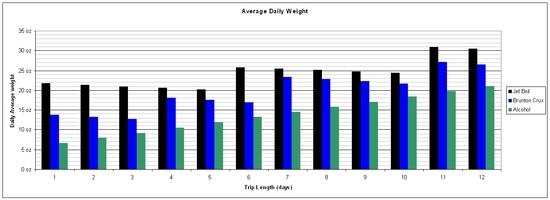
It's a pretty similar situation for other daily boiled amounts. Essentially, the Alcohol stove is always the lightest average per day. The JB and light canister stove both are similar on longer trips where the canister is almost totally used, but the JB is way heavier for shorter trips.
This contributed to my decision to use alcohol stoves almost exclusively for backpacking now. I use the JB when I picnic with friends and family….
Ben
Very interesting.
The new Caldera Cone design is reporting pints boiled on less than 20 grams. (=1/2 the fuel consumption you've reported here.)
I'd love to see the graph based on that number!
Average weight is an important number to consider, but for me the starting weight is also quite important. At the start of the trip the pack is the heaviest, with the most food (much more than the amount of fuel). Pack weight decreases each day due to food consumption much more than it does due to fuel consumption. And I am normally heading uphill on the first day. Getting that maximum weight down is important to me. Using maximum weight, your graph would look different.
Since I had all the data in xls already, it wasn't hard to create a max weight chart:
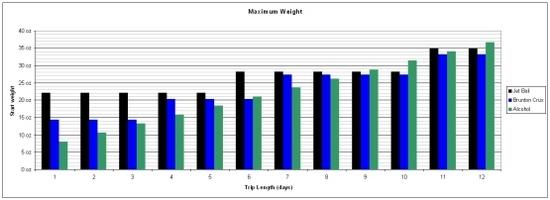
Indeed this illustrates that the alcohol stove can setup, under some circumstances, weigh more than a JB or light canister stove at the beginning of a trip. This is surely worth considering in trip planning….
Become a member to post in the forums.
 How to Plan with Decision GatesKeep going, change your route, or turn back? Watch how decision gates help structure these choices in our YouTube video.
 © Beartooth Media Group Inc.
 Loading...