


Which would you rather own based on performance and ease of set-up?
Topic
Become a member to post in the forums.
Which would you rather own based on performance and ease of set-up?
I don't own either, but i do own a number of tarps. I'm NOT very good at pitching a tarp – other than a simple lean-to pitch. Hence, my choice is the MLD Grace Tarp. I own tarps somewhat similar to the Grace tarp. I've seen many pics of different pitches for the Cave. Other than simpler modified lean-to pitches, most of them required a lot of guying to keep the big panels from drooping. Usually sticks were used so as not to set up conflicting tension in the panels, i.e. it wasn't advised to guy directly to the ground, but rather out straighter to branches or a second pair of trekking poles.
Keep in mind that this is second hand info which i've seen online in pics and reiviews/articles.
To me your two requirements are somewhat interrelated. If a shelter becomes too difficult to pitch either b/c of its design, or the terrain that you happen to be stuck with for a given bivouac, then performance suffers. In my case, i would anticipate that ease of setup equates to performance given the two tarps that you've specified. YMMV, esp. if you are more skilled at pitching tarps than I am.
The Grace Tarp would be my choice. Caternary cut tarps with a 'tapered-rectangle' shape are easier and quicker to pitch than beaked tarps. I'm big on being able to whip out my tarp and have it pitched within a minute or so, and I practice accordingly. Beaks add complexity and weight, and usually require two additional small tieouts at the ends of the beaks. A non-cat cut doesn't float my boat in windy weather either, unless I can tie out the middle of each side panel too. (I'm not positive, but I think the Cave is not cat cut.)
Something like the Cave might be better if one needed near-full coverage, ie- in nasty weather w/out a bivy. But even then, the less taut pitch and more complex setup turns me off of shaped tarps. I'm a fan of the bivy + small tarp combo, or larger cat tarps w/ enough length to close off the foot end. The latter option requires a tieout along the ridgeline approx 12-18" from the rear edge.
Definately the Cave.
It has more setups one can use, namely the ability to pitch one, two, or all sides to the ground depending on the conditions at hand. It has beaks one can pitch to the ground in cases of rain from all directions.
This tarp is unbreakable. I had it set up with one beak pitched to the ground, into a 45 knot wind and was out fishing in the Gulf when BOOM, suddenly a front blew in and completely reversed wind direction. The winds gusted at anywhere from 50-55 knots into the tarp pitched exactly opposite way it should now be pitched. It took me about 30 minutes to get back to the tarp to repitch, and there was no damage to the tarp whatsoever.
I'm also not sure of the advantage of a Cat tarp in windy weather. I think the curve will help one get a taut pitch, which helps immensely, but I don't think installing a curve in a soft material adds any to the intergrity of the structure. In fact, a curved seam is weaker than a straight seem, so I am betting that a flat set up, if as tightly pitched as a cat tarp, is actually stronger than a cat tarp.
The straight edges also provide more coverage when pitched directly to the ground.
Using bungee cords on the corners of a tarp to reduce wind load in high winds is also a bad idea.
The Cave 1 (or the ray-way kit version) provides good protection from rain blowing in the front or back of the tarp, which is a consideration if you are using a bug-bivy or net-tent or a simple groundsheet with no bivy. If you are using a water-resistant bivy, then this is less of a concern.
The Cave 1 is not that hard to pitch. Jardine made it more complicated than is necessary, but you can easily ignore the added complexity. In particular, the side lifters are unnecessary in my experience. They give more headroom towards the sides of the tarp, but I have never found a need for such headroom. Maybe two people in a Cave 2 who wanted to sit up and play cards might need such headroom. Personally, I'd just as soon lie down as soon as the tarp is pitched. Also, the beak stabilizers are unnecessary other than for reducing flapping noise, which is purely aesthetic. (BTW If you use the ray-way kit, take my advice and replace those superthin cords in the kit with some standard 2mm dacron. Those superthin cords are impossible to untie once knotted and you WILL eventually knot them by mistake in the field.)
Though I have never seen or used a Mountain Laurel designs tarp, the list of features is impressive. In particular, the main tieout (ridge-line tieout, I presume) is advertised as being bonded as well as sewn. I assume this means the ridge-line tieout reinforcement patch is glued to the tarp body with seam-sealer, thus reinforcing things there. This is a weak point in all tarps and so extra reinforcement is a very good idea there. I once ripped out the ridge-line tieout on an Integral Designs sil-shelter. The MLD tarp has a catenary cut, which is nice for getting a taut pitch in the afternoon. Unfortunately, this taut pitch won't last through the night if there is condensation, since silnylon stretches considerably when wet. But at least it will be taut for a while. The pole tip grommets sound like another nice touch. And many other nice features for less weight than the Cave 1. The MLD is slightly smaller than the Cave 1, but this is mostly in the foot end, where extra width isn't needed. Indeed, less width is better in the foot end, IMO, because it reduces footprient when the foot end is pitched low.
Bottom line: if you plan to use a water-resistant bivy, I'd say go with the MLD. If you plan to use just a groundsheet or a bug-bivy, I'd still go with the MLD but I'd first ask to have a back panel sewn in and put a triangular door at the front end. (That is, a triangle with tieouts on the 3 corners so as to attach to the tar in three place–namely the front corners, via carabiners, and the ridge-line tiout, via a knotted cord–thus providing partial protection from frontal direction wind blown rain while still allowing air flow around the sides of this triangle.) If you can't get MLD to modify their tarp or you can't modify it yourself, AND you will be using just a groundsheet or bugbivy, then use the Cave 1 since the MLD tarp provides no protection from wind-blown rain at the front and back.
Before buying a GoLite Cave 1 measure the actual length with and without the beaks. The last versions sold by GoLite were too short. Someone at GoLite told me that Jardine's original plans were lost when they changed manufacturer and then discontinued. Too bad, it was a great tarp.
I have a GoLite Cave 2 for solo use and love the extra room but those new MLD tarps look pretty tempting. MLD tarps are longer than most and that is a good thing.
Become a member to post in the forums.
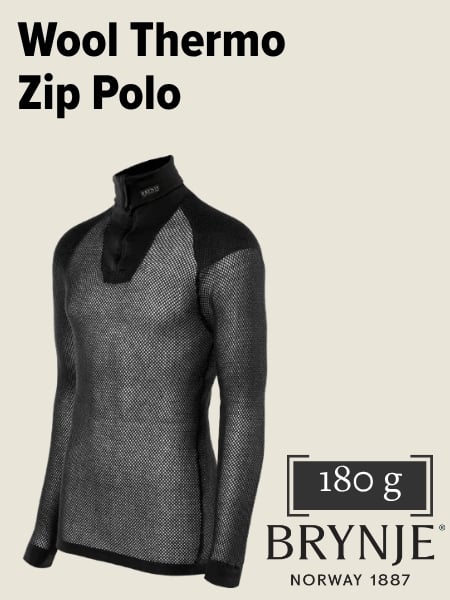 Wool Thermo Zip PoloMerino wool-blend mesh base layer with a 3/4 zip neck for venting and reinforced shoulders for pack-carrying comfort. Weighs 6.3oz | 180g
 © Beartooth Media Group Inc.
 Loading...