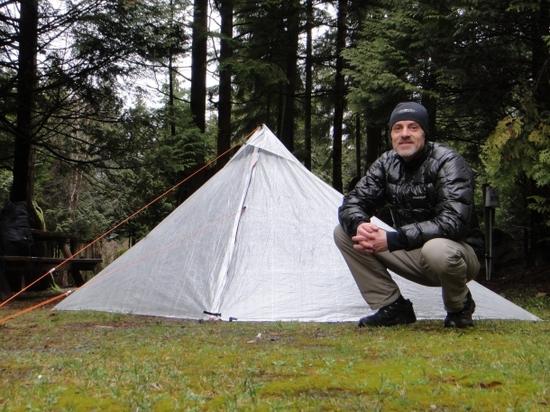
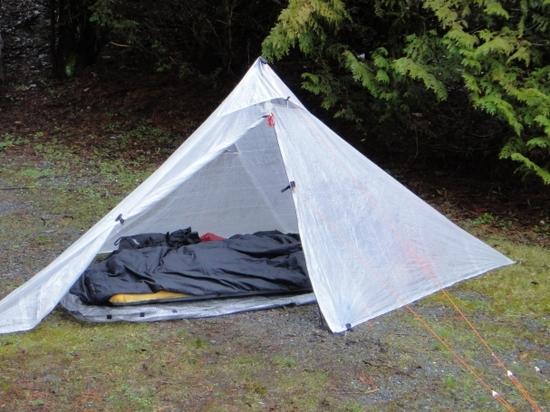
John Stultz at Bear Paw Wilderness Designs recently made a tent for me to my design I call the Diamond Solo. John did a great job of translating my ideas from paper, and even added a few construction details I wouldn't have thought of myself. I recently spend a wet night in the tent and it stood up well to a light steady rain with no leaks. The raked pole angle and guyed-out rear peak seem to work well, and provide lots of unencumbered space and plenty of head and shoulder room. There was room for my pack and bits of gear at the rear of the tent and room for my shoes inside the door. There is more than enough headroom for comfortable sitting and enough to kneel, which was one of my criteria for the tent. I am 5’-10” and the tent is very roomy for me for both lying down and sitting. The second peak creates enough extra space around the head and shoulders to make it easy to put on a jacket or shirt. The headroom at the peak is just under 47 inches. With most of the gear space at the rear of the tent, there is no need to climb over gear to get in and out.
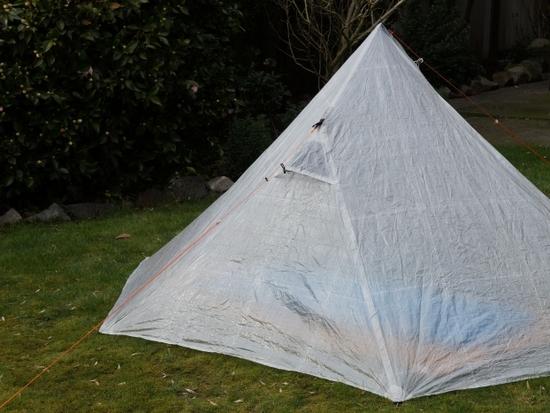
With five stakes and two guys, it takes a bit of practice to get a good set, but after a few attempts it looked almost as good as in John's own photos. The bit of extra effort setting it up pays off in an almost luxurious amount of space for the weight. I haven’t had an opportunity to test the tent in strong winds yet.
The basic tent in Cuben comes in at about 250 grams. With a single skinny Nanolite pole and Titanium stakes, the trail weight is about 370 grams (about 0.8 pounds). The tent is staked right to the ground, so unlike many tarp tents of similar weight, it provides full wind protection. It should also keep most bugs out. Ventilation is provided by two bug net vents with closeable beaks, one on each of the peaks, which creates cross-flow through the tent. In practice they seem to work quite well. There was a noticeable amount of air movement and I had no problem with condensation even though the temperature dipped to about 6 deg C (43 deg F). To save weight, the tent has no floor, and I used a custom designed Cuben groundsheet that doubles as a rain poncho. All in all, it turned out great and I am looking forward to using it on my next trek. Thanks John!