


…
Topic
Become a member to post in the forums.
…
Peter Pan, of Jacks ‘R’ Better did an article on this over at Hammock Forums a while back. His was a conservative estimate, but the basic math boiled down to the following:
Take the less-warmly rated bag rating (with your example: you have both a 55 and a 35 degree bags, take the 55 degree bag) and subtract that from 70 (so 70 – 55 = 15). Take the resulting number and divide by two (15 / 2 = 7.5). Then subtract that number from the better bag’s rating (35 – 7.5 = 27.5). That gives you the combined rating (so, about 27.5 F as a rating for the two of them).
It’s conservative, but if one of the bag’s loft is severely constricted by the other, this may not apply. It gives you a ballpark number otherwise, though…
Hope it helps!
Where does the 70 value come from?
70F is roughly the temp at which you need no insulation.
On first glance, it seems very conservative (you only get "half credit" for the second bag!). But thinking about how much a -20F or -40F bag weighs (and how thin a 40-50F bag is), yeah, you'd need to nest many of them EVEN IF you didn't compact any of them badly in the process.
People always say "wear a hat" and that's fine. But wear a balaclava instead – cover both your head AND your neck.
That is a lot of extra nylon to carry for sleeping bags.

And where does the divide by 2 come from?
Is this just another anecdotal rule?
If the two bags don't compress each other, then insulation just adds:
Take the rating of one bag and subtract it from 90 (your skin temperature when you're just barely comfortable). Subtract this from the other.
subtract 55 from 90 = 35. Subtract this from the other rating (35 – 35 = 0).
theoertically the combined rating would be 0 F.
But, when you start going much below freezing, then it get's more complicated, like your head will lose a lot of heat. And what about losing heat on the bottom. And, if the bags compress each other then it depends how much.
So, maybe the anecdotal rule isn't that bad, seems a little conservative though.
Jeff LaVista said: “Where does the 70 value come from?”
David’s right. Most folks don’t need insulation above 70 if they’re wearing clothes at all. It’s also where CLO values come from, if Wikipedia can be trusted. A CLO value of 1 is supposed to keep a normal person warm at 70 while resting.
David Thomas said: “On first glance, it seems very conservative (you only get “half credit” for the second bag!). But thinking about how much a -20F or -40F bag weighs (and how thin a 40-50F bag is), yeah, you’d need to nest many of them EVEN IF you didn’t compact any of them badly in the process.”
Yeah, it is conservative.
However, once you start getting below freezing, drafts (which a two-bag system, unless they’re designed to work together seamlessly, will have more of than a single-bag system) become a large portion of heat loss. And, let’s be honest, how often are folks going to need to nest bags above freezing? I wouldn’t expect it to be very often; a warm set of clothes can stretch most 40-degree bags to freezing. And that’s not even taking into account the compression of insulation.
more or less …. depends on youself and yr ground insulation as well of course
Haha, I've been working on this recently myself (wondering if I make a summer synth quilt how much I can push a 20F bag).
For me I can pretty much sit around naked in still air at 80F (ah, springtime in AZ). However with a slight breeze In only light short/pants and a tee I can pinpoint 78F perfectly (I'm fine, then at 77F I shiver). From numbers I've been researching I'm getting about 80-90F as skin/air temp and using that to calculate insulation factors. I'm also normalizing for my surface area. Also with a supposed clo of 1=70F I get 82.4F/28C as air temp where 0 clo is needed to maintain thermal regulation while sleeping (which sounds about right, around the 80F mark at night I need to throw off sheets at home and sleep on top of any insualtion).
For me, with a 55F bag I'm getting a clo of about 2.2 which is equivalent to ~2.75oz/sqyd weight of APEX. So my estimations are sounding a bit in line with manufacturers weights for synthetic bags.
Assuming clo is a linear relation between thermal resistance and comfort, though a lot of anecdotal evidence suggests that there are two relationships. One for above freezing and one for below freezing (ie things change below 32F) but no scientific evidence looks at sub-freezing temps and clo that I've noticed.
A 35F bag will have a clo around 3.8 based off my formula which is way off from the charts that Richard Nisley has posted and I have some faith in (I'm guessing his charts, based off EN standards, are more geared towards sub freezing temps though since 3.8clo would be around 4oz/sqyd APEX and in line with temp rating of Tim Marshall's Enlightened APEX quilts). That said, adding 2.2+3.8 gives me a clo of around 6 which would yield around 8F temp…call it 10F for conservatism.
Hmm, if we divide the clo in half for the weaker bag that gives us 1.1clo so a total of 4.9 which is roughly 20F on my spreadsheet. (I get 1 clo is equivalent 12F while sleeping, much more if moving around).
Ugh…I don't know. Take both and sleep in a walk-in freezer and find out! I really wish I had the time, money, and location to properly test all my spreadsheeting and refine some models.
EDIT: I should add that I've also come across studies in the elderly showing that just a 0.4C increase in skin temp of hands and feet dramatically increases deepness of sleep (ie you wake up less). So I would say gloves, booties, and for good measure a decent balaclava are probably the biggest factors for sleeping well in cold situations. Your metabolic rate is just so low that simply keeping torso/head warm probably doesn't work quite as well as when active and you're pumping heat.
Become a member to post in the forums.
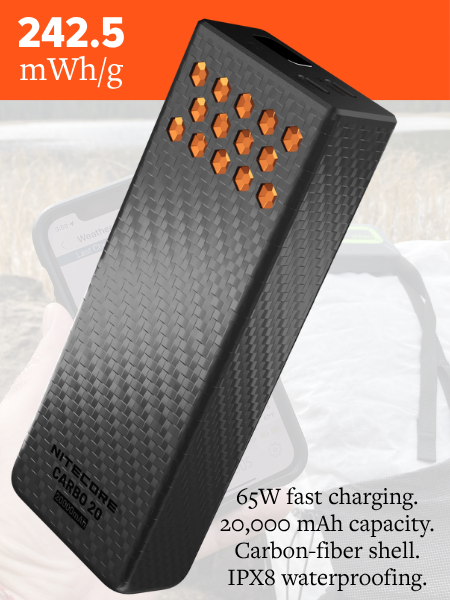 Carbon Fiber Power Bank20,000 mAh power bank with a lightweight carbon-fiber shell.
 © Beartooth Media Group Inc.
 Loading...