Topic

Glue instead of pins?

  • This topic is empty.
Viewing 17 posts - 1 through 17 (of 17 total)
PostedMar 9, 2012 at 11:19 pm

I've found many posts in this forum on glue/bonding instead of sewing, but was wondering if anyone but me uses glue instead of pins? I just stitched the ridgeline on my silnylon tarptent, using little dots of general purpose fabric glue instead of pinning, and it worked fantastic. Used the same technique with my m90 windshirt. It really makes these slippery fabrics nice to work with. Anyone have experience with this? (I'm particularly concerned with the bad ones!)

It's worked well so far!
PostedMar 9, 2012 at 11:29 pm

Only thing I would be worried about is the glue gumming up the needle. I used to tape my seams before sewing, but found it gummed it up too quick. I now just pin them perpendicular to the line I am sewing, and I can sew right over the top of them.

PostedMar 10, 2012 at 7:25 am

Glue is pretty commonly used by quilters, who have very exacting standards about where pieces need to be. There's no need for special fabric glue, regular washable glue works just fine, since the glue isn't structural, it's just for assembly. On the rare occasions that I need to do this, I use a glue stick. The last one I had was neat: it went on purple, and then dried clear, which makes it easier to see where you put the glue.

I wouldn't use glue on anything that isn't washable (or at least spot treatable.), though.

PostedMar 10, 2012 at 9:24 am

My sewing skills are poor, and I have trouble with light and slippery fabrics, and I have found water soluble glues and wash-away tape very helpful. A company called Dritz makes a water soluble tape (that is a bit expensive) that seems to wash away more readily than glues I've used and you don't have to wait for it to dry when you apply it. You can sew immediately and it doesn't gum up the needle.

Bill Fornshell BPL Member
PostedMar 10, 2012 at 11:00 am

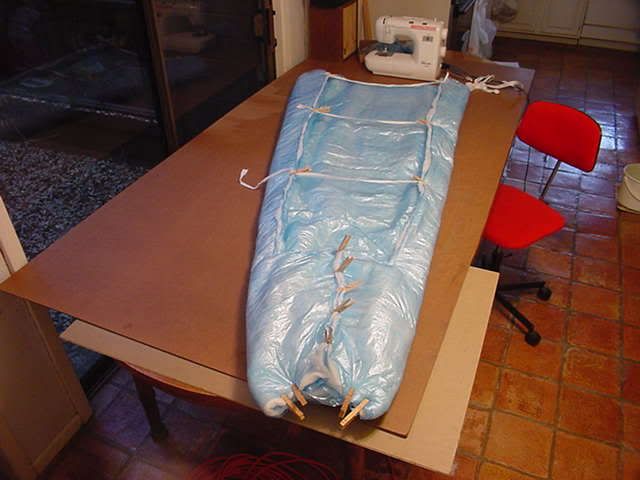
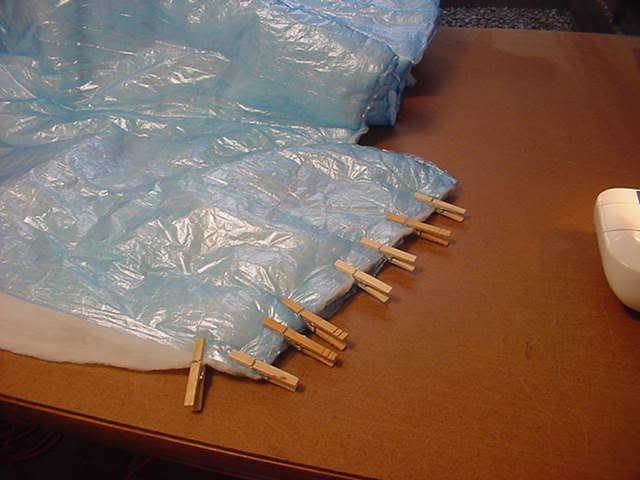
I started using cloths pins several years ago. They are faster to attach and remove then pins and for layers of shell material and insulation much easier.

1.

2.

PostedMar 10, 2012 at 11:20 am

That is an excellent idea, I'll utilize that when I start my apex quilt. Thanks!

Bob Gross BPL Member
PostedMar 10, 2012 at 11:46 am

Bill, it is good to see that you are still around.

(Bill is one of the senior statesmen of MYOG)

–B.G.–

PostedMar 10, 2012 at 4:49 pm

Ozzy,
Wondering what kind of glue you are using that quickly bonds the silnylon enough for sewing. I use sil glues for reinforcement patches, but they need at least 24 hours at around room temp to cure. No other glues I've seen bond silnylon. Ditto, tapes.

PostedMar 10, 2012 at 5:27 pm

I'm using Beacon Adhesives Fabri-Tac

http://www.amazon.com/Beacon-Fabri-Tac-Permanent-Adhesive-4-Ounce/dp/B00178MNFO/ref=sr_1_1?ie=UTF8&qid=1331428825&sr=8-1

Why? because when I went to joannes, it was the cheapest and it said "fast grab and quick dry" on it. However, after a few projects (inlcuding a sil tarptent) i am only about 1/10 through a 2oz bottle.

To clarify, I use this stuff just for sticking seams together before stitching, not for bonding a no-sew seam. It dries in seconds, and I haven't had any issues with gumming up needles. I use very small amounts.

Edit- atrocious grammar now slightly less atrocious.

PostedMar 11, 2012 at 8:21 am

Some commercial backpack companies use glue spots but I prefer long straight pins.
Glad to see you around Bill the Skunkworks of Cuben fabric used in ultra light weight backpacking, Before it became popular.
Terry

Bill Fornshell BPL Member
PostedMar 11, 2012 at 9:20 am

Hi Bob and Terry,

Thanks for the comments.

I got my first Cuben Fiber in 2003 and never looked back.

Before the cloths pins I also used long straight pins.

PostedMar 11, 2012 at 11:57 am

Bill, your site is the first MYOG type blog I found, and ultimately how I found BPL. Great stuff.

PostedMar 11, 2012 at 12:12 pm

I used double sided adhesive tape from Extremtixtil.de last time I made a backpack. I highly recommend it on trickier seams. Straight seams are best done by hand when you get some experience as it’s faster and you can adjust on the move. Just watch out for the usual errors, such as sewing a double layer (when some fabric not ment to be sewn, sneaks under the feeder).

Previous thread about flat felled seams

Jerry Adams BPL Member
PostedMar 11, 2012 at 12:17 pm

"Just watch out for the usual errors, such as sewing a double layer (when some fabric not ment to be sewn, sneaks under the feeder)."

I hate it when that happens

For some odd reason, I always get a good laugh right when I discover it, then a word that the profanity filter wouldn't allow : )

PostedMar 11, 2012 at 2:17 pm

Bill's clothespins ROCk !

people have been using rubber cement for decades to hold slippery things together while sewing. sometime it gums up (a little bit) the machine, sometimes not.

Go Bill !

PostedMar 12, 2012 at 5:54 pm

A thin silicone sealant such as Permatex flowable windshield sealant applied sparingly makes an effective glue on silnylon and you can sew through it in 10 minutes or so. With careful procedure it works on stuff sacks without sewing. And it's great for holding long seams in place for stitching.

Bill F. I second or third the plaudits. Keep on truckin'.

Viewing 17 posts - 1 through 17 (of 17 total)
Loading...