> Snow loading – you didn't mention what thickness of snow?
Jennifer mentioned 'All loading values were determined using the National Building Code of Canada'. This makes me think that the snow loading figures are for buildings, potentially with flat roofs. In which case, the loadings are likely to be massively more than can be expected with a tent, especially a dome tent where much of the snow will slide off; it's not a flat roof…
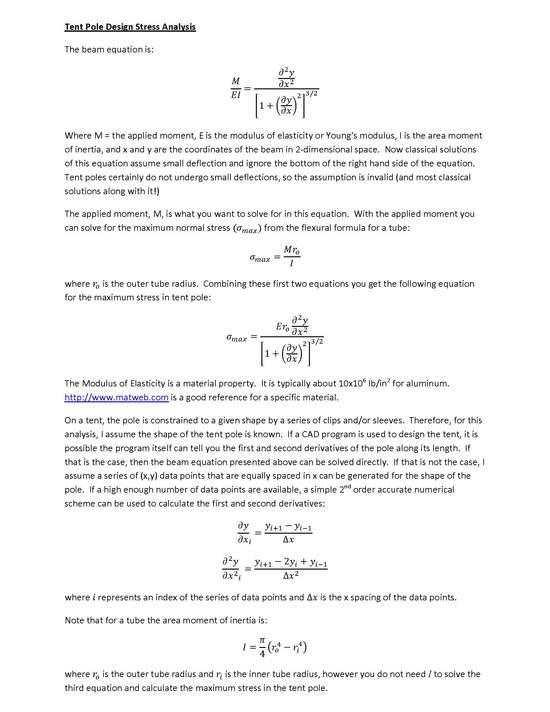
Bent poles don't form semi-circles. Unless you pre-bend them to that shape. Fabric loading compicates the shape even further.
I think we need to determine what level of analysis is required here; is it a college project which is intended to demonstrate some understanding of the basic analytic principles, or are we talking about a real-world product? If the former, we might be tempted to ignore the difficult bits (failures at fabric stress points, etc), and state our assumptions about wind and snow loading (no dynamics, or some simple factor to allow for estimated dynamics).
If a bent pole is subjected to a loading on one side, the entire pole is affected and needs to be analysed (action and reaction).
16mm diameter, 3mm thick 'poles' are very sturdy for a tent. Either it's an enormous tent, or these figures need to be re-addressed. I wouldn't like to try bending a 3mm wall thickness, 16mm diameter pole; it's certainly not a flexipole…
As an engineer, I'd like to think that we can design a tent using analytical methods, and know how strong it will be. But the reality is that almost all tent designs are done empirically, playing with pole configuration in some variable test fixture (e.g. a large wooden base board with lots of holes in to anchor pole ends), and draping/stretching fabric over the top to get the pattern, and then testing in the real world.