


Douglas-The Adventure Medical bivy has a therorectical TOG rating of about .8. It is not in the same class as the Blizzard/MPI.
Topic
Become a member to post in the forums.
Douglas-The Adventure Medical bivy has a therorectical TOG rating of about .8. It is not in the same class as the Blizzard/MPI.
Richard, Many thanks. I was hoping for some input from you. So, my initial suspicions about somewhere below 40F were corre ct. plain DUMB lucky, i guess. So, it's doubtful that the one is going to survive a typical Northern NA winter's night w/o suffering from hypothermia, at the very least.
Even with an El Nino year here in New England, we've been having single & low teens at night. All my hiking clothes+Cocoon+MBThermawrapPants+thatBlizzardThingy won't work anywhere near that low – for me, at least.
Hi Guys-
I've been carrying the MPI Xtreme Protech bag in my backcountry day ski pack for the past year. I've never had it out of the vacuum sealed brick package. But, some quick (albeit untested) calculations a year ago convinced me that it would let me survive an unintended night in a snow cave when used with the (substantial) insulated parka, balaclava, mitts, and boot liners I carry skiing. With a fire instead of a snow cave, it might even be downright toasty!?
Anyway, I was impressed with several features of the design:
Waterproof/windproof exterior should work well on snow.
Honeycomb construction traps dead air.
Perforated inner layer allows moisture to condense (and possibly freeze) on the inside of the outer layer rather than wick back into your clothing.
Montbell-style elastic bands cause it to conform to your shape, reducing interior air volume, bellows effect pumping, and convective heat losses.
All this is untested. As I've said, I've never broken the bag out of the brick. One of these days I'll have to do just that and see how it really performs. Still, IMO, the design looks to be a vast improvement over a single-layer mylar bag.
Maybe PJ and I could do simultaneous tests and see who's initial opinion gets twisted more in actual use… ;-)
Cheers,
-Mike
Michael, it sounds like you're saying that Richard's calculations are a bit off (~37.3F), or your ski parka is good to below freezing when you're inactive. What's a snow cave, 20F to 30F (at most or it's melting – just guessing here; never been in one).
I know adding, a Cocoon & Thermawrap pants to base+mid layers will only add +5 to +10 (MAX) for me. So, a 37.3F calculated rating for the FoilEnchilada won't take me below 27F. I'd save a lot on fuel oil heating my home if a winter's night only went down to 27F. So, below 27F, i'm maybe going to be in some stage of hypothermia or a PJ-cicle, come morning.
Hi Paul,
If you added Vapor Barrier Clothing to your base layer and mid layer clothing system, Cocoon, Thermawrap Pants, and Extreme Protech Bag, this may well get you down to about 20 degrees F and possibly lower, perhaps about 17 dgrees F. Of course, the Vapor Barrier Clothing would have to be the first clothing layer and under your base layer.
Rich
Now let me really confuse things. So far we have all been considering the one-person bag, appropriate if you are hiking alone. They also do a blanket which could be wrapped round two people. It is made of the same 8 Tog material but will presumably keep two people alive to a lower temperature in an emergency than the unknown minimum for one person. I'm guessing it will come out to about the same weight as the bag. If you normally hike in company this sounds a better bet. The blanket is also better for handling casualties. You can roll an injured person onto it then seal the blanket round them more easily than one person could get their sole companion into a bag.
You would effectively increase the TOG rating by up to 50% by having two people enclosed in the blanket.
Hi PJ-
A couple of notes:
1) 37.3 degrees is way more precision than I used. ;-) I figured things to the nearest 5 degrees and estimated the bag would be good to around 40 degrees when used alone — by my calcs, it's equivalent to around a 2" thick layer of Climashield HL or a single layer of 6 oz Primaloft One.
2) My parka is a RAB Quantum Endurance Neutrino which is much warmer than the insulation layers you mentioned.
3) Most of my skiing is in North Idaho, where nighttime temps are usually in the teens or higher (at least at lower elevations).
4) A properly constructed small volume snow cave, with an opening below the living quarters will hover right around freezing unless it is bitterly cold outside or the snow has previously been very cold. Note that this type of cave is built for survival, not comfort — you're in an upright semi-fetal position seated on your pack and/or vegetation.
5) If I'm expecting unusually cold conditions, I bring a candle which can dramatically warm up a snow cave.
6) Even if I'm injured and can't build a snow cave or fire, the bag could potentially buy me several hours of warmth — hopefullly enough time to get rescued.
I'm not suggesting that my kit is recommended for anybody but me. It's just my choice given the conditions, risks, and weight I'm willing to trade off.
Cheers,
-Mike
Understood. Thanks for the detailed reply & clarification. Sounds like you have a sound plan for survival.
In my case, i must avoid shivering as this can, and has in the past, actually reinjured ruptured, heavy scarred, muscle tissue in my upper back originally from an old power-lifting injury.
So, my plan is to stay warm by carrying more/heavier cold-weather bag, especially since i'm a cold sleeper.
Become a member to post in the forums.
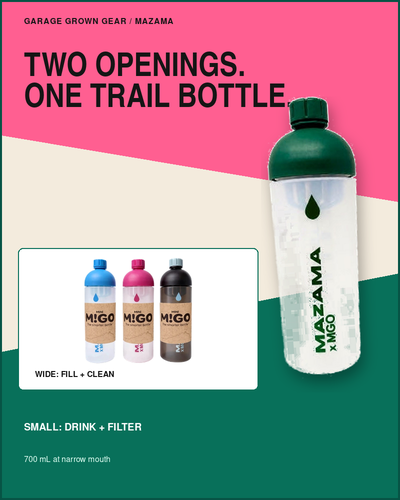 Mini M!GO Bottle700 mL reusable bottle with a dual-cap design.
 © Beartooth Media Group Inc.
 Loading...