


Looks like better LED's may be coming out soon including perhaps Cree.
http://www.nytimes.com/2012/02/21/science/engineers-take-aim-at-efficiency-barrier-in-led-technology.html?ref=science
Topic
Become a member to post in the forums.
Looks like better LED's may be coming out soon including perhaps Cree.
http://www.nytimes.com/2012/02/21/science/engineers-take-aim-at-efficiency-barrier-in-led-technology.html?ref=science
Wonder if LED will become a better alternative than CF? CF is energy efficient, but not environmentally friendly. What about LED's?
Slightly different topic… but I am still waiting for an LED like this to do double duty as UV water purifier:

Yeah I hope we get strong UV LEDS eventually. I like CFL's they've come a long way but don't dim well. So I switched many bulbs to newer halogens which are better than conventional and dim well. GE makes them and they have a slightly tricky warranty. Their cost is modest at least and the light is beautiful.And I just installed a new set of long tube t-8 fluorescents which are more efficient for starting seeds. So we are at least getting better.
I have no understanding whatsoever of electricity beyond basic undergrad physics, so I have a few questions.
Why do LEDs need to be run at high current for residential illumination? Why can't an array of LEDs be run at low current? I've seen LED streetlamps (on UC campuses, for example), LED domestic light bulb replacements, and LED automotive headlights. These all rely on an array of LEDs (sometimes dozens), not a single diode.
My zebralight headlamp has a Cree LED with very high efficiency, ostensibly. Cree sells LEDs with putative efficiencies above 70 lumens per watt, which is competitive with the best compact fluorescents and tenfold better than common incandescents. At the high setting, my zebralight produces over 200 lumens. A small array of these, run at low current, could easily produce far more light than any residential application would need.
I second the zebra light. Mine burns at 220Lm at brightest level but only lasts about an hour at that mode…
I think the reason they use high current in household applications is simply because the electrical supply is 10amps which is high. I think they would have to include a transformer to convert it to something else. Imagine trying to fit that in a light socket.
It's a very good question. When I was living in China we bought very cheap strings of LED Christmas lights. At 220 in China and even at 110 back in the US once a few burned out the whole string went out. In a way you are suggesting a return to the old Tensor style lights which used a step down transformer and used automotive DC bulbs. There may be such systems for kitchen under cabinet lighting already. As of now when you read the reviews of 110 LED bulbs at Amazon they all seem to be losers.

Voltage drop across an LED is small, like 1.5 Volts
Household voltage is 110 (or 220) – that's the mismatch
Step down transformers – how 20th century – inefficient
You can get cheap, dim LEDs, like flashlights or nightlights
You can get LEDs that screw into light sockets, but they're expensive.
You can fit the electronics into a light socket. Compact Flourescent bulbs have to be stepped up to 1000 Volts (or something like that) which requires some electronics.
Wait a couple years and there'll be cheap screw-in LED lights that are more efficient than flourescent, especially if the government encourages this. (Just trolling here : )
Become a member to post in the forums.
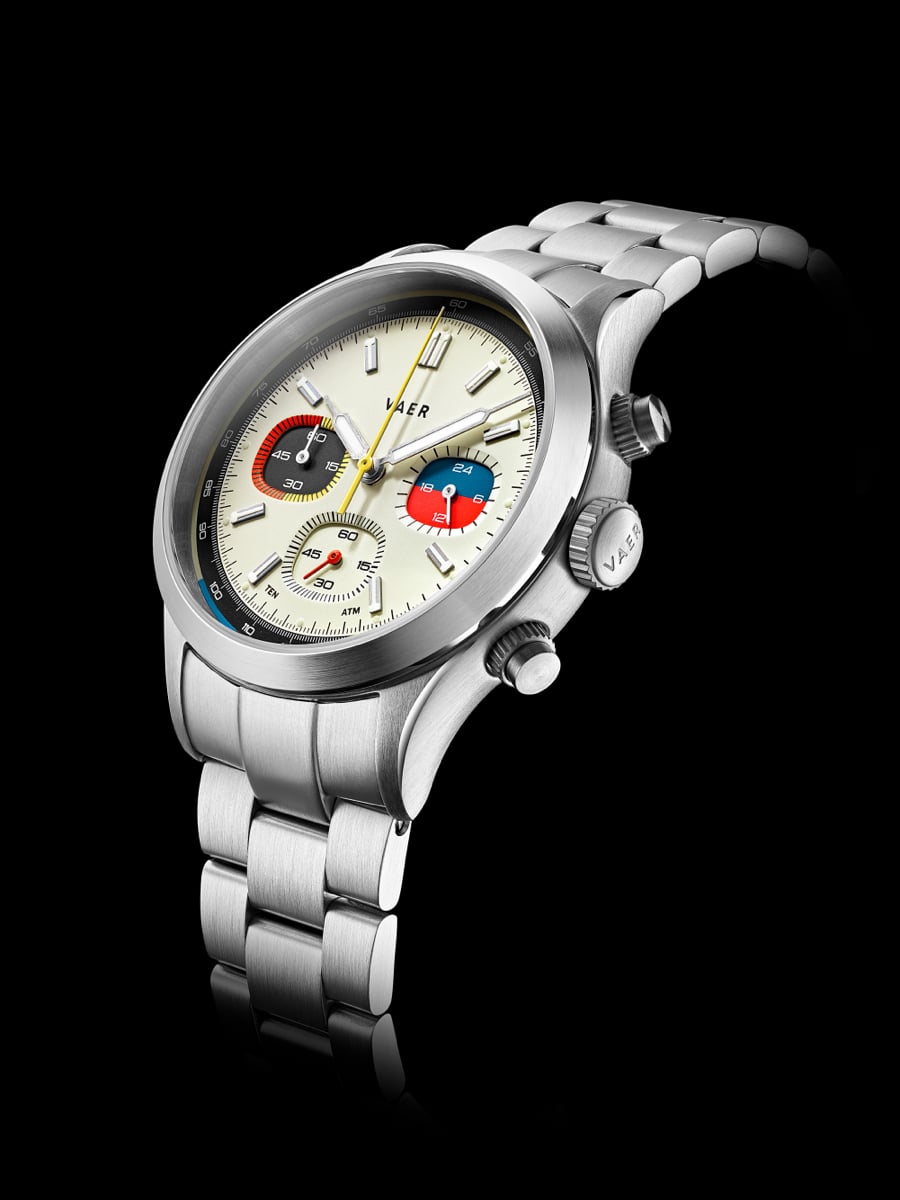 Retro Racing Character, Built for Everyday WearDrawing on the colorful racing chronographs of the 1960s and '70s, the RS1 Rally pairs vintage motorsport style with the durability expected from a Vaer. Its 40mm case houses a Japanese VK63 meca-quartz chronograph movement, complete with stopwatch functionality and an integrated tachymeter scale, while contrasting subdials give the watch its distinctive retro character. Sapphire crystal, 100 meters of water resistance, a screwdown crown, and strong BGW9 lume make it far more than a style piece. At under $300, it's an easy pick for the car enthusiast or chronograph fan.
 © Beartooth Media Group Inc.
 Loading...