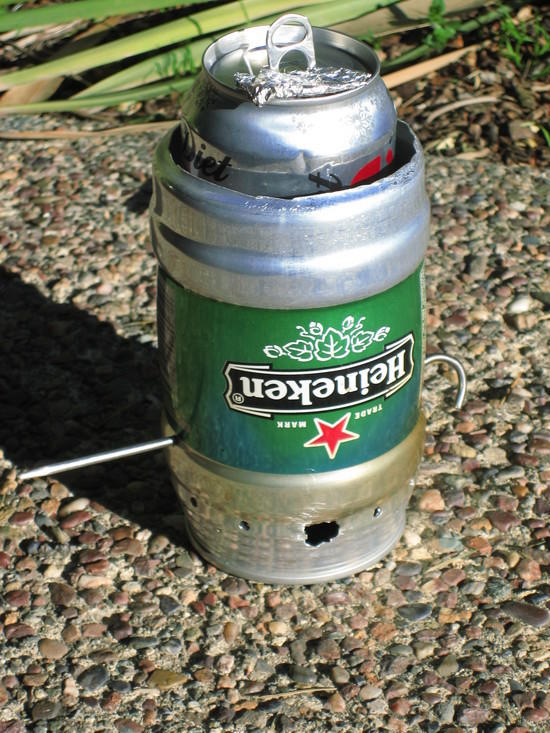
This stove/windscreen/pot design was motivated by frustration with the clumsiness of ultralight stoves that I’ve previously used. It has fewer parts to keep track of, sets up faster, works with alcohol or solid (Esbit) fuels, and weighs only 1.5 oz.
My previous set-up typically had a heat reflector/priming base (usually aluminum foil), a soda can alcohol stove, a slightly wobbly pot base made out of hardware cloth, a Heineken can pot for boiling water, an aluminum lid, and a windscreen fashioned from aluminum flashing and held closed with a paperclip.
Even a little wind or numbed fingers made operation of the stove difficult. Light aluminum parts always threatened to blow away. The stove would tend to blow out without the windscreen in place, but was hard to light when surrounded by the windscreen. The windscreen was hard to adjust precisely especially when hot from the stove. Cold fingers made manipulating all these components even more challenging.
This new design simplifies my life in the great outdoors. The windscreen is a Heineken can with the bottom cut out and turned upside down. (You need metal snips and some patience.) Holes drilled about an inch from the new bottom provide ventilation. A single large hole provides easy entry for a match.
The heat source is either alcohol (poured onto a small wad of fiberglass insulation thrown in the bottom of the windscreen-can) or an Esbit tab dropped in the bottom. No priming needed.
The pot for boiling water is a soda can (the usual 12 oz. size works fine for the solo backpacker; there are also 16 oz. cans available in the same diameter that work well for two). It fits down in the Heinekin can with just the right amount of clearance. The soda pop-top is left as a handle for raising and lowering the can. A small piece of aluminum foil covers the opening in the soda can while the water is heating.
The soda can pot is held above the flame by a single titanium stake borrowed from your tent or tarp, inserted through two small holes drilled about an inch and a half to two inches above the bottom of the Heineken windscreen.
That’s it. The total apparatus, less the stake, weighs only 1.5 oz. Since the soda can fits nicely in the Heineken can, the two are easy to store and transport.
In outdoor tests with air temperature in the mid-40s, 0.7 ounces of alcohol heated 12 oz. of water just short of boiling in about 7 minutes—not a great record, but adequate. With an Esbit tab, the water began to boil at 7 minutes. A spurt of water from the top of the pot doused the flame, leaving the remaining tab for later reuse. To my pleasant surprise, the Esbit fuel burned cleanly, with little odor, and left almost no residue in either the Heineken can or on the bottom of the soda can. I’ve never before been able to tolerate Esbit; now I’m a convert. Carrying two tabs of Esbit over a long weekend, you can enjoy two dinners and a hot beverage for only 2.5 oz.