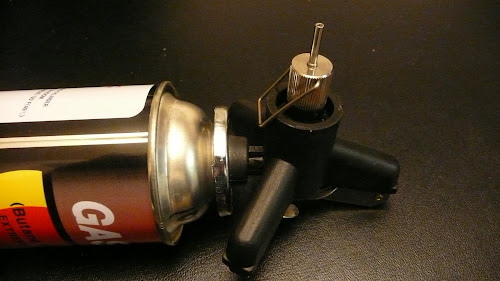
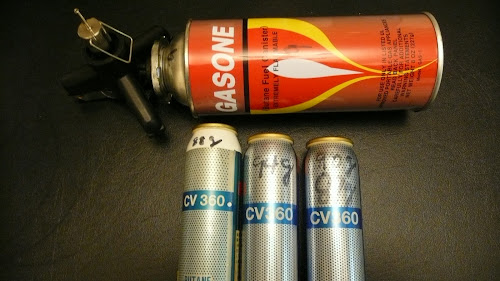
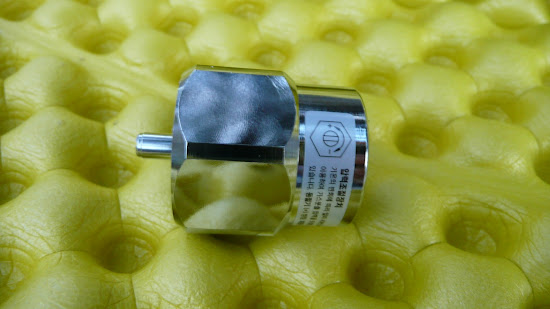
I have had a heap of old gas canisters hanging around, not quite enough gas in them for my trips and I can only use up so many when playing with my stoves. When I purchased my Kovea Spider I noticed on the same seller’s site this little device for connecting 2 screw thread canisters so I added it to the order.
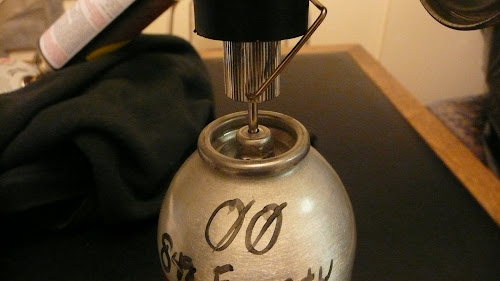
I have just tried out my new “Gas Saver” device and emptied 2 largely empty Elemental 230g canisters into another one and a 3rd into a small 110 gram canister.
While I do not recommend, or even suggest, anybody refill canisters themselves, I reserve my right to immolate myself at a time and in a manner of my own choosing.
I also solved the problem of stopping the canister from being overfilled. I remembered a solution to preventing a canister from over filling being suggested on bpl. That is to tip the canister being filled at an angle to the vertical to maintain an air gap between the top of the container and the lindal valve in the canister. The suggestion was that a 20% volume air gap was required. It was also stated that calculating this would be a nightmare.
I have derived the angle by experiment rather than calculation for the elemental 230g canisters. They seem to be identical in profile to KMart’s CampMaster 227g canisters and no doubt other brands as well – these are Australian brands but made in Korea like just about all of them. Please note that this angle is dependent on the profile of the canister. It is also dependent on the pressure in the two canisters being equal but this would normally be the case (unless you were filling with pure propane).
I knocked a second hole in an empty canister next to the valve. I filled the canister with water and weighed it – 633g. Subtract the canister 131g to get a volume of 502cc (1/2 a litre). We want an air gap of 20% or 100cc, so I poured out 100 grams of water. I then tipped the canister while aligning it with a protractor and read off 35 degrees just as water started to escape from the hole next to the valve.
Mark,
I too had noticed that G Works canister refiller. I like it. I think it should be pretty safe when refilling like to like. What I mean by “like to like” is that refilling, say, a 70/30 butane/propane canister from another 70/30 butane/canister should be pretty safe, so long as one is careful to not overfill — which with your angled refilling should never happen. I think that’s pretty good how you’ve worked out the angle. Of course I’d want to confirm by weight as well.
The one little thing that keeps tugging at the back of my mind is that a bit of water vapor might get inside the canister as one refills. That water vapor might cause some type of internal corrosion, corrosion that could not be seen from the outside. I haven’t ever had this happen, though, and in the several years now that I’ve been refilling canisters with cheap 100% butane, I’ve never had an issue of any kind. I do limit refills per canister to about a dozen. After 12 refills, it’s off to the recycle bin.
The advantage of course of the G Works adapter that you have shown is that one can refill with better mixes. With the refiller that I showed in the orginal post of this thread, one can only refill with 100% butane, a poor mix for colder weather. With the G works adapter, one can use a fresh 450g can of, say, 80/20 isobutane/propane to refill a 110g canister. The receiving canister should also have an 80/20 mix since the refilling is done in liquid form. An 80/20 isobutane/propane mix beats the heck out of 100% butane in colder weather although 100% butane is generally fine for temperatures above 50F/10C, and 100% butane is very, very cheap (at least here in Los Angeles it is).
HJ
Adventures In Stoving