Topic

Food intake for 20 hour days

  • This topic is empty.
Viewing 12 posts - 1 through 12 (of 12 total)
Aaron Sorensen BPL Member
PostedJan 19, 2007 at 10:31 pm

While discussing my pack-list for the JMT attempt at a different site, (sorry), everyone there is giving me a hard time about the amount of food I am bring, so I wanted to bring it up here.
Here is a link to the current pack-list posted here and some good pictures.

http://www.backpackinglight.com/cgi-bin/backpackinglight/process#forumtop

There has been a lot of talk about the 1.25 lbs per day of food so I wanted to expand it a little to discuss my food intake.

I am looking a taking 10 pounds of food for a 5 day trip? I am hoping to bump the calories I take up to about 18,000.
Although this may seam adequate for a normal hike, I will be on my feet for 20 hours a day.
My biggest gripe about this is that I am strongly leaning toward going with a starting pack weight of sub-15 lbs. So carrying less means getting to the end fast and needing less food.

If I am not able to make it in record time, I will re-supply at Reds Meadow or Tuolumne and finish the hike, (not really what I want obviously).

So is the sub-15 lb foolish?

I was tooling around with Romin Dials "How far how fast how heavy" calculator to find answers.

In order to carry 2.5 lbs of food per day and make it in 5 days, my pack would change to 17.5 lbs and I would have to make up about 1:15 each day. That would be the extra time it would take to make up for 2.5 miles each day for the 2 1/2 pound weight penalty.

Just changing the food weight to 2.5 lbs a day without making up any time would put me a 5.5 days, (not a record). What doesn't seem like much of a change can make or brake the attempt. Then again, so can not having enough food…
Richard Nisley BPL Member
PostedJan 19, 2007 at 11:29 pm

AAron-What is your BMR, VO2max, and %of VO2max that you anticipate averaging?

Aaron Sorensen BPL Member
PostedJan 20, 2007 at 9:37 am

Richard,
Lets see:

6'- tall
155 – lbs
34 – years old
58 – max VO2
% – What ever will get me down the trial at least 43 miles a day.
Resting heart rate is in the low 50's.

I plan to sleep 3 hours a day, except the last night and take how ever many 20 minute naps I need, (average probably 1-2 a night. Add in the breaks for getting water and fixing feet means, (in reality), about 19 hours on my feet each day, (awake and moving around for 20).

Food taken would be 10 lbs 4 oz with 18,000 calories.

Richard – I know what's coming next and if I say I want to use 65% of my max VO2, I can probably go close to 65 miles a day. This is why I put the mileage there instead of the percentage.
If I am able to do 43 miles, I am hoping you will be able to figure out what the % of VO2 would need to be for 19 hours of moving and then get the calorie intake needed from that.

Thanks for the help.

PostedJan 20, 2007 at 11:39 am

Don't take it personally, the forum users are just concerned that you will have enough to fuel you. For me I can see eating under 1.25 lbs a day, but more my worry is you don't have variety. But that is a HYOH thing ;-)
Food is one thing that as you eat it, your pack weighs less. Is a couple extra lbs at the start really going to slow you down that much? Just me, but I move the same speed when carrying 17-30 lbs. It's only over 30 I start slowing down. Maybe some trial runs of different weight packs in the next couple weeks/months and time yourself with a GPS?

PostedJan 20, 2007 at 7:34 pm

I'll second the concept of "variety". Packing out uneaten food is a huge waste. A poor meal plan consisting of food that you can't get down your throat without gagging is a very real threat. It does sound like an exciting adventure and I wish you well. I'll be on the JMT for three weeks in August. I don't know when you are going but if I leave before you then I'll listen for you as you blow past me in my sleep! Hike safe my friend.

PostedJan 20, 2007 at 10:33 pm

My most impressive race accomplishment is watching an entire “Ironman” on TV, but the book “Sports Nutrition for Endurance Athletes” seems to know what it is talking about, unlike me. ALTITUDE EFFECTS COULD BE OVERLOOKED. “If your stomach feels bloated and is not emptying properly, you may be dehydrated. If you vomit, start consuming a sports drink slowly afterward to rehydrate. It will empty from your stomach as quickly as water and provide needed carbohydrates and sodium…. As you adjust to altitude, your blood volume will return to normal after an initial drop designed to concentrate your red blood cells that carry oxygen in your blood. You will also develop more red blood cells if you stay longer at altitude, and your muscles will begin to extract more oxygen from your blood… You may require 4 – 8 quarts of fluid daily… Your basal metabolic rate can increase by as much as 40% the first few days at altitude and then drops off to about 15% above sea level values. Overall, your energy needs at altitude may increase by 200-300 calories daily. The real decrease in appetite that sets in at altitude may be a problem and it may be possible to under-eat by several hundred calories daily… Your body will utilize valuable protein…” P. 233

Aaron Sorensen BPL Member
PostedJan 21, 2007 at 4:25 pm

Richard:
4 lbs 10 oz
Would you also be able to figure out what the VO2 % would be for doing this??

As far as variety goes, If I like something, I can eat it how ever ofter you want to serve it to me.
The only thing that gags me is stuff I don't like.

PostedJan 23, 2007 at 10:30 am

Aaron, look into some protein drink/energy drinks, 'Pro Recovery' by MetRx, and the like. You'll be needing to replenish your water intake and by combining your fuel/food into this will make it easier to consume, and save you time. The only caveat with this is that you need to start drinking it frequently during your training phase, if nothing else to get used to the taste. I tend to dilute the products down about half recommended doses for my stomach.

I cycled quite a few long distance events, and this is pretty much inline with what you are attempting IMO.

PostedJan 24, 2007 at 1:16 pm

Aaron i don't know your dietary preferences but if you like coconut; coconut macaroons can take you over hill and dale and not get 'old' before they are gone from your pack. Calorie dense too.

Richard Nisley BPL Member
PostedFeb 1, 2007 at 3:39 pm

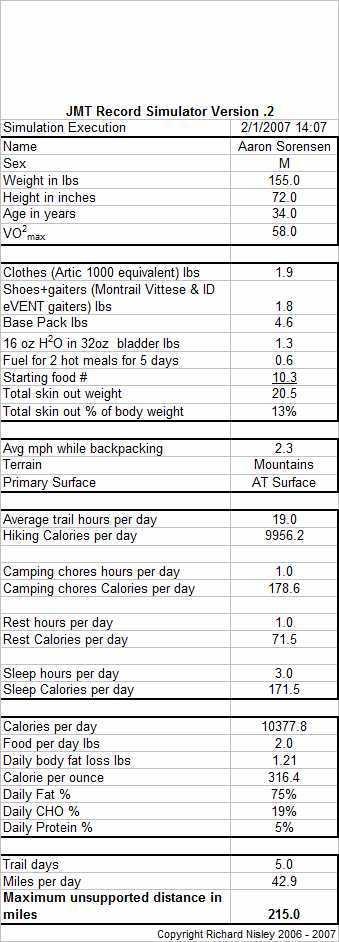
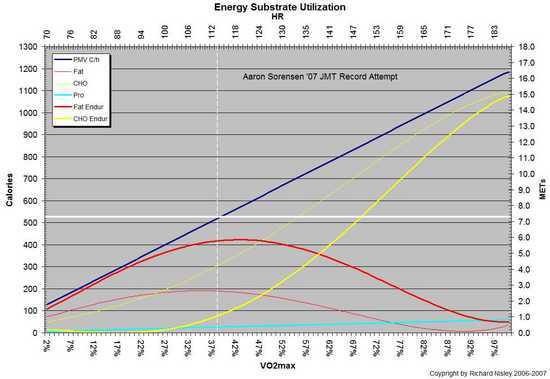
Aaron-Based on your physiology, your equipment, and your food weight, your moving JMT record attempt stats should be approximately as follows:

VO2max %= 37%
MHR % = 61%
HR = 113 bpm
METs = 7.3
C/hr = 518

In summary, your food weight and equipment plan is solid but, it is mandatory that you maintain CHO and protein energy balance continuously to achieve your goal. The recommended dietary fat allocation should create a deficit of 1.2 lbs of body weight per day without adverse consequences.

Your JMT attempt is similar to other multi-day, ultra-endurance races (e.g., Eco-Challenge, Iditasport, Southern Traverse) where participants compete over several days with little rest in varied environmental conditions. Race strategy typically motivates participants to continually exercise with very little sleep, likely resulting in large daily total energy expenditures. Roman’s related research addresses this class of event.

If you don’t maintain CHO and protein energy balance, the USMC Crucible studies indicate that your sustainable pace will drop by up to half or 3.5 METs. The Crucible is comprised of 20 hours of strenuous activity per day, 4 hours sleep per day, and restricted C resulting in an average sustainable MET of 3.5 with body weight losses of 3-4%. 3.227C in conventional food, plus unlimited CHO sports drinks are available to Crucible participants for the 2.25 days. Calories expended average 6,700 per day for 2.25 days or 15,075 total. Only 21% of the expended calories are consumed during the exercise. Average temperature is 51 – 57F. The USMC participants aren’t trained to maintain CHO and Pro energy balance. Even 3.5 METs is well above what is considered the upper limit of sustainable metabolic rate for the general (nonmilitary) population. The Marines in this study were able to maintain relatively high METS, even though their energy intake was only 24% of that required to remain in energy balance because of their conditioning. Hoyt et al. found the average of 4 METs during the initial 4 days of Marines training in a cold, mountainous environment when they stayed in energy balance.

I mentioned the USMC Crucible data, in part, to put your effort into the perspective. For 20 hours per day, you will be required to output approximately twice the amount of energy that an 18 year old USMC candidate does during their toughest test.

I wish you the best of luck in achieving the JMT record.

Table

Graph

Aaron Sorensen BPL Member
PostedFeb 2, 2007 at 8:35 pm

Oh Richard,
You're killin me.
Isn't it just a walk through 3 parks?

It looks like the different charts you have done show a higher level of activity, but for a shorter time.
The only thing I have to say about that is "The tortuous always wins".

75% of daily calloric intake to come from fat???
Most of what I've seen puts me at about 20% for % of fat intake.

As far as your comment about, (Your JMT attempt is similar to other multi-day, ultra-endurance races (e.g., Eco-Challenge, Iditasport, Southern Traverse).

I completed the hardest Adventure Race ever put on in the states last year, (Primal Quest), in Moab, UT.

We had problems with a team-mates "IT" band right from the start and put us in last place before we let him go. We went on to pass about 20 teams and finished the short course in 9 1/2 days, about 400+ miles.
We ended up getting 17.5 hours of sleep over 10.5 days.

This attempt will be harder from it being much harder to complete in time. 5 days on nothing but the feet will also take its toll a wee bit more than the multitude of events during the Adventure Race.

Hopefully I can get my VO2 Max up a little bit in the next 6 months to make it seem a little better, (on paper).

Gene:
I will have Hammer Jel Perpeteum in my water 100% of the time. I contains no simple sugars, only maltodextros. This works much better than drinking a sports drink containing sugar.
I hate coconut. It looks like I will be eating a lot more nuts and pringles though.

Viewing 12 posts - 1 through 12 (of 12 total)
Loading...