Topic

how bad REALLY are compression sacks for my puffy stuff??

  • This topic is empty.
Viewing 20 posts - 1 through 20 (of 20 total)
PostedJan 10, 2012 at 2:19 am

Not trying to raise hell or whatnot – but i have seen and read many people here and elsewhere using merely stuff sacks (or drybags) for their sleeping bags and puffy clothes when packing.
also the sacks i got with most of the stuff i bought (like WM bags or MLD XP quilt) are generous and pack the gear only lightly.

now i realize that crushing the gear ferociously will eventually kill it – but i REALLY NEED THE SPACE so i use compression sacks (lately the waterproof+event bottom type) or if i use drybags i basically sit on them and push as hard as i can before sealing to get the volume low.
Now assuming i DONT tear the baffles in the bags (since i am very careful when compressing and taking out) – how bad can this be? How many cycles will make a diff – since i assume many people here hike many more days than i do a year my previous thinking has been that this is irrelevant for me (same as washing sleeping bags -not relevant if i end up sleeping in them 5~10 nights a year)

Would love to hear thoughts/theory and especially practical evidence

Thanks
Mike

Mike M BPL Member
PostedJan 10, 2012 at 6:51 am

Tim Marshall (enlightened equipment) once answered the same question w/ that compressing down had little effect on it (we're not talking long term storage here, just stuffing into small sacks to save on volume)

when I used my Ion I was really pressed for volume, so both my down jacket and quilt were compressed quite a bit- never saw any degradation of performance

I never used compression sacks (mainly due to weight) but I can't imagine they would compress too much more than the small sacks I was using

I think syn is a different story, compressing can (will) shorten it's useful life

PostedJan 10, 2012 at 7:17 am

I think stuffing has more to do with destroying the feather content. Feathers give shape and don't compress very well – they aren't resilient like down clusters are.

Lower quality down has more feathers, so it's going to suffer when those feathers are more or less broken. High quality down is more impeded by feathers than helped, IMO.

Overstuffing can destroy down clusters, too, which IS an issue, but I think this is quite hard to do. I'll let someone else chime in on that issue.

Ben W. BPL Member
PostedJan 10, 2012 at 7:37 am

My understanding is that down can take more repeated compressing than synthetic insulation. I don't know what the tipping point is though. I'd say if you have to compress then do it. But given the opportunity, don't.

From REI: synthetics are Less durable than down, especially if repeatedly compressed.

http://www.rei.com/expertadvice/articles/insulated+outerwear.html

PostedJan 10, 2012 at 8:10 am

Mostly the reasoning behind not compressing your down or synthetic quilt,sleeping bag or clothes is because it take less than 30 minutes to almost 3 to 4 hours to reach maximum loft for maximum warmth. Depending on how much compression the clothing or quilt/ sleeping bag went through in your backpack.
If you unpack your gear and put in large cotton storage bags when not on your trip. You should get good use through out the use of that garment ,quilt or sleeping bag minimal degradation.

Also I have noticed most sleeping bags come from the manufacturer stuffed in stuff sacks and sometimes left that way by dealers for years. I have bought them on clearance sales noticed no sign of loss warmth.

Also the rule is kinda of dated IMHO because most of us gear junkies are buying, selling or making are old stuff so fast for the newest greatest equipment we will never see the degradation of insulation of our equipment.

Terry

PostedJan 10, 2012 at 8:19 am

western mountaineering a couple of years ago. he recommended that i use nothing too much smaller than the stuff sack provided and that i not use a compression sack. he expained that with high loft down if you really crank on it you won't damage it for short periods of time, but you might not get full loft once you take it out for a day or two.

i have pretty-much stopped using stuff sacks for my down gear all together. i just stuff my sleeping bag into the bottom of my pack. i find down gear takes up less pack space when it's allowed to fill all of the voids. the void-filling can't happen if the gear is constrained to the shape of a stuff sack.

repeated cycles of compression will ower the effective life span of synthetic fibers. over-compression will speed the process.

PostedJan 10, 2012 at 8:23 am

Maybe it's just packing philosophy, but I carry my down bag in an event sack at all times. As far as I'm concerned, if my down bag gets wet my primary source of warmth is negatively impacted, which can have very serious consequences. I'll take the weight penalty to know my bag is relatively safe from water.

PostedJan 10, 2012 at 9:20 am

None of my puffy layers, synthetic or down, ever get compressed. Like another poster, my down quilt goes in an over sized stuff sack at the bottom of the pack, and allowed to fill out any spaces.
I've noticed synthetic gear losing loft over a couple of years, but i depends on usage. My down gear is fine, even though some pieces are over 20 years old.
On another thread about washing down gear, i noticed folk were commenting on loss of loft, so washed their bag to restore it. Maybe it wasn't the dirt, but compression that caused the loss of loft? I've never washed any of my down sleeping gear (even the 20 year old bag), and haven't noticed much loss of loft.

PostedJan 10, 2012 at 9:27 am

obviously im talking only about when in the field – i store in large sack..

I have done this with down and synth (both continuous filament Climashield from Ron at MLD and short filament PL1 jackets) and to date havent seen any effect. It does seem that the down lofts faster after compression and thus i usually compress the syth a bit less these days


@richard
F – same as @Ben F i too am very cautious regarding getting my gear wet – so at a minimum will pack sleeping bag in dry bags – i have heard some of the people on the forum doing what you do – namely packing in bottom of rucksack but IMO that is a hit or miss with rain and if your pack falls into water. I realize its a small chance…but you could be in a real jam if it happens and some places (like scotland) can have torrential rain for days on end

It seems all you guys that chimed in have similar experience – you have been warned but havent seen it happen personally – I wonder if anyone has contrary experience, or maybe some of the MFG chime in.


@mike
moore – lets assume the life span is indeed affected somewhat and instead of lasting 400 cycles it will last only 300…but if i use a quit say 5~10 nights a year (cause i hike less and also have 4 sleeping bags) that might be more than my entire hiking career

M

Jerry Adams BPL Member
PostedJan 10, 2012 at 9:34 am

I think you're right, no good data on this

I hate doing things based on anecdotal evidence

It seems like my sleeping bag has lost loft over a number of years, probably 100 cycles of stuffing in my backpack loosely, but this isn't good data either.

Stephen Barber BPL Member
PostedJan 10, 2012 at 9:48 am

I have a couple of synthetic bags about 10 years old which have less than half their original loft.

I have a 30+ year old bag (North Face) which still has at least 3/4ths its original loft. It's never been washed. I've used it, all three of my kids have used it. It's been stored in the usual large cotton bag, and stuffed in the little stuff sack it came in innumerable times.

I've never used compression sacks, so I can't comment directly on that.

If anecdotal evidence is insufficient, perhaps someone should run some controlled tests on compression bags vs. stuff sacks?

PostedJan 10, 2012 at 9:58 am

I was in charge of logistics for an outdoor program where we used synthetic sleeping bags.
Compression didn't seem to have much effect, but what did, was having them dryed in
commercial dryers. They would shrink right up. Length, width, loft. One trip through
the dryer did far more damage than a years worth of constant field use, including stuffing
in compression sacks.

That said, the compression bags used were way oversized so that cold fingers could easily
stuff them. When compressed the sleeping bags were still were fairly loose in the compression bag so it could fill the space in the bottom of the pack.

James Marco BPL Member
PostedJan 10, 2012 at 10:02 am

Generally, it depends on the quality of the down.
Good 800fp down has a LOT of fine barbules. Each will exert some resistance to compression. They are VERY resiliant. close to a full fold is required to break a strand. I do not believe that you can compress a handfull of down to the point of damage by simply squeezing it. WIth a bag, it will apply a lot of total pressure against any compression before it will become permanently damaged. Even a compression sack with the leverage they apply will be close to bursting, before any permanent damage is done.

That said, it will take some time and work to shake them loose again. At camp, set up your tarp/tent and pad, set up your bag and shake it out. Then make your supper. Before sleeping, shake it out again.

Generally WM gives it's recommended compression size here:
http://www.westernmountaineering.com/index.cfm?section=products&page=Sleeping%20Bags&ContentId=27
These are conservative as befits a company with a lifetime guarantee.

For long term storage? Well, leave it loose. In the cotton bag, or, hung. Hung may be slightly better, but not enough to void a lifetime guarentee.

For cheaper down fillings and synthetics, I would be cautious about compressing the bag or article of clothing. Kinked feather stems, or fill fibers may result. There was already a good description posted. In fact, most of this was posted. Soo, more of a corroberation with a bit of documentation than anything.

Michael Ray BPL Member
PostedJan 10, 2012 at 11:10 am

I had found this post to reference for my recent paper.

Down isn’t an issue unless you REALLY crank down on it or clean it improperly.

PostedJan 10, 2012 at 12:15 pm

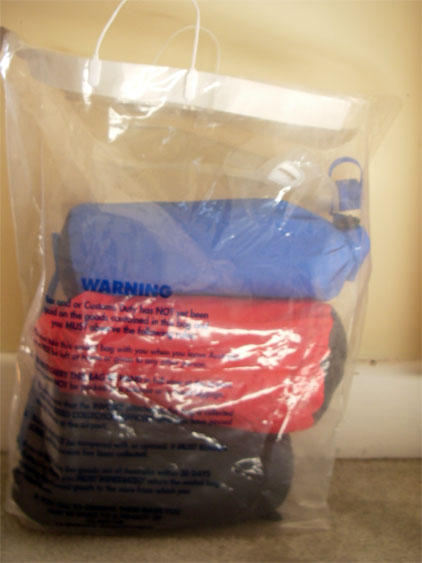
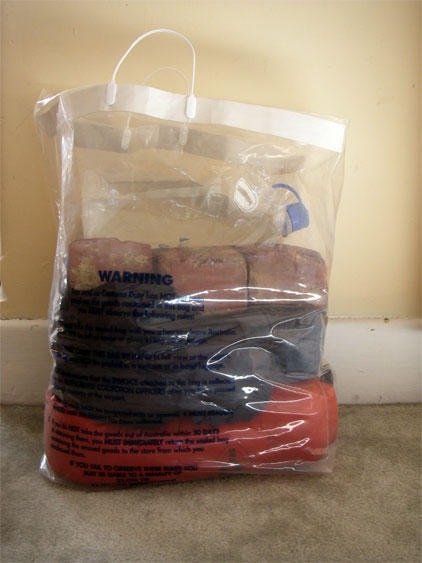
This is a comparison I made for a member of another forum to explain the 'bowling ball" effect.
Pack 1
pack 2
In the first shot my gear is stuffed inside three sacks. So the shape is determined by the sack itself. (plus 4 liters of water on top)
In the next one it is loose (the red bit is my sleeping bag) but compressed by the added three bricks (handy as dead man anchors on hard soil) .
The point here is that it may be better to let the weight of your food and maybe water compress your kit so that it uses up all of the available space.
Or use the backpack top compression strap.
(the shots are meant to exaggerate the effect…)
Franco

Travis L BPL Member
PostedJan 10, 2012 at 12:28 pm

I had a sneaking suspicion Franco carried bricks inside his pack.

PostedJan 10, 2012 at 2:17 pm

@franco – thats pretty cool demo :) i realize this could work better – but what are your thoughts re water protection? i am conservative in that respect so full bag liners seem not enough to me on wet trips..
Mike

Justin Baker BPL Member
PostedJan 10, 2012 at 2:32 pm

I don't use any kind of compression sack, unless it's going in a sled.
But… I am something with an aversion to neatness and organization.

PostedJan 10, 2012 at 2:40 pm

Michael
I mostly use Aarn packs, they have built in (rather thick) liners and have my delicate stuff (sleeping bag and puffy jacket) inside weather resistant sil bags that are larger than they need to be.
When I use the ULA Circuit I add a large white bag , similar to the tough trash bags.
Franco
(without the bricks I walk too fast. It embarrasses the younger ones)

Viewing 20 posts - 1 through 20 (of 20 total)
Loading...