Topic

Best UL groundsheet

Viewing 24 posts - 26 through 49 (of 49 total)
Nick Gatel BPL Member
PostedJan 6, 2012 at 12:05 pm

One other thing… I have a nylon ground sheet that I used for maybe twenty years. It is still in good shape. Heavy, but it lasts… does not end up in a landfill.

I have used Tyvek, I like it but it is a little heavy.

I bought several polycro groundsheets from Gossamer Gear because I was concerned about who well they would last. Well, the first one is still in excellent shape with a couple years of frequent use.

What I like about the zPacks poncho/ground sheet is that in weighs less than 4 oz and is multiple use. Rain gear and groundsheet. Hard to beat it.

PostedJan 6, 2012 at 12:28 pm

I've never had a problem with polycro. I only replaced my polycro because I couldn't find it…it was tiny enough to lose. I love that about it.

Since I have a Hexamid, I think a cuben fiber poncho would be even better since it's a dual purpose item.

Link . BPL Member
PostedJan 6, 2012 at 8:28 pm

I've never had a problem with polycryo being to fragile,I know people to thru hike using the same piece and continue to use it after.

Randy Martin BPL Member
PostedFeb 4, 2013 at 4:07 pm

I currently have polycryo and it mostly works fine. As for wind performance I think a few well placed rocks along the edges generally hold in place. I do admit to being intrigued by the multipurpose usefulness of the Groundsheet Poncho.

Bob Bankhead BPL Member
PostedFeb 4, 2013 at 8:34 pm

There is one important caveat with polycryo or any heat-shrink window covering: don't let the sun beat down on it as it will (as designed) shrink on you. See the Gossamer Gear website for their test results.

That said, slightly over-size your polycryo sheet from the get-go. Then, if (when) it does shrink, you're still protected.

When considering cuben groundsheets, remember that you can buy many,many polycryo, painters cloth, or even Tyvek sheets for what you'll pay for a single Cuben sheet.

It's your money. Spend it when you want to.

PostedFeb 4, 2013 at 11:20 pm

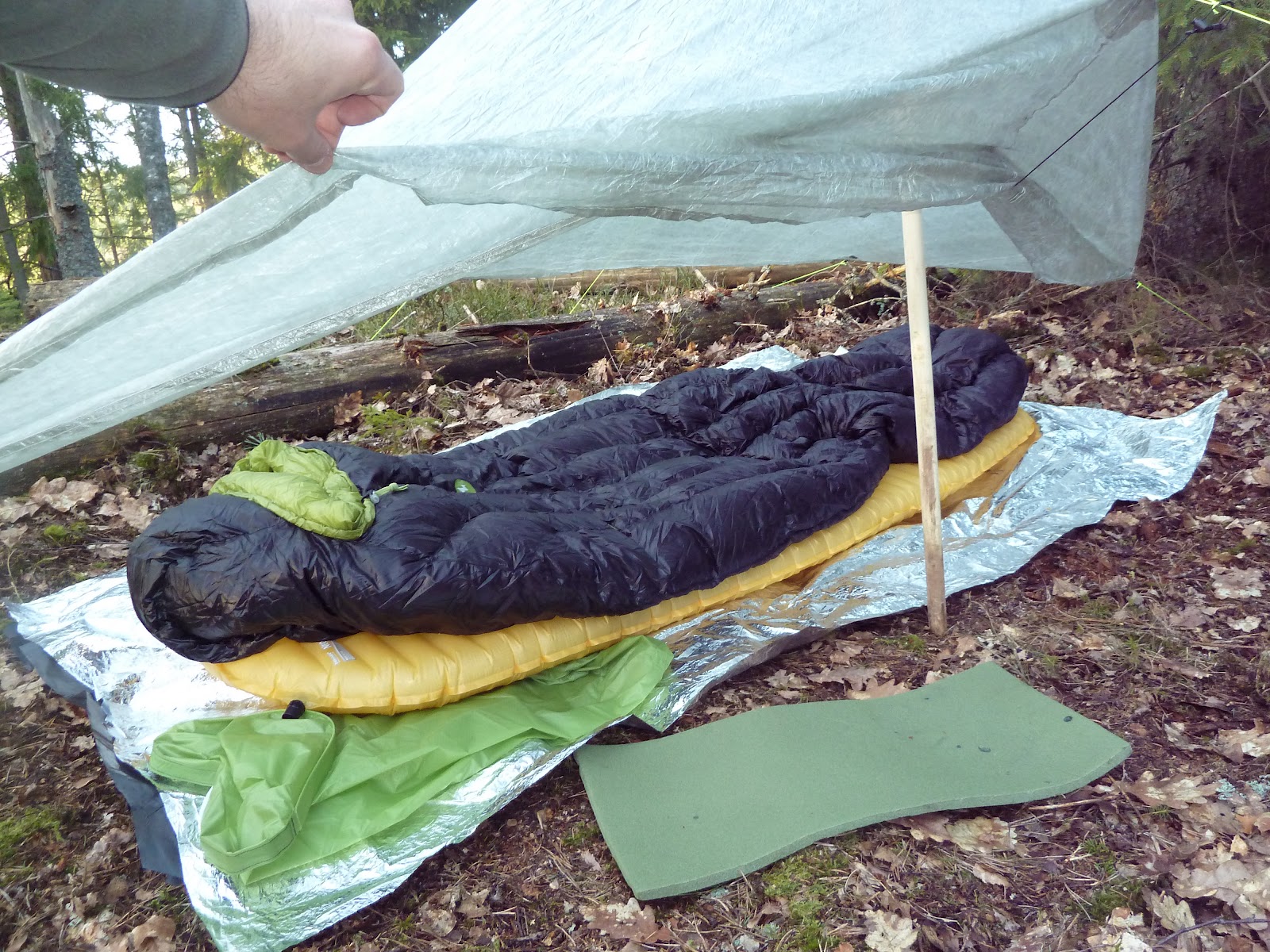
…Is my MYOG double ground cover. On the bottom is a garbage bag, on the top is space blanket, and held in place by duct tape.

Here is it in action: http://4.bp.blogspot.com/-7FNC8ef9Oho/T19L_rNEdQI/AAAAAAAAAbA/S-pFx1jcqRE/s1600/P1030114.JPG

Some may say it is "heavy" at 86g/3oz (includes weight of an elastic strap to hold it when it is rolled up). I defended the extra weight recently on my blog:

"It is perhaps a "heavy" ground cover from the perspective of SUL, but I feel it serves several important uses to make up for the small weight burden. For one the space blanket reflects back heat, giving a minor boost in warmth/insulation, but it is somewhat fragile–hence the garbage bag under it, which on the other hand is quite tough.

As I mentioned earlier, at times I use natural material to make a nest to sleep on, and this (especially pine boughs) can cause minor wear and tear on a ground cover and/or bivy. A double layer ground cover fixes this, and I also use this ground cover with my inflatable sleeping mat (Neoair Xlite) in the spring/fall to give added protection from the ground. I never use natural materials combined with my inflatable mats, as it is just not needed–my Xlite for example has an R value of 3.2, which is plenty of insulation and warmth for 3 season use.

The ground cover also is quite large, giving me a nice sized boarder around my sleeping space to put gear I might need (e.g. headlamp, cell phone, clothing, etc.) to keep it clean/dry. And finally, the ground cover also gives my bivy less wear and tear, so that I can continue to use it for awhile with less wear and tear. Bivies in general are not that cheap (nor are inflatable sleeping mats), so I feel it is best to take especially good care of certain pieces of gear."

For my tents I use just a garbage bag as a ground cover, and the weight varies from brand to brand of garbage bags. The one I use is only 42g/1.5oz and pretty tough, though not as tough as other thicker bags I used to use several years ago that are about 80g each.

I am surprised people don't use garbage bags more as ground covers.

PostedFeb 5, 2013 at 8:10 am

i suggest you go for tyvek or the zpacks. i care about the planet and would rather not see you throwing away a huge piece of plastic every time you go out…

Hikin’ Jim BPL Member
PostedOct 23, 2013 at 7:47 am

Nice looking set up, Nick. I really like how it clips into the shelter. My pet peeve with sleeping on a simple, flat ground cloth is how dirt and stuff easily gets on to the ground cloth and then onto my sleeping bag. Having a bit of a curl around the edge would be great for rain of course but would also keep stray bits of stuff and dirt off my gear.

And it’s oh so stylish. lol.

HJ
Adventures In Stoving

Dale Wambaugh BPL Member
PostedOct 23, 2013 at 8:34 am

It is polycryo, "cryo" as in cold, as in winter storm windows, which is a made-up trade name anyway. When you by the window kits, the ones spec'd for outside use may be better. I never compared them, but have noted the difference in labeling; it could be just the taped included. I got some 3M stuff that is really tough.

The stuff lasts, so it's not a one-shot product at all.

I like it big to keep ground moisture at bay. I move around a lot and would get my sleeping bag muddy with one that is just pad-sized.

Dean F. BPL Member
PostedOct 23, 2013 at 8:43 am

The best groundsheet is probably… a decent bivy sack. It also increases the temperature range of your sleeping bag slightly, and keeps bugs off.

PostedJun 18, 2019 at 4:07 am

I made one myself from 1.1 oz/sqyd silnylon from RBTR and really liked it, but sold it with the tent I sized it for (TT double rainbow). While much better than off-the-shelf ground cloths, it still didn’t fold down very small.

I only use a ground cloth when I know I’ll be camping in abrasive environments (like rocky mountaineering “camp sites”), not groomed campground spots. So I may lean more toward durability than some on this site. If I will be camping on soft dirt, I generally don’t use a ground cloth since I use a tarp tent with a floor.

I have tried polycro and hated it! The biggest problem I have with it is tear strength. Once a rip starts, it tears across the entire sheet with almost no effort. I end up with shredded strips of plastic which doesn’t do much!

I think I’ll try the polyethylene (LDPE) painter cloths since they’re so cheap. Maybe I’ll find a thickness that is a good balance for me.

Does anyone have other suggestions?

Geoff Caplan BPL Member
PostedJun 18, 2019 at 9:08 am

I use a metallised polyester emergency blanket, such as the LifeSystems Heatshield Thermal Blanket.

Not the lightest, but much stronger than a standard space blanket and has proved very durable so far.

Never got on with polycro. Something unnerving about being able to see the mud and water you’re sleeping on. And it’s fragile, so you have to change it often – don’t want to add unnecessarily to plastic pollution.

PostedJun 18, 2019 at 3:24 pm

I use the heavy duty window film (polycryo), thicker than the regular window film but not that much heavier. I’ve been using the same piece for a couple of years now, still going strong. I also put a grommet in each corner so I can stake it down in windy conditions while I get the shelter set up over it.

PostedJun 18, 2019 at 3:26 pm


. RBTR’s 1.1 Mountain Silnylon will probably be the most bomber/durable UL option for a groundsheet there is.  However, in the past I’ve used “Polycryo” and it worked fine for our use.  But the former will last a lot longer.  The nice thing is that while eventually, over a long time, you will start to lose waterproofness, you could re treat it with silicone to regain it back.

Unfortunately, RBTR currently only has white as a color.  (Hmmm, might get some of that, and treat one side with black silicone and make a beach tarp out of it).


David P BPL Member
PostedJun 19, 2019 at 11:13 am

Typically I use Swiss Safe standard emergency blankets off Amazon. 1.4 ozs and < $4 a piece. I have about 50 plus nights over the winter and spring on the one in use.  If a small tear occurs I arrest it with some red house wrap tape, duct tape would probably work. Only has one little tear so far… Comes in pretty colors, I like silver…

Doug- great idea about the grommets I am going to try that. Wind can definitely be a little annoying at night rustling the crinkly blanket… I might try some duct tape in the corners with 4 Ti Shepard’s hooks, minor weight penalty if I use the hooks as my cook pot stand as well.

PostedJun 19, 2019 at 4:06 pm

That should work ok, but imo/e, the Mountain Silnylon is in a different league than the Silpoly.  For one, the Mountain stuff has a much higher HH.

Nylon is generally stronger and tougher per same weight than polyester, but the Mountain line uses a less common, higher strength nylon.  So for around the same weight, if you use the Mountain stuff, you’re going to get a more WP fabric which is much tougher and more durable.

But when you factor in cost, the Mountain stuff is definitely a lot more expensive. The nice thing about the Silpoly is that it absorbs less moisture/dries faster.  Nylon has a significantly higher moisture regain than polyester.  Even if both had an equal, high quality WP treatment, the nylon will absorb some moisture within it’s fibers, even just from the high humidity within the air.  Nylon’s moisture regain is around 8% vs polyester’s .4%.

PostedJun 19, 2019 at 7:08 pm

Dan Durston recommended it to me so that’s what I rolled with. I’m not that “in the weeds” on a ground cloth fabric (pun intended) :)

PostedJun 20, 2019 at 3:34 pm

The 1.1 oz/sqyd silnylon is the material I used to make my own ground cloth for my TarpTent Double Rainbow (finished weight is 1.24 oz/sqyd). I used it for “cowboy camping” too. I really liked how it turned out – it packed down small and was quiet and durable. It was about 48×86” (just smaller than the floor) and including elastic corner loops and mitten hooks weighed 5.2oz (148g), so not really ultralight.

I’m tempted to try RBTR’s lighter Membrane silpoly fabric to make another one since I typically only use it under a tent floor (except the PU4000 version appears to be discontinued now). I really prefer polyester fabric now even though it’s less abrasion resistant than nylon because, as mentioned above, it absorbs less water and dries faster. (That’s why I like my SMD Lunar Solo – they use silpoly for it now).

Viewing 24 posts - 26 through 49 (of 49 total)
Loading...