Topic

DIY Alcohol Stove Design — Basic Considerations

  • This topic is empty.
Viewing 25 posts - 26 through 50 (of 62 total)
Hikin’ Jim BPL Member
PostedDec 16, 2011 at 2:53 pm

Hi, James,

Thanks for your thoughts. Your ideas for causing greater mixing (angled jets, varied placement) sound good.

The principles listed in the blog post make for a fairly efficient stove as they now are. I can boil 500ml of 7C water with 15ml of fuel. The trick now is to see if I can get a bit cleaner burning design.

HJ
Adventures in Stoving

James Marco BPL Member
PostedDec 16, 2011 at 3:22 pm

HJ,
Yeah, same thing actually. Clean burning is usually efficient. Just some thoughts, anyway.

Hikin’ Jim BPL Member
PostedDec 16, 2011 at 5:40 pm

Well, that’s what’s been bugging me. I’m getting good results in terms of efficiency, but I’m getting soot.

My efficiency numbers: 500ml of 7C/45F water boiled with 15ml green denatured alcohol at 1260ft/385m elevation. Those are good results.

I hardly think this is an issue unique to the stove I’m using. Trangia in their instructions suggests adding water to eliminate soot, so clearly it’s a common problem with alcohol stoves. I’m just frustrated that there isn’t a good way (that I’ve yet found) to have a sootless burn on high ethanol content alcohol blends.

HJ
Adventures in Stoving

al b BPL Member
PostedDec 17, 2011 at 3:56 am

I wonder if the you could increase oxygen access to the "ring of flame" around the "open well" by using a non-circular aperture; increasing its circumference for the same well area:

eg an elipse / plus sign / several smaller holes etc (getting harder to fill).

Roger Caffin used a plus sign wick (with no centre in plus) in a candle wax burner for this reason (BPL article).


http://www.backpackinglight.com/cgi-bin/backpackinglight/candle_stoves.html
But the person who did all the work was Mark Hurd. I just helped him write the article.

Cheers
Roger Caffin

Dan Yeruski BPL Member
PostedDec 17, 2011 at 5:13 am

< Also, per #2 above, if a stove requires priming, it's not the stove for me. Priming is by definition inefficient.>

I agree, stoves that require priming are inefficient.

.

James Marco BPL Member
PostedDec 17, 2011 at 6:21 am

Yeah, the numbers look good. The soot says you could do better. Water slows evaporation of fuel, so, that is an easy fix. It also cools the flame, so you don't gain anything. Nor do you loose anything because it burns longer. Playing with reagent grade ethanol made me aware of that. It really made no difference in overall efficiency with a properly tuned stove.

Soot means too little air, or, too much fuel in the fuel/air mix. Its burning too rich. This means incomplete combustion. This means loss of efficiency.

If you must tune for high content ethanol:
Smaller jet holes? Less fuel in the mix, ergo, more oxygen available.
Smaller center hole? Less vapour escaping, ergo more oxygen available.
Distributed jets? More air availibility to each jet…
Greater turbulence? Better mixing, ergo, more heat available and higher efficiency.

Like tuning a kero stove to WG. Or WG stove to Propane. You need to change the jet diameter a bit. Changing between the approximate 1/4 greater heat density of ethanol from methanol is really no different. Fettling a old Optimus to run on vodka is a good example of what you are doing and my thought train.

Hikin’ Jim BPL Member
PostedDec 18, 2011 at 9:40 pm

James Marco wrote: > Yeah, same thing actually. Clean burning is usually efficient. Just some thoughts, anyway.

Hi, James,

I generally agree although there are two types of efficiency in the case of stoves: efficient burning and efficient heat transfer. They are of course highly correlated, but it is possible to design a stove that is fairly efficient at burning but isn’t necessarily efficient overall in terms of heat transfer.

This is a rather esoteric distinction though, and in general the two go hand-in-hand.

HJ
Adventures in Stoving

Hikin’ Jim BPL Member
PostedDec 18, 2011 at 9:44 pm

Alan Bradley wrote: > I wonder if the you could increase oxygen access to the “ring of flame” around the “open well” by using a non-circular aperture; increasing its circumference for the same well area:

eg an elipse / plus sign / several smaller holes etc (getting harder to fill).

Roger Caffin used a plus sign wick (with no centre in plus) in a candle wax burner for this reason (BPL article).

Hi, Alan,

I think I remember that particular article that you’re referring too, and that’s a good idea to try fiddling with the shape of the aperture. Just makes fabrication a bit more tricky is all. Something to experiment with though.

HJ
Adventures in Stoving

Hikin’ Jim BPL Member
PostedDec 18, 2011 at 9:51 pm

James Marco wrote: > Soot means too little air, or, too much fuel in the fuel/air mix. Its burning too rich. This means incomplete combustion. This means loss of efficiency.

Yes, agreed. Just not easy to get rid of the darned soot!

James Marco wrote: > If you must tune for high content ethanol:
Smaller jet holes? Less fuel in the mix, ergo, more oxygen available.
Smaller center hole? Less vapour escaping, ergo more oxygen available.
Distributed jets? More air availibility to each jet…
Greater turbulence? Better mixing, ergo, more heat available and higher efficiency.

Excellent ideas. I also liked your idea of angling the jets and varying the placement of the jets.

James Marco wrote: > Like tuning a kero stove to WG. Or WG stove to Propane. You need to change the jet diameter a bit. Changing between the approximate 1/4 greater heat density of ethanol from methanol is really no different. Fettling a old Optimus to run on vodka is a good example of what you are doing and my thought train.

Ah! Excellent analogy. Alcohol capable stoves like the old Optimus 111T used restrictor tubes as I recall to limit air in the mix. The new Whisperlite Universal uses “air control technology” (a high wall around the jet aperture in the mixing chamber) to burn gas in the same burner as WG and kero. If anything I’ve probably got too much air not too little, although in tests done under a Caldera Cone (a presumably oxygen reduced environment), I didn’t see a significant diminution of soot.

HJ
Adventures in Stoving

Hikin’ Jim BPL Member
PostedDec 19, 2011 at 10:52 am

Addendum to the above:
I’ve been hesitant to do it so far because of cost and availability, but I’d like to compare Everclear 190 proof to Green denatured alcohol. Part of me wonders if the soot issue will be reduced if there are no denaturing additives. Sounds like the topic of a future blog post. :)

HJ
Adventures in Stoving

James Marco BPL Member
PostedDec 19, 2011 at 12:11 pm

HJ,
Yupper, especially if they are using Octane or the like as a denaturing agent. The heavy molecules are little sticks…they require time to replace CO2 and Water with ionized O…you end up with soot when it doesn't happen fast enough. 2-3% will start causing soot, as I remember…again, lost data…

Hikin’ Jim BPL Member
PostedDec 21, 2011 at 9:58 pm

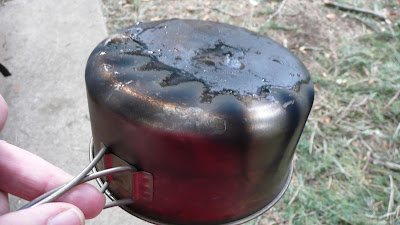
Just for fun, I thought I’d post a photo of one of the pots I used for this past weekend’s stove testing. Now, in all fairness, this was after probably 20 to 25 tests, and no I didn’t clean the pot off between tests. Still working on the soot issue in other words.

HJ
Adventures in Stoving

James Marco BPL Member
PostedDec 22, 2011 at 7:08 am

Wow, that is bloody TERRIBLE. Hmmm….I don't remember an issue between reagent grade ethanol and SLX…they both burned fairly clean. I am only somewhere around 1000' in elevation, though.

I think it's pretty clear you are running too rich, based on the pic. Somewhere along the line, you are not getting enough oxygen into the fuel/air mix.

That *does* look like my pot after burning WG a few times in the mercury stove.

John Donewar BPL Member
PostedDec 22, 2011 at 7:30 am

Jim,

Are you sure you weren't testing a wood burning stove with that pot in the picture? ;-)

Party On,

Newton

PostedDec 22, 2011 at 9:56 am

"…especially if they are using Octane or the like as a denaturing agent. "

Isn't that a main ingredient in gasoline!

Hikin’ Jim BPL Member
PostedDec 22, 2011 at 10:10 am

Wow, that is bloody TERRIBLE

Yeah, not so good. That was after 20+ tests though, and I wasn’t taking the time to wipe down the pot.

So, I’m not getting enough oxygen. Interesting.

I did notice that my DIY stoves do a lot better in a Clikstand than under a Caldera Cone. A 12-10 stove (the one that comes with the Caldera) is tough to beat. They even burn reasonably cleanly on high ethanol blends that my DIY stoves make a sooty mess of. The Clikstand has a lot more ventilation.

Hmm. Now how to supply more oxy to the mix? Angled jets and varied jet placement may help.

I’m also still very curious to do a side by side test of Green denatured vs. Everclear. I still believe the denaturants are contributing to the soot.

HJ
Adventures in Stoving

James Marco BPL Member
PostedDec 22, 2011 at 11:42 am

"I'm also still very curious to do a side by side test of Green denatured vs. Everclear. I still believe the denaturants are contributing to the soot."

Before you start changing anything with stove designs, etc, try the fuel comparison. I would guess you have the answer right there.

James Marco BPL Member
PostedDec 22, 2011 at 11:49 am

"Isn't that a main ingredient in gasoline!"
Supposed to be. Several different isotopes, longer chained, shorter chained organics involved, too.

David Thomas BPL Member
PostedDec 22, 2011 at 12:09 pm

> "Isn't that a main ingredient in gasoline!"

Short answer: gasoline contains over 200 compounds including several percent of isomers of octane. The exact ratio varies with the source crude oil and has varied over the years as refining processes have been varied to improve yield, fuel specifications, and smog requirements.

Longer answer (this is part of my day job): "Octane Rating" measures the knock resistence or the ability to be compressed without igniting the gasoline vapors prematurely. 100% iso-octane would have a rating of 100. 95% iso-octane and 5% heptane would have a rating of 95. Lower compression engines can use lower rated fuels. Higher compression engines MUST use higher rated fuels.

But "91 octane" gasoline isn't 91% iso-octane. It's maybe 1-2% iso-octane and a few percent of other octanes. It's got hundreds of different hydrocarbons in it, most because they were in the orginal crude oil, others are added to improve octane rating, higher volatility compounds are included for cold-starting capacity (and are varied summer to winter), and oxygenated compounds (MTBE, ethanol, etc) are added to reduce tailpipe emissions. Plus there are traces amounts of detergent to keep the fuel lines clean and dye (amber for leaded, pink for unleaded, purple for untaxed, etc).

Hikin’ Jim BPL Member
PostedDec 22, 2011 at 12:22 pm

Before you start changing anything with stove designs, etc, try the fuel comparison. I would guess you have the answer right there

I will definitely experiment with “the good stuff” before I start cutting openings in my stove(s) or some such!

HJ
Adventures in Stoving

David Thomas BPL Member
PostedDec 22, 2011 at 12:39 pm

> "So if there's only 1 – 2% octane in the gasoline, how do they come up with the Octane rating?"

Only as a way to measure pre-detonation of the fuel-air mixture. Iso-octane is a very centralized molecule and therefore needs higher temps to ignite. Heptane is very linear and therefore ignites at lower temps.

Iso-octane and n-heptane

We could measure human heights on a scale of Herve Villechaize = 0 and Michael Jordan = 100. It doesn't mean that at a rating of 85 you are composed of 85% Michael Jordan. Only that your height falls at that point on the line. And, like octane rating, you could have heights above 100. Aviation gasoline in WWII got up to "150 octane" for use in very high-performance, high-compression engines. But don't me started on how it was actually chemical engineers who won the war.

Editted to add: Herve Villechaize = 1970's reference to the midget actor famous for: "Da plane, boss! Da plane!" as that Grumman G-44 Widgeon amphibious airplane was on short final for Fantasy Island.

James Marco BPL Member
PostedDec 22, 2011 at 1:11 pm

Ha ha, Don't even think of asking what is in White Gas. You really don't want to know, nor do the distillers.

Mostly, and in it's easiest understood form, a fractionating tower is a big distilling tower tapped at various temperature levels for various components. A very crude type example…

This means that any substance that forms some eutectic at some temperure will evaporate together/condense together. (Again, a simplistic example and ignoring vapour pressures of the variuos products in the crude.)

Soo, like distilling alcohol mixed with water, it is not 100% alcohol.

Light prodicts go one place to be combined with catylists and heat into larger chained products. Longer chaned products go into other chemical tanks with cataylists to break them down.Both go back into the "gasoline" you burn. Usually the mixes are not octane, unfortunatly. Anyway, depending the exact nature of the crude, the products from distilation and recombination varries.

Additives get added to make up the difference in how the "gasoline" will burn compared with pure octane (a standard.) This is the octane rating. Fuel is different in most batches. You should not notice much difference at the pump, though there are regional and climate differences.

Rule of thumb says use the lowest octane rating available for your car that does NOT lead to spark rattle (predetonation.) But, there are still people out there that use 105 rated gasoline in a family car because they think it gives them more power.

PostedDec 22, 2011 at 1:59 pm

That's nuts. My wood stove leaves less crud than that on the bottom of my pots. I've got hundreds of alcohol stove burns on my Ti pot and it's still perfectly clean.

BM

Viewing 25 posts - 26 through 50 (of 62 total)
Loading...