Hey everyone i searched this and didnt like what i had found, right now im looking for a pack for a planned thru hike in early April. Im trying to keep my pack light as can be but still able to hold on my back with comfort. I was thinking about the Gossamer Murmur but i just dont know if it will ruin my hike. I have never used a UL pack before and looking at most of them just cannot pull a trigger on any one of them. About me, im 5'10 175lb, thinking hip straps be nice for the distance im goig, and with some heavier resupplies occasionally.
Topic
UL bag for a AT thru-hike?
Become a member to post in the forums.
- This topic is empty.
Do you want to go SUL or UL? With that pack I am assuming that you have mostly SUL items and a very low baseweight. How often do you plan on resupplying? It's hard to say which pack to help you choose since you didn't give us much info about your items or hiking style.
How about this: you tell us more and we'll help narrow it down for you.
Ok gotcha im trying to go UL but i have started getting more SUL gear then i realized, zpack tarp, quilt, Gnat stove, montbell UL jacket, zpack kilt. just the lightest durable stuff i can get my hands on. i plan on resupplying ever 3-4 days. Any other questions that will help narrow the list of Packs let me know. I think a SUL pack with comfort of a hip support would be grandm but then again i never had a UL or a SUL pack. I have ordered most of my gear just waiting on delivery now, so i dont know how much i need the hip support
Your title says UL bag, but your question seems to be about a UL pack.
I have a Gossamer Gear Murmur that is several years old. The good news is that it is terribly light, about 8 ounces. When I inquired to Gossamer Gear about its maximum weight capacity, they said 15 pounds. I've carried around 20 pounds in it, but that is about as high as you would want to go. With a low weight like that, you don't need a heavily padded hip belt, but a flimsy hip belt will keep it from bouncing around.
So, if you take that 15 or 20 pound maximum and subtract your base weight, how much does that leave you for consumable weight? On that consumable weight, how far can you go between resupplies?
–B.G.–
That is definitely food for thought, my base weight is around 7.5 in theory and 2 pounds of food a day is in that range with water.
So then 20lbs (max load) – 7.5lbs (base) = 12.5 (for food)
12.5lbs / 2lbs per day = ~ 6.25 days you can go between your resupply points. Now the question is how often and where are your resupply points?
I think you need to start by checking gear lists of people who have done major thru hikes. You can check gear lists here on BPL and other Websites.
I have used a Murmur a lot. You need a base weight of well under 5lbs if you are going to do a thru hike with it, and I bet you could count the number of people who completed a major thru hike with less than a 5 lb base on one hand, or maybe just one finger :) unless you have a support crew to carry stuff for you.
Check out Greg Gressel's gear list for his PCT thru hike this year. Greg is an experience UL hiker and did the PCT in something like 90 days, resupplying every 3 days or so. He used a GoLite Jam. But you really need to assemble all your other gear first before getting a pack. You probably will be best of with an internal frame pack, unless you can keep the total pack weight under 20 lbs, which is not easy for the majority of people to do on a long hike.
I would guess you might want to size up from the Murmer (or similar pack) to allow for more comfort after resupplies and to also have enough room for the extra food. A UL pack with a light frame or removable stays would probably be my choice. Something like the MLD Exodus FS, GG Gorilla, or the ULA Ohm (but there are still multiple others). They should all stay reasonably comfortable up to 25 or 30 lbs and also allow plenty of room for food and gear.
Greg's (aka Malto) PCT trail journal that Nick is referring to and the page where he provides post hike gear commentary is here. It looks like he carried the MLD Burn on his thru-hike: http://postholer.com/journal/viewJournal.php?sid=2d9483c5c1a4554dafa7b676462d1090&entry_id=26869
Ryan Linn's blog is good read and has a lot of information on thru-hiking (http://guthook.blogspot.com/p/appalachian-trail-2007.html). He completed two through hikes with a frameless MLD pack and appear to have been very happy.
I've carried a decent bit of weight in my Murmur clone before. My baseweight for that time of year though in the lower AT is closer to 4.5 lbs, and I could carry 2 liters of water and 4 days of food comfortably. I agree that using a pack like the Murmur may be a better choice if you can get your base weight down closer to 5lbs, but not necessarily under it. I would just worry about stressing the silnylon too much (if they still make it with that) and causing material failures with a baseweight closer to 7.5lbs and the food you would need.
A great SUL style gear list to read is Joe's over at zPacks. He definitely has his list whittled down to work great for long thru hikes.
I think a GG Gorilla would be a safer bet. Or a ULA Ohm.
http://postholer.com/journal/viewJournal.php?sid=345eebb7102cbc421cb8fba9956ded64&event_id=801
http://postholer.com/journal/viewGearlist.php?sid=345eebb7102cbc421cb8fba9956ded64&event_id=801
http://francistapon.com/Travels/Appalachian-Trail/AT-Gear-List
http://www.pmags.com/a-quick-and-dirty-guide-to-the-appalachian-trail
http://www.backpackinglight.com/cgi-bin/backpackinglight/walking_the_backbone_cdt.html
http://www.rayjardine.com/adventures/2009-AT/index.htm
http://www.rayjardine.com/index.shtml
http://www.backpackinglight.com/cgi-bin/backpackinglight/lyme_disease_challenging_stereotypes.html
Just finished a thru hike of the AT this year.
I used a Mountain Laurel Designs Exodus to carry my 7.5 lb baseweight.
The Exodus is a frameless pack.
I also used the Exodus for the CDT
I used a Golite Pinnacle for the PCT.
One of the biggest factors regarding all day comfort when using a frameless pack is how you load your gear into the pack and the volume of the pack versus the amount of gear you have to fill it.
Let me go back to my first thru hike, the PCT, with the Golite pinnacle which was my first experience with a frameless pack.
The pinnacle does have a small foam sheet inside but for the sake of argument lets ignore that for the moment.
I found my Pinnacle to be very comfortable up around 25 lbs. I had a 10.5 lb base weight on the PCT and ate about 2 lbs of food a day. So that meant even with 4 liters of water in So Cal and several days of food the pack was still comfortable.
upon reaching the Kennedy meadows and the Sierra I added a bear cannister, iceaxe, heavier gloves, and 7 days of food.
Suddenly my pack was in the 30 lb range.
The pinnacle would develope a fold right above the hip belt and transfer almost all the weight back to my shoulders.
I countered this my stuffing folding my ridgerest in three and stuffing it inside my pack against my back to stiffen the back panel. This worked wonders.
Fast forward to the CDT.
I had lowered my base weight and my gear no longer filled up my Pinnacle. Even with the ridgerest pad inside the pack slumpedheavily on my shoulders.
So, i purchased a smaller volume frameless pack, the Mountain Laurel Designs Exodus.
When the Exodus was stuffed with my gear and ridgerest pad enough of the volume was filled to make the pack ridgid enough to transfer a large amount of the weight to my hipbelt without sagging.
This works up to about 25lbs.
At that point more and more of the weight will transfer to the shoulders. Thankfully the MLD Exodus has extrememly well made shoulder straps and the pack is still comfortable up to 30 lbs for a time. Also those times it was overloaded were brief since it was extra water weight which decreases by the hour and food weight which drops about 2 lbs per day.
Fast forward to last spring.
I hiked the AT carrying the same MLD Exodus pack with a 7.5 lb baseweight.
Resupplies are much closer together on most of the AT and my preferred style of hiking all day meant i never had to carry more than four days of food.
Water is also ridiculously plentiful on the AT. I often only carried 1/2 liter in a soda bottle.
Interestingly i also found that i could hike quite comfortably without the hipbelt when i only had a few days of food in my pack and no need to carry more than a liter of water.
A frameless pack can be used for the AT quite comfortably but the lack of a frame means a strategy must be employed.
My strategy was:
1. Hike fast=less food and water to carry between resupply points/water sources.
2. Stuff gear into my frameless pack without stuff sacks to occupy more volume and make the pack rigid enough to transfer weight to my hipbelt.
3. Use my ridgerest sleeping pad folded thrice inside my pack against my back to help keep the pack rigid for the reason above.
Frameless packs are not going to make everyone happy.
Actually out on the AT you will catch a lot of flak for having a small pack like i did.
You will see some gargantuan load haulers on the AT.
It's okay. Everyone has their own way to hike and they are all correct ways to hike.
Just be ready for the interrogation you'll get at the shelters, on trail, and in town by other hikers.
That AT is a beautiful trail! I already miss it. Even the pain and brutal tread of the Shire and Maine.
.
.
.
.
.
.
.
.
.
.
I did all of my PCT training hikes using a Jam2 but I ended up taking a MLD Burn on the hike. I customized the pack with an upgraded hipbelt, I think it was an exodus belt, not for weight transfer but rather to mount four pouches where I carried my 2L of water and a half days worth of food, typically about 3-5lb total. Taking this weight off my back left only my 8 lb baseweight and food. (More on that in a minute.)
I would not reco a pack as small as the Burn for a thru unless:
1) You have very low VOLUME gear.
2) You are doing high miles with shorter resupplies.
The Burn worked well for me with one exception, leaving Kennedy Meadows. While I didn't have a bear canister at that point I was carrying 7 heavy days worth of food, a total of about 21lb. plus an extra couple lbs of gear bringing my weight up over 30lb for the first couple of days. This was the only point during the trip that I noticed the pack on my back. But the bigger issue was that the food volume just wouldn't fit into my pack, extension collar and all. I ended up strapping a plastic grocery bag to the back with a days worth of food for the first day out. So while the pack worked "great" 99% of the time, it was a pain that one day.
You stated that you will be carrying 2lb of food per day. I suspect that that is optimistic. During the second half of the trip I was eating over 6000 calories EVERYDAY and up to 8000 on isolated days when I was ahead of schedule and eating extra food. This is a minimum of 3 lbs of food per day, 125 calorie per oz. average, and probably closer to 3.5. But I was also hiking over 30mpd during that stretch and only lost 1lb during the second half. Even with my normal 3 day resupply that would end up being 10lbs of food and twice the volume of all my gear, so don't underestimate food weight and volume.
For most thru hikers, small packs like the Burn will be too small. I had a love/hate relationship with mine. It was tall and narrow and a pain to load but once loaded it was a dream to carry. An advantage to a small pack is that it will be packed full and more like a monolithic block. The only "frame" was a folded up POE airmat to smooth out the bumps from the food bags loaded in the top and bottom.(with the rest of the gear in between.)
I think Matt's choice of the Exodus would make more sense than the Burn. The gear list in my profile was tweaked prior to the trip, I changed sleeping pads and the Jam was just too big. You can see my actual gear list on Postholer, Trailname Malto to compare it with what you taking.
Have a great hike, wish I was joining the festivities next year!
Matt,
That is a motley crew!
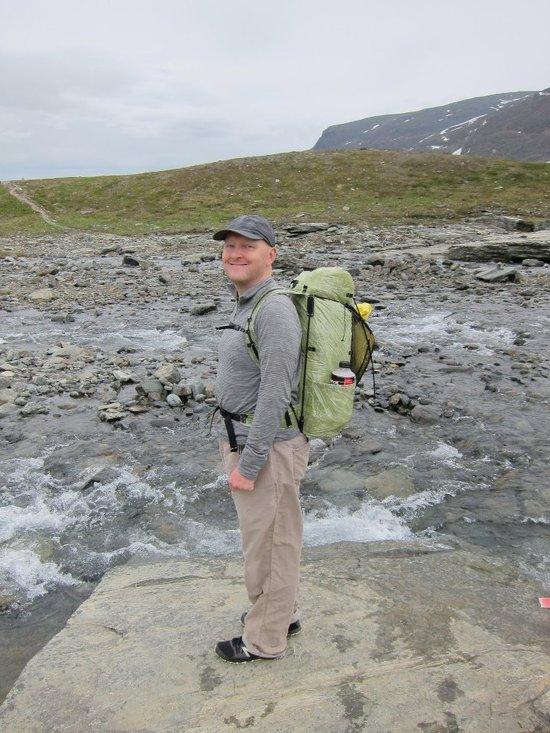
Timm, since you've already worked with Joe at ZPacks before (on your tarp), I'd like to put in a word for the ZPacks Blast. I have the 2600 with the carbon fiber stays, and I've used it on two multi-day backpacking trips so far: a five-day through hike of the Lone Star Hiking Trail in Southeast Texas and a six-day hike of part of the Kungsleden in Arctic Sweden. In both cases I carried all my food (my maximum weight, with food and water was never more than 22 pounds), and the pack acquitted itself admirably.
Here's a pic of the pack in use, the third day of the hike in Sweden.
I hiked the CDT this summer with a Zpacks Blast 26, no frame or stays, no folded pad. The key is to pack your sleeping bag and your puffy layers near the bottom without stuff sacks and to use small items like socks to fill in the corners near the hipbelt. The pack is then always close to full volume, whether you are leaving resupply town or entering civilization with little food weight. I hiked with a baseweight around 11 lbs, slightly less in the middle of the summer when I used my quilt instead of my bag for about 3 weeks. I estimate that for my longest carry in southern NM (7days) and up to three liters of water, my max weight was about 30+ lbs. This is heavy an uncomfortable for about 2 days, but doable. The pack is perfectly comfortable and weight can be effectively transferred to your hips up to about 25 lbs if you fill all the volume and don't have a loose pack.
For the AT with shorter resupplies and a baseweight below 10 you could probably even get away with the smaller Blast 20, depending on your gear volume. Have fun!
Thanks everyone for the help I think im going to go with a zpack blast 22 with the fiber stays that double as me tent pole just incase my trekking poles crap out on me ever on the trail. Now i just gotta figure out what fun extras i need on it!
Become a member to post in the forums.