Topic

Crazy light and compact survival-level sleep system

  • This topic is empty.
Viewing 20 posts - 1 through 20 (of 20 total)
Dale Wambaugh BPL Member
PostedNov 16, 2011 at 8:19 am

I've been looking at the lightest and most compact sleeping options— something for summer use and really on a near-survival level. I've considered space blankets or bags, but I'd like to get an actual insulation layer worked in. Perhaps a super light quilted blanket on the order of a poncho liner, but using lighter materials? This would be used with a shelter, torso-length pad and polycro ground cloth, so it doesn't need to be waterproof and some breathability would be preferable. Low volume is very important.

I'm thinking that having an extra clothing layer may be a better bet for the most compact and versatile kit, using that with something like a Pertex bivy bag for a minimalist sleep system.

PostedNov 16, 2011 at 10:34 am

Down quilt with 3-4oz fill made of Seven D? Could be commissioned to a forum member.

PostedNov 16, 2011 at 10:58 am

I would agree with the others. If you want it to be breathable, a SevenD+down elephant-foot quilt would be the lightest and most compressible (if you have a warm parka for the top).

If you don't mind a vapor barrier (ie, if you won't be wearing any down underneath), you could opt for something in 0.33 oz cuben + down. The cuben is half the weight of SevenD and the vapor barrier effect would make it warmer as well. The top could be tucked under your parka up to your armpits. A low-loft cuben quilt is pretty IR transmissive, so a space blanket over that would boost the warmth as well.

Here There BPL Member
PostedNov 16, 2011 at 11:37 am

Dale, do you have a particular temp range you're aiming for?

I've slept out lots of nights either just in my clothes, or inside a light bivy with no quilt or sleeping bag. The most helpful thing I've found is to have enough insulation under you to keep the ground from sucking all the heat out of you.

When I travel I occasionally like to be a hobo, so I'll take along a BPL torso pad, a polycryo groundsheet, and a poncho tarp. I wear as much of my clothing as I need for the conditions, and find that light gloves and an appropriate hat are wonderful luxuries that don't take up very much space.

If the trip is wilderness focused then I'm usually happy for the comfort a light quilt can provide, especially for those nights that are colder than expected.

-David

PostedNov 16, 2011 at 11:45 am

One of the instructors from Northwest Outward Bound years ago would toughen himself for
alpine climbing by sleeping in his pack and clothes when on course. He had a long extended collar on his pack.

The advantages to a half bag over extra warm clothes is your feet are better insulated and
you can stick your hands inside too.

Having said that, I have been surprised how well I can nap in the cold with just ground insulation and some sort of large coat or wool shirt thrown over the top, providing there is no wind.

Here There BPL Member
PostedNov 16, 2011 at 11:56 am

Even if you only have a small pack instead of a big one with a long collar you can stick your feet in it to warm them up. It won't do your hands any good, but that's why some light gloves are nice.

Avoiding wind is definitely a must if you're going for a minimal system. Wind can drain you of heat just as quickly as cold ground if you don't have a good way to shed it or get out of it.

PostedNov 16, 2011 at 12:20 pm

I agree about wind. Vapor barrier materials like cuben or aluminized mylar are lighter than any textile and warmer due to both reduced evaporation and reduced convection (VB effect and windproof).

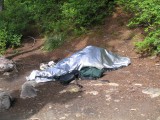
Below is a photo of a trail racing/emergency bag I made a few years ago (sorry for the small size and poor image quality). In this picture I was napping in the Olympic mountains. I had gone on a three-day trail running outing with two friends, who brought conventional down sleeping bags and pads. My bag was made from several layers of aluminized mylar (thinner than space blankets, from an RC plane supply company) with layers of 0.25 oz/yard polypropylene agricultural fleece ("row cover") between them. The design was modelled after satellite multilayer-insulation-blankets ("MLBs"). I had no pad, but made a nest out of grass, leaves, and duff. It weighed just under six ounces and rolled up to the size of a soda can. A few snowflakes fell the second night and my two friends both got cold. I got overheated in my bag and had to strip down to my underwear, plus mine was waterproof so I didn't worry about the snow.

alumibeast

One of my friends named that bag the Alumibeast. It was basically disposable and fell to shreds before I could use it again. The point of this boast is just to illustrate the insulative value of vapor barriers and designs that incorporate multilayer IR barriers. The commercially-made Blizzard Bag does this, as do NeoAir pads.

PostedNov 16, 2011 at 12:46 pm

I looked it up and found that I still have some info about the film I used for that bag. It was 0.9 micron one-side aluminized mylar from a company called Peck Polymers/A2Z Corporation. It weighed 1.2 grams (or 0.043 oz) per square yard. So, one ounce of it was about 23.5 square yards of film. It was roughly 1/14 the thickness of a standard space blanket. It was extremely fragile and I was lucky that it didn't turn into confetti-like shreds in the mountains. I handled it very, very carefully and it still tore to bits when I got back home. I think I used four layers of it in that bag, with 0.25 oz/yd polypropylene gauze between each one.

Dale Wambaugh BPL Member
PostedNov 16, 2011 at 1:21 pm

David Lantz wrote: "When I travel I occasionally like to be a hobo, so I'll take along a BPL torso pad, a polycryo groundsheet, and a poncho tarp. I wear as much of my clothing as I need for the conditions, and find that light gloves and an appropriate hat are wonderful luxuries that don't take up very much space. "

That pretty much nails my project— I am thinking of low altitude wilderness mid-summer overnight trips and 45F-50F lows. Agreed on the helpers like hat and gloves.

I got an REI Flash 18 pack and was doing some imagineering on getting things down to an easy 18 liter kit. A compact sleeping bag is the sticking point for me.

Luke Schmidt BPL Member
PostedNov 16, 2011 at 1:32 pm

Colin your MYOG bag sounds very interesting. I'd be inclined to try one made with a space blanket on the outside for more durablity. Can you give more info on the "agricultural fleece" stuff, I did a search but wasn't really sure what I shoudl be looking for.

Dale Wambaugh BPL Member
PostedNov 16, 2011 at 2:57 pm

I did a lot of experimenting this summer with layered space blankets for hammock bottom insulation. You could layer up a couple bag-style space blankets with a third flat blanket crumpled for loft, folded, and placed between the two bags. You still have the condensation issues, but four layers of space blanket can be surprisingly warm. Go any farther and you would be better off with one of the Blizzard Bags.

Mike M BPL Member
PostedNov 16, 2011 at 4:25 pm

military guys have been building on the poncho liner design using light nylon and Climashield, I've got the materials but haven't built mine yet- should be pretty light and compact

Here There BPL Member
PostedNov 16, 2011 at 6:28 pm

I think your best bet for light warmth that doesn't take very much space is probably a very light quilt or half bag, cuben if you don't mind the vbl effect. If you like the clothing idea instead, a very light down parka and some warm sleep socks are great and don't take up very much space at all, plus they can be worn around camp.

I'm a huge advocate for experimentation–people try crazy things then I get to hear a great story about how things went awry and learn from their mistakes. If you've ever thought about trying a poncho-tarp for shelter in a snowstorm send me a PM first…

Luke Schmidt BPL Member
PostedNov 16, 2011 at 6:52 pm

To late on the Poncho tarp in a snowstorm idea. Remember a year or so there was that big snowstorm that shut down Washington D.C, they called it "Snowmagedon." I was camped out along the AT under a poncho tarp in that snow storm. Lets just say it was a long night (the drive back in that snow wasn't much fun either).

Anyway Colin thanks for the info I might give that a try sometime.

Jerry Adams BPL Member
PostedNov 16, 2011 at 7:30 pm

I bought the spunbonded polypropylene from Territorial Seed company

I cover my vegetables with it

I have a vague idea of making some insulated clothing with it.

Viewing 20 posts - 1 through 20 (of 20 total)
Loading...