Topic

Survival Equipment

  • This topic is empty.
Viewing 25 posts - 51 through 75 (of 75 total)
PostedOct 29, 2011 at 4:10 pm

"Are there any waterborn diseases/etc for which the onset is immediate?"

Bacillary dysentery comes on within 24 hours. At least it did for me the one time I contracted it. The same goes for travelers' diarrhea. Cholera onset can be as little as 6 hours, as long as 5 days. Fortunately, these diseases are not common in the US, and definitely not a problem in the high country. I don't know what their prevalence is in lower, warmer parts of the US.

Dale Wambaugh BPL Member
PostedOct 29, 2011 at 4:33 pm

"Are there any waterborn diseases/etc for which the onset is immediate?"

E coli would probably hit you faster (24-72 hours) than giardia– and kill you quicker too. If you are carrying a spare water container, it's no big deal to include a few AM or MicroPur tablets. I tape four foil packs to my water bladder for backup.

My daughter got hit with e coli a few years ago (she was 18). You don't even want to think about coming down with it— it is the definition of miserable, even with the best medical care. I don't think there is a big risk in the North American backcountry unless there are livestock involved, but I'll pass on taking chances if at all possible.

David Goodyear BPL Member
PostedOct 29, 2011 at 4:45 pm

My hiking style is always off trail, thus I carry more than the usual hiker. I have sewn small loops into the pockets of my hiking pants and everything I need is on a lanyard. Here is a page from the group I hike with that explains "on person suvival gear"

http://therucksack.tripod.com/MiBSAR/SARgear/SurvivalGear/SurvivalGear.htm

I also carry a miniature map in a small zip-lock, I leave a map, itinerary and an impression of my boot (in foil) in my car and at home.

Enjoy,

Dave

PostedOct 30, 2011 at 2:28 am

"But that's precisely the point…To alert people looking for you (especially if you're hurt/immobile)…"

What I'm getting at is that a whistle is unlikely to alert people as far away as lighting a smoky fire or flashing a signal mirror, for example, and not meaningfully further away than other things you could do without carrying an extra piece of gear–such as banging a spoon against your pot, waving a brightly colored groundcloth, or banging rocks together.

Of course, each of us makes choices about what to carry based on our own beliefs about the chances we will need to be rescued, and how much of our time and pack weight should be devoted to preparing to help rescuers find us as opposed to making sure we won't need to be rescued in the first place.

John Donewar BPL Member
PostedOct 30, 2011 at 5:58 am

FWIW

My wife and I were on a trip to Mexico.

You know where this is heading don't you? ;-)

We had been very careful about what we drank and ate while we were in Acapulco. We drank bottled everything.

One Night In Mexico City Makes A Hard Man Humble!

My apologies for taking artistic license with that song, but I'll explain.

After a week in Acapulco with not even a hint of gastric distress we spent one day and night in Mexico City. After 1 full week in Acapulco, I had been lulled into a false sense of security. During our 24 hour stay in Mexico City I succumbed to a water born ailment whose onset while not immediate was indeed rapid.

While eating supper in a restaurant a glass of water was placed on the table before me. Without thinking I took a sip from the glass of water. I immediately noticed a grittiness in the water and realized my mistake. Upon a visual inspection there were quite a few swimmers and sinkers in that glass of water.

I'd estimate that it was only 3 hours or less when that sip of water resulted in a long sleepless night of either kneeling or seated positions. ;-(

I feel much safer collecting my water from streams and springs as I hike. I treat my water with Micropur and only "filter" to remove swimmers, sinkers and floaters. I've encountered no ill effects to date using this method. YMMV

Party On,

Newton

Jeff LaVista BPL Member
PostedOct 30, 2011 at 9:15 am

This is bad advice, man.

A signal mirror is good stuff, but requires line of sight and is highly directional. And you have to spot the person first.

If you think banging on your very small cooking pot is louder then a whistle, well good luck with that.

If you're hurt, immobilized how will you gather fire materials for that signal fire? What if you're low in a ravine, underside tree cover where the ffire has low chance of observability?

If your gear gets ravaged by a bear, or dragged off or you got hurt on that little siide trip how will you bang pots and pans?

If you can breathe in and out you can operate a whistle. The weight is under an ounce.

PostedOct 30, 2011 at 10:02 am

"that the base-wood is saw cut. it could be even WORSE using downed wood.
ohh holy moly, what a chore."

Yes, it was. I used some firewood I had laying around the house. In the scenes filmed "on location" I prefabbed everything for the fire bow ahead of time, and brought the materials for the tinder bundle with me. The intention was to save time, and the contest did not require that I use any specific materials. I did have a saw on my multi-tool, and used it to cut the notches in the base board burn holes.

However, it certainly made me realize just how hard it would be to do this in a real survival situation. You need just the right materials and it could easily take all day.

And thanks for the complement. :^) I'm glad that the over and over frustration was evident in the video.

And, I have the fox 40 whistle. It is the one suvivorman recommends. They are also good for signalling each other if you get suddenly separated.

PostedOct 30, 2011 at 10:53 am

@Mike: Thanks for that link – those aqua-pouches and emergency water bags are pretty cool! I might get one or two…

In the "what if you lose your pack" scenario department, I always hike with a GG Hipster with the pouch part in front ($15 and just under 1.5oz on my scale). Mostly, it's for convenience of having some things right there (even easier to get into than pack hip belt pockets). Size is just right. It only comes off when I am in the tent. In a particularly isolated area, I might sleep with it on. Contents on any given morning when hitting the trail are usually as follows:

-Trail snack food to eat on the go (not all of it, just enough until the next time I rest and refill from my pack. Usually at least 3 or so packets of Justin's almond butter in addition to bars, small baggies of fritos, nuts and raisins, VIA packets, etc.). These are stuffed on top of everything else and may make it a little too full at first, but only until I eat something. Overflow can go in a pocket.

-Map and compass there for easy access to check navigation

-Very small little Rite in the Rain notebook and wee mechanical pencil for notes.

-Hand sanitizer, eye drops, lip balm with sunscreen, ibuprofen

-Tiny folding knife

-Identification

-Camera

-I also have one of those AMS mini survival kits in a wee waterproof zip pouch in the hip pouch, containing a magnifier, signal mirror, fishing kit, backup compass (tiny), whistle, needle and thread, scalpel blade, duct tape, foil, nylon cord, wire, safety pins. While I'm comfortable on my sofa, I could easily work out how best to use these items, but knowing that if I need to use them, I will likely NOT be comfortable, and may be fighting the urge to freak out, I left the written instructions in the kit for when my brain shuts down…

I also will temporarily stuff other stuff in there or hook them on the belt part, like toileting items when off to dig a cat hole (hooked on belt in pouch, not in with food), or tent stakes as I'm pitching to make sure they're not lost if I am worried they'll fall out of my pocket. I also keep two empty dog-doody cleanup bags in there that are the perfect size for trash – some of my own (wrappers for bars, etc.), but also for trash I pick up on the trail (it's a compulsion, I can't leave something once I see it. Bottle caps, bits of plastic, clothing labels, reflectors that have fallen off bikes…). Once trash bag is a bit more full, I carry it in my pocket instead of the hip pack.

I have not included more robust fire-starting stuff (though there's stuff in the little survival kit), because it's been so dry (strict burn ban/stove ban) that if I tried to start a fire, I'd probably be more likely to start and then be caught in a giant wildfire!

I usually don't keep my head light in there, but it's tiny, so now that I think about it, I'll add it next time. I also don't have something for a shelter. I have an emergency blanket/bag I carry, but it doesn't fit in the little hip pack. Haven't figured that out… Oh, and something to carry water. I'm going to take a look at those emergency water bags.

Anyhow, I mostly use the little hip pack not because I'm paranoid about losing my pack, but because I like to have certain things very easily accessible. But I decided that if I was going to carry emergency survival stuff, it was kinda dumb to put it deep in the pack if I was wearing a hip pack, too.

Now I'm just wondering whether I can get a set of bagpipes into the back pocket of my Circuit. Hmmm….

Dale Wambaugh BPL Member
PostedOct 30, 2011 at 11:02 am

Playing bagpipes would be a good way to get left behind ;) Should keep the wildlife away!

Nick Gatel BPL Member
PostedOct 30, 2011 at 3:31 pm

I always take on a lanyard
– photon II
– whistle (never used it)
– sometimes firesteel
– sometimes classic Swiss Army kife

Some other thoughts…
My kit has gotten so small and light, I now take the following even on day hikes just to fill out my pack
– cuben quilt
– Poncho Tarp (now replaced with Hexamid and Cuben poncho/ground sheet
– Caldera Keg with esbit tabs

Regarding emergency water bag. I seam-sealed a cuben stuff sack and it holds water. I tie off the draw string to keep the top at the top of a water pocket or even in my pack. Hope I never have to use this, as I always have some sort of a water container with me. But I tested it and it works.

I have a small FAK/Personal items kit in a small cuben sack. Very easy to slip into a pants pocket if needed. I always take a Bic, a book of matches and a razor blade.

I almost got into a survival situation of sorts yesterday. Went on a 18 mile hike, with the last 12 or 13 miles a descent of over 8,000 feet elevation. After about 5,000 feet elevation drop my legs were sore, weak, and shaky. I think part of this was due the a bad case of the flu a couple weeks ago and my body has not fully recuperated. So I really slowed my pace. At 7,000 feet drop I could barely walk and my intended last mile was just too steep to hike. By now it was dark. At this point I had two options, make camp and spend the night or take an alternate route which was longer but a much more gradual drop and an easier trail. I took the later, with the intent to stop and camp if things got worse. I had everything I needed to spend the night. I used the Photon to guide me in a slow 2 mile hike that took 2 hours with no moonlight. Normally I can do this section in 45 minutes or less.

PostedOct 31, 2011 at 11:11 am

I've found that one major key in making a fire with a bowdrill is to do everything within your power to reduce the friction between the spindle and the bearing block.

Think about it- laws of physics. You cannot create or destroy energy, just change it form one state to another. So, you are taking energy from you muscles (chemical energy?) and turning it into kinetic energy (reciprocating motion of the bow, rotating motion into the drill). Then you are turning that kinetic energy into heat through friction. If you have zero friction at the bearing block, all of that energy is being funneled into the concentrated area in your fireboard. As you add friction to the top of the spindle, heat starts being generated there. Where is that heat coming from? Not thin air- obviously (pesky laws of physics)… It's being taken away from the bottom of the spindle. For every btu generated at the bearing block, that's one less btu working towards making a burning ember. I cheated when I was learning and put some axle grease on the spindle. It was incredible how much faster I started generating clouds of smoke. In a survival situation, assuming you haven't showered in a while, I've read that you can rub the top end of the spindle on your face, neck, hair, etc., to lube it up some. I guess that's a situation where it would help to have oily skin. If you have killed anything recently, maybe you could rub it on some animal fat.

But yeah- there's been some great information posted in this thread! I went ahead and made some firestraws the other night. That has got the be the most sano way I've seen yet for carrying pjcb's… It's amazing how much cotton fits in a 3" section of drinking straw.

And living in the desert, carrying water has been something I've given lots of thought to. The plastic bags make great sense. I folded up a 1 gallon bag (this is the desert! can't have too much water) to about the size of my wallet. I will look into those bags specifically designed for carrying water as well. Also, if you have clear sunny skies, clear water (not murky), and a clear container, you can use sunlight to kill pathogens. UV radiation from sitting it in direct sunlight for 6hrs or so is supposed to be enough to do the job…

I have been wanting a small fixed blade knife too, like the izula or the bark river neckers.. My folder has been great and have used it to batton a lot of small wood to make kindling and fuel for my wood gas stove testing, but I know that pivot is a weak link.

I've spent some time on the survivalist forums, but those guys are go a bit overboard when it comes to edc survival carry or short camping trip gear. Of course, I'll be eating my words if the zombie apocalypse happens today…

BM

PostedOct 31, 2011 at 11:18 am

The oils from your skin work well, even if you have dry skin (forehead and the side of your nose). And after working up a good sweat trying to make that d**m coal, you should have enough oil to work with. I did. ;^)

Mike M BPL Member
PostedOct 31, 2011 at 11:40 am

green grass and other vegetation makes for decent "lube" for the spindle, haven't tried but would think that sunscreen, lip balm, etc might work as well?????

PostedOct 31, 2011 at 11:43 am

I found the oil from my skin worked better than anything else. I tried vegetable oil and a few household oils. The oil from my skin worked the best, and was what would be available "in the field" anyway, so I stuck with that.

PostedOct 31, 2011 at 1:29 pm

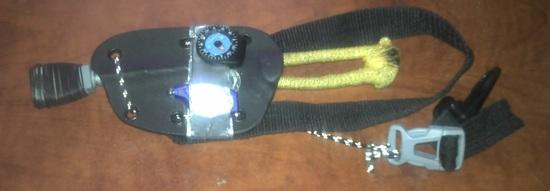
Here's my solution. Stays strapped around my right thigh at all times in the woods.

It could just continue to be neck-hung but anything around my neck bothers me.

Survival knife

Bark River fixed blade and sheath, para cord, firesteel, snare wire, flashlight, compass, fishing line, duct tape, fishing hooks (under duct tape), beeswax-infused cotton firestarter (stuffed in hole of firesteel).
It's ridiculously light considering the amount of valuable stuff, and always stays together as a package.

But the most useful thing is probably my McMurdo FastFind PLB which stays in a zipped pants pocket.

PostedOct 31, 2011 at 5:34 pm

When travelling in the Philippines by plane, boat or auto in the countryside I carry a small REI fanny pack (on my front to avoid razor-weilding theives) full of emergency gear.

This kit includes:

> headlamp (Used it in Mindanao in 2006 during a night time auto breakdown.)
> 1st aid kit
> all-latitude Silva compass
> fire-starting gear (tinder, magnesieum/striker/sparker kit, good lighter, hurricane matches)
> 3" lockblade knife
> Katadyn chlorine dioxide tabs (20)
> gallon ZipLoc freezer bag to carry water
> 50' light Spectra cord
> spare glasses
> color photo copy of my passport
> $50. US
> detailed road map of the area

All paper items are coated with Thompson's Water Seal Ultra and sealed in Ziploc bags.

I have to check to see if a SPOT beacon will work there on a "911" call.
When I return next year I will add a few things like my loud ski patrol whistle and some meds for cuts like polysporin. Cuts go south fast in that hot, damp cliomate.

Dale Wambaugh BPL Member
PostedNov 4, 2011 at 3:42 pm

I received the water bags today. They look for for a backup and I can easily stash one in the crown pocket of my Tilley hat. With that and my "Gollum" pocket kit, I'm ready to go :)

PostedNov 7, 2011 at 3:27 pm

I'm probably going to go ahead and pick up a few of those for myself. I thought I'd be all cool in the spirit of myog and cut a 1gallon bag in half lengthwise, and re seal it with an iron making a tall narrow water bag, but apparently it's not quite that easy. I made a few attempts, and was able to hold water for a few minutes (holds about a quart, but it's a very convenient one hand carry size)but the seam was very difficult to make water tight and strong. My best attempt didn't leak, but with a little pressure the seam came apart and burst open. Maybe one of those vacuum food seal iron thingies might get the job done, but that's a lot less cost effective unless I want to start vacuum sealing my food…

BM

Mike M BPL Member
PostedNov 7, 2011 at 4:43 pm

the little water bags are actually pretty tough, I used one on a bare bones overnighter (I mean really bare bones! :)) I treated and carried about 8-10 bags full- was ~ 1/4 mile cross country from the spring I was using and my shelter

pictured leaning against the tree

Photobucket

PostedNov 8, 2011 at 10:57 am

jd

That said, the more you know about bushcraft/primitive skills, the less you need to carry.

Viewing 25 posts - 51 through 75 (of 75 total)
Loading...