You are on the right track by getting a list together. If you want to get lighter, try weighing each item and making a spreadsheet or list with the weights.
There are folk here who go out with kits that are just 5 pounds base weight (everything except consumables– food, water, and fuel). That is on the radically light side, but you should be able to put together a comfortable kit and stay under 12 pounds or so base weight— or better as you can handle it. You'll be loving that as it will help with your photo gear.
The job should be a little easier as you don't have sub-freezing weather to deal with. Hammocks are great for warm weather, bugs and creepy-crawlies.
Do read all you can in the forums here. Books by Ray Jardine and BPL's own Ryan Jordan and Mike Clelland are a great help.
Here is a guide I wrote for another forum. I think it will point you in the lighter direction:
Getting light takes a few steps:
*Don't take anything that you won't use. About the only exception for me is first aid or other emergency/survival items— stuff you never want to use but would be VERY glad to have when it hits the fan. And you can still keep those items Spartan and as light as possible. If it won't keep you warm, dry, fed, or safe, it stays home.
*Take only the amounts you need for the trip. Decanting soap, insect repellent, sunscreen and the like to small containers can save many ounces at little cost. You don't need a 3oz bottle of bug juice for an overnight trip, and so on.
*Weigh everything, write it down and add it up. Doing a spreadsheet may seem bothersome, but it is the easiest, cheapest way to lighten your kit. Scrutinize everything you put on your back. You will see the heavy stuff and know what to look for in future purchases to get your kit lighter and more coordinated (read efficient).
*Seek out the lightest, highest performance items you can afford. Sometimes that saves money: two recycled drinking water bottles will save you about 8oz and $20 over a pair of 1 liter Nalgene bottles. Chlorine dioxide tablets weigh far less than a filter, etc.
*Coordinate your gear to work as a finely tuned system rather than a random accumulation of gear that you just happen to like.
*Seek out items that can have multiple uses, like the rain cape/tarp shelter I mentioned above.
*Give up some of your city life conventions. You don't need separate sleeping clothes or several spare tee shirts, etc. It is okay to be a little smelly and dirty. It's not a fashion show and I don't care if your colors aren't coordinated.
*Know that you have control over what you take and how much it weighs. It is YOUR decision– and also your responsibility to live with the outcome. Much of the excess that we pack is in response to a fear of nature. Know how your body works. Understand the physics of staying warm and dry. Know how to navigate and take care of yourself. Your brain is (or should be) the best piece of equipment you have, and preparing it can make your wilderness experience safe and comfortable.
*Don't be afraid to hike your own hike. Everyone has opinions; they are free and worth every penny ;) You will find opinions on both sides of the weight fence– "that is too heavy" and "that is too fragile" for the same equipment. At one point my base weight was about 8 pounds, but I found frameless packs to be a royal pain to load and to wear, so I upped my kit weight a pound for a different pack and I'm willing to live with the compromises. Many people need more comfortable sleeping pads, or warmer bag and clothing. What works for a 20 year old male in top condition may be different that your needs. I see no gain in suffering– it is supposed to be recreation, not the Seal Team 6 training course! You may see gear lists that work for Colorado or the Sierra, but would be cold and wet in the PNW. For example, I like fleece and synthetic fills over down.
*Weight savings can snowball in your favor. A lighter kit allows you to use a lighter pack, you can wear lighter shoes, and so forth.
Of course there is a lot more to go in the pack and it adds up. If you have 20 items in your kit and can find replacements that are an average of 1oz lighter each, you saved 1.25 pounds. Cook kits tend to be too large and meal planning (or the lack of it) can tip the scales. I think clothing is the hardest for many to get their heads around and can be very expensive. Toys creep in all over, with cameras and electronics heading up the list, along with a host of "handy" trail gadgets. Books are another brick in the pack. A lot of little things can add pounds quickly. Nothing is lighter than leaving it at home.
Here is a very generic gear list for a typical ultralight kit. There are many variations and opinions, so consider it just a basic framework.
Ultralight generic gear list:
Backpack
Pack liner
Trekking poles
Shelter
Ground cloth
Guy lines
Stakes
Sleeping bag
Sleeping pad
Knife
Headlamp
First aid kit
Whistle
Compass
Map(s)
Fire starter
Sunglasses
Insect repellent
Sunscreen
Duct tape
Sewing kit
Water container(s)
Water treatment
Cook pot
Stove
Windscreen
Fuel container
Spork
Cup
Food
Bear bag
Line
Shoes
Socks
Briefs
Base layer shirt
Pants/shorts
Insulation layer
Windshirt
Bandana
Insect headnet
Hat
Beanie
Gloves
Rain jacket/poncho
Rain pants
Potty trowel
Toilet paper
Hand cleaner
Soap
Toothbrush
Floss
Toothpaste
Comb
Now, to start working on your list. We dont' have all the weights, but I'll give my $0.02 on what you have:
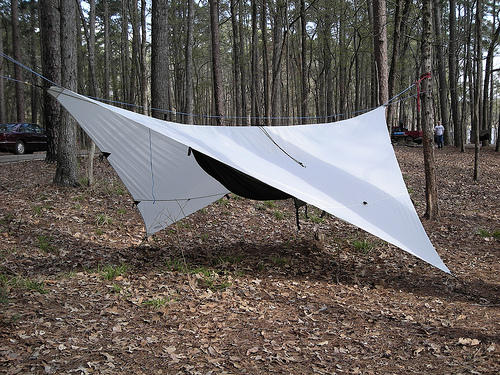
Eureka Solitaire tent 3# [heavy– you can do better by 30%, or more]
Teton Fox 5200 backpack 6# [REALLY heavy. You can get a framed 58 liter pack that is less than half that weight and many frameless packs that are 24oz or so]
Suisse Microtekk .7 Adventurer sleeping bag 3# [heavy and bulky. You can get 32F bags in the 2 pound range or less]
space blanket [why?]
[sleeping pad?]
jacket/poncho [you need more planning here]
gloves [be specific and the weight]
walking stick (monopod) [understood on the photo end, but you can get a lighter trekking staff with a 1/4-20 thread under the top knob. We may save you enough weight to afford a real live tripod!]
knife [that one in the photo looks big. I use a 3.5" folder that is considered huge here, see multi-tool remarks below]
trash bags [one for a pack liner]
zip ties [a couple small ones for repairs, maybe]
ziploc bags [why?]
first aid [keep it small and stuff that you need for this environment]
venom kit [do they work?]
toilet paper + bags [watch out for Mike Clelland and TP!]
hand sanitizer [good, but a small container– enough for your trip, no more]
toothbrush/paste [small and light]
contacts solution [small container– enough for your trip, no more]
sunscreen [small container– enough for your trip, no more]
deet [small container– enough for your trip, no more]
small micorfiber towel
talcum powder [okay. but as above, small containers– enough for your trip, no more]
vitamins
binoculars [if needed for your photo work and small, otherwise, no]
shovel [NO. A small potty trowel or tent stake, but not that folding thing in your photo]
shortwave radio [really small and light? CountyComm GP4L rocks]
cooking mess kit [NO. Read up on stoves and cooking systems. UL is typically a 500-850ml titanium pot and a spork, maybe a cup. Stove?]
canteen [NO. Platypus bladder or a recycled water bottle]
food+snacks and water (if I need to cache for a trail??) [needs planning. Water purification needs to be nailed down]
2 tshirts [one, and no cotton]
underwear/socks [what you wear and one spare pair of socks, no cotton]
compass + maps [good!]
flashlight + batteries [LED headlamp: small, light, long-lived]
camera gear + video (small p+s) filters= ND + cpl 6# [per your needs]
multi-tool [A small one like a Leatherman Micra or take a Swiss Army knife and nix your other knife]
fire-starter [good– like a mini firesteel?]
lighters [one mini-Bic]
cell phone [if you have reception. How will you re-charge?]
book [if you are going to have the phone, get a smart phone and use e-books]
There is a whole bunch of other stuff you need. Time to study up :)