I wanted to know if anyone has one of these with a MSR Titan Kettle. I already have the Kettle but I was considering buying the Ti Cone system. I would prefer if the cone could be stored in the Kettle. Also, what the weight of the entire system? Anyone know?
Topic
Caldera Cone Ti Tri with MSR Titan Kettle
Become a member to post in the forums.
- This topic is empty.
Slight tangent; have you seen the hacked IKEA stove that perfectly nests outside the MSR Titan Kettle?
Franco,
Since the original poster seems to prefer a Caldera that fits inside his pot, I believe he's looking for the weight of the Sidewinder Ti-Tri system. The Trail Designs site only lists a range of weights under its specifications, since it varies by pot size.
Andrew,
While I don't know the weight, I remember reading something to the effect of the Caldera system being so efficient with alcohol that, after a few days, its weight is negated by the amount of fuel it saves. I think the weight of the Sidewinder cone + the included alcohol stove will be around 2 oz, 2.5 oz if you include the pair of titanium stakes, 4+oz if you're getting the Inferno add-on(s). Just guessing though.
From the Trail Designs site:
Min Weight:
Sidewinder Cone – 30gm to 42gm
Inferno Cone – 16gm to 23gm
Grates – 15gm to 21gm
Floors – 10gm to 18gm
10-12 Stove – 16 gm
Gram Cracker – 3 gm
I own a Titan Kettle and I wanted to get a ULC/Sidewinder style cone for it, so it would fit into the pot. However, the Titan Kettle is a shape that doesn't work for these designs. If it was short and wide it would work for a Sidewinder, and if it was narrower and taller it would work for a ULC.
What I wanted to do was get a custom ULC style cone made for my Titan Kettle that would be a little shorter than normal (about 3.5" tall as I recall) and I would use a different, shorter stove (Zelph Starlyte) instead of the provided 12-10 stove to make the whole thing work, and as an added bonus I would be able to ditch the complexity and weight of the stakes because the Zelph Starlyte has a built it pot support. I emailed Trail Designs about such a cone, but never got a response….perhaps because it was during the busy time surrounding the outdoor retailer market.
Anyways, I ended up just ordering the 0.9L Evernew deep pot and a ULC from Trail Designs and I'm going to sell the Titan Kettle. I love the Titan Kettle, but I feel strongly about using a cone that fits into my pot as part of my cook system. I'm really hoping the Zelph Starlyte stove works well instead of the 12-10 stove so I can ditch the 2 stakes (0.6oz) and avoid the hassle of using the stakes. For me, these stakes aren't multi-purpose because I like to have my shelter fully setup while I'm cooking some meals.
One suggestions for Trail Designs (in case they read this thread) is to add a pot support onto their 12-10 stove, so they can ditch the stake system for their Sidewinder and ULC stoves. It seems to me such a design would lead to a simpler and lighter system.
I had the system you are talking about. It worked great, but I just sold it. (I have a couple other CC systems.)
The Sidewinder is not made for the Titan Kettle as it is not wide enough. (Dur, should have kept reading. What Dan said…)
Dan:
Extremely sorry for not replying back……you did catch me at a busy time and you just fell through the cracks…..sorry about that. :-)
To the original post….Andrew contacted me directly in addition to starting this thread and I've replied directly. In the end, the SP600 and the MS.85 Kettle are the two pots that are the most painful for us. They are EXTREMELY popular, and their geometry, huge handles, and aspect ratio blocks out all of the common tricks we've come up with to do a packable solution.
Rand :-)
Thanks for the post Rand.
It sounds like you're saying that using a stove as the pot support, rather than stakes, results in a significant decrease in stability, perhaps all the way down to regular (non-cone) levels. With the Starlyte, I was hoping to get most of the normal ULC stability, with the cone still stabilizing the sides of the pot and the stove just supporting the weight. Perhaps it doesn't quite work out like this and I might have to re-adjust my expectations. If the stability is far worse using the Starlyte than with stakes, then I'll likely continue to use stakes. The stability of the Starlyte with a traditional windscreen is one of the problems I'm trying to solve.
Dan:
Well….you might get lucky…hard to say what configuration you end up with. However, from a pure engineering load path analysis…..here's the way to look at it.
Cone assembly as designed:
With the pot full of water sitting on the stakes inside the cone, in a "tipping" configuration you can view the assembly as more or less a single rigid member for the sake of this analysis. With that said, all weight is going down through the cone body and into the ground at a good distance outside the diameter of the pot. It is at this location where the cone interacts with the ground that the center of rotation is going to have to occur. As a consequence, when a tipping force is applied, the center of gravity (more or less near the center of the pot) is going to have to travel vertically up in addition to a good distance horizontally before it "tips" over the center of rotation somewhere near where the cone is sitting on the ground. Further, with the weight going through the bottom of the cone, the force it applies to the ground is measurable over an unloaded cone which adds to it's lateral stability.
Cone as a member of a Jenga stack:
With the pot full of water, sitting directly on a small footprint stove (as compared with the cone footprint), with an unloaded cone surrounding it, I would suggest that this assembly is not a single rigid member for the purposes of a tipping analysis….and more a loosely aligned assemblage of parts. The slip fit of the cone on the pot is not going to resist a sliding motion, the small interface between the bottom of the pot and the stove is to be noted, and the fact that the center of gravity of the pot is not necessarily inside the footprint of the stove….or if so not necessarily very far inside. So, take a scenario where a tipping force is applied to the pot. As the pot starts to move laterally, there is nothing constraining the cone to support the pot. One legitimate behaviour might be for the cone to rotate about a point where it is touching the ground, and simply slide up the pot as it tumbles over. Further, as the tipping force is applied, the pivot point on which it is resting is nearly right underneath the center of gravity…..so it won't take much of a push to get the center of gravity past the edge of the stove, and have it either slide or fall off…..with as noted earlier the cone simply sliding up the pot face.
Now, with all that said, you may be able to find a scenario where the handle of the pot gets locked up with the cone somehow and the whole conglomeration could bind up into a more rigid assembly part way through the collapse that might present a less catastrophic result…..but I suspect it will be more chance than design that will take you to that scenario. I further could see a configuration where you stake the cone to the ground through its lower vents to provide more support to a tipping pot, but then that re-introduces the stakes back into the equation and you were trying to remove them.
Hope that helps! Let me know if I misunderstood your design intent…..or could provide any more thoughts on the subject!
Rand :-)
I think you nailed that response Rand. It was clear and based on a correct understanding of what I am proposing. Thank you for taking the time to write that out. I agree that using a stove with a built in pot support will be significantly less stable than the normal stake method. I will need to actually try this combo out to see if the stability meets my own minimum requirements.
I see on the Trail Designs website that the 0.9L deep Evernew pots are 3.7" deep and the fry pan lid is 1.1" deep, for a total height of 4.8". Assuming the ULC cone is ~4.6" tall, the cone could suspend the pot by its rim and hang it 0.8" off the ground. The total height of the Starlyte stove including the pot support is just 1.8", so it maybe possible to position the stove into some sort of a natural or constructed depression so that the system can function. On the downside, this eliminates the sort of simplicity I'm trying to achieve so it's not an improvement.
Perhaps if a pot exists with a taller lid, then such a setup would be possible without constructing a hole. I personally don't have a great deal of use for a fry pan lid, but I would find value in a tall/narrow pot that had a mug as it's lid. The mug Evernew sells as part of it's 750ml/400ml stacking set would be perfect (2.3" tall). It's too bad that it doesn't appear to fit as the lid on any solo sized pots. A 900ml/400ml combo with the mug as the lid would be the ultimate setup….no wasted weight on a tiny fry pan and you could have a cone that both fits inside the pot, and supports the pot by it's brim….the simplicity of the original Caldera cone with the pack-ability of the ULC cone.
IMO, the caldera cone idea is the best idea out there for cooking with alcohol stoves. I believe that any sort of future designs that may improve upon the basic cone design will always be cone based…and Trail Designs is leading this evolution with ideas like the Sidewinder and ULC. Both of those ideas are huge steps forward IMO as they eliminate the largest downside (IMO) to the original caldera cone…packing it.
Moving forward, the salient areas for improving the cone design seem to be in terms of simplicity and weight. If you could get it down to just 2 parts (cone and stove) while retaining the ability to pack it inside the pot that would be the ultimate. The pot/mug combo may be one idea that works for this. I'd love to see this explored. Perhaps you guys should team up with Evernew for a custom pot/mug combo…please :) Other areas for design exploration (which you've probably already done) would be to suspend the pot by a means other than stakes, such as tabs that are part of the cone that fold down (likely too weak) or maybe you could have a stove with a built in pot support, and then somehow attach the stove to the cone (likely not going to wind up lighter or simpler though).
Anyways….enough rambling from me. Cones are awesome and I'm just a geek that likes to play around with ideas.
Love reading your thoughts….and though I hesitate to do this because we are taking a hiatus on building them right now……I should bring up the Fissure. If you haven't seen it, it is a two piece cone (split horizontally) of which both pieces will fit into the tall/skinny Evernew pots or the Snow Peak Mini Solo. While we have the design figured out, and you can see it here on the BPL Wiki…..it is such a pain to make (2x as long as a typical Ti-Tri) and it consumes way more titanium than it should for what you get, that we (as noted) are taking a break from offering it right now. THAT is truly the optimum solution for that pot. Admittedly it is not as elegant as a one-piece cone, but it packs up smaller and you get full cone performance.
Rand :-)
I'd heard a bit about the Fissure but never really understood it (I thought it was split up/down, not around the equator) until I looked up a picture just now. That's definitely a neat design. Perhaps someday you'll come up with a way to simplify/ease the production of the these units.
One other quick idea is that you had a really wide pot (ie. Width-Height = >3") then it could hold a cone that is 3" taller than the pot is, thus giving you room for the stove. Such a pot would likely need to be about 4' wider than it is tall, since the cone can't run the full diameter of the pot. This might work for large pots where a ~4" differential isn't rediculous. For example, the regular Evernew 1.9L post has a 2.95" difference between the height and width, so if you found something a little wider still you might be able to squeak a cone in there Sidewinder still that supports the pot by the brim.
You could also experiment with ways to shorten the 12-10 stove if you get really close to making it work but not quite. A wider, shorter stove could perhaps be 1/2 shorter but I'm just speculating. I'm sure this would a headache amount of work though for a minor change.
One thing I really like about the ULC (over the Sidewinder) is the ability to store some stuff inside the cone. It doesn't really work for super skinny pots like the Evernew 640ml, but I'm hoping I can drop a small skinny mug and maybe a short spoon inside the ULC cone for my Evernew 900ml. With my 1.3L Evernew, the Sidewinder occupies most of the pot so you can just get the stove and stakes in there too. It takes the right technique to fit the stakes in, but it's easy if you're doing it right.
In closing, I wanted to mention my reasons for liking the Zelph Starlyte stove, as perhaps some day Trail Designs will offer a selection of stoves that work well in a cones oxygen environment. The Starlyte stove in addition to be quite short (1.8") and light (11.8g) uses wicking/batting material inside that makes the stove way easier to light in cold/winter conditions. It really makes a big difference once you're below zero. It's also spill-proof which is nice, but a relatively small consideration. Some stoves in winter (not the 12-10…I haven't tried it in winter) are a real pain and keep going out once you get to 20F or so.
In my opinion the Caldera Cone Sidewinder for the .9L Evernew/REI pot is the best system ever for backpacking. The titanium cone is expensive, but is more durable and just a nicer material for a cone than aluminum. I keep it rolled up it the pot for months, and upon taking it out it just snaps back to an almost flat configuration unlike the aluminum cone which has a "rolled up memory."
I have tried the alcohol stoves that sit on top of the stove, but they are inherently unstable and tend to fall or blow off the stove which could result in a serious burn.
Lastly, I have dealt with Rand before, and he is really a stand-up guy. He always answered my private emails in a timely and efficient manner.
"I have tried the alcohol stoves that sit on top of the stove, but they are inherently unstable and tend to fall or blow off the stove which could result in a serious burn."
John, what are you really trying to say here?
–B.G.–
"Some stoves in winter (not the 12-10…I haven't tried it in winter) are a real pain and keep going out once you get to 20F or so."
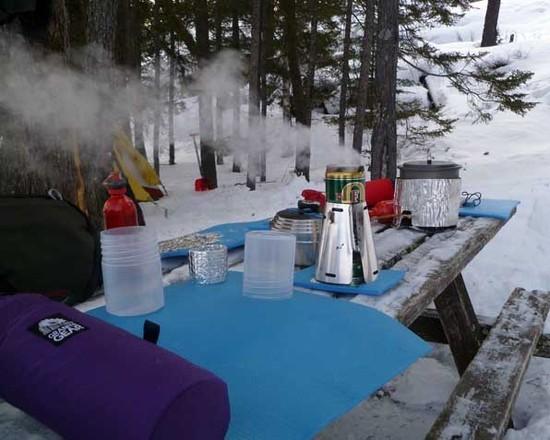
Dan, I used a Keg F on 5 over-nighters last winter and brought it on a 3-day trip to Voyageurs NP last February. (Just because the guy I met up there wanted to see it in action. We had two MSR stoves for snow melting duties.) In the pic below it is right around 0 F on its way to -31 that night.
Bob I am talking about the kind of alcohol stove that has no pot stand, sometimes called a side jet, where the pot sits directly on the stove. About a month ago I was using this type of stove and a wind gust of no more than 20 mph literally blew the pot (GSI Minimalist) off the stove inside the windscreen dumping all the water. If my hand had been close to the stove it would have been scalded. The cone design of the Caldera Cone makes it inherently more stable and able to take wind gusts.
"I have tried the alcohol stoves that sit on top of the stove,"
John, it was not obvious what you tried to say with this.
–B.G.–
Become a member to post in the forums.