Preparation Days 1-4. I drove to the White Mountains (California) on July 28 and hiked up White Mountain Peak on July 29 (a large bighorn sheep herd was there). I hiked the Ancient Bristlecone Pine Forest loop on July 30 and did a hike to an old gold mine on July 31. I got rained on somewhat for three days in a row, so I was getting suspicious on how this was all going to turn out.
Prep Day 5. I picked up my Whitney permit in Lone Pine on August 1, and I soon started hearing the news. Apparently three days of rain on the mountain had started off flooding, rock slides, and sand slides. Whitney Portal was awash and had several hundred cubic yards of sand dumped on it, thereby the road was closed for a couple of days, and it had reopened when I got there. Worse, all of the main hiker stream crossing aids on the trail had been wiped out, and many parts of the trail had been damaged.
Worse still, apparently some hiker had been up on the summit ridge during an electrical storm, and he was struck. In today's litigious society, that demands attention from the Forest Service. So, apparently the next morning a wilderness ranger was posted to Trail Crest. Everybody who passed through there prior to 8 a.m. could go on. Then at 8 a.m. the ranger got a weather report by radio, and Trail Crest was closed ( ! ) for anybody hiking up from Whitney Portal that day. Wouldn't that make your day! So, the word spread around the hiker community for August 2, and we all decided to make an earlier run for the summit, to avoid an 8 a.m. turnback by some fed.
Prep Day 6. I left Whitney Portal at 1:15 a.m. The difficult stream crossings were very wet to the knees, the water was cold, and the current was fast. I made it through Trail Crest at 7:30 a.m. and then made the summit in perfect weather. There was no storm predicted that day, so there was no action by rangers. With all of the difficulties, I didn't make it down until 6 p.m. on August 2.
BP Day 1-4. After a brief sleep, I got up very early on August 3 to drive to Bishop. My intent was to be standing in line when the permit office opened, and maybe I could score a wilderness permit at 11 a.m. which I could use August 4 in the John Muir Wilderness (North Lake-Piute Pass-Evolution-Muir Pass-LeConte Canyon-Bishop Pass-South Lake). The permit person said that I could have a permit for that very day, August 3! So, with no Whitney recovery time, I drove up to North Lake, saddled up, and took off for Piute Pass, intending to do the whole route in 5 or 6 days. The first night was in Humphries Basin. The second night was in Evolution between Colby Meadow and Evolution Lake. The third night was over Muir Pass in LeConte Canyon next to the ranger station. Then for the fourth day, I went over Bishop Pass and made it out to South Lake at 3:30 p.m. For the trip, the weather was mild, and the dawn air temperature never dipped below 38 degrees F.
That's when the fun began. I had to hitchhike back to North Lake, but there wasn't much luck. I got a part-way ride after 2 hours. I walked uphill for a half-mile and then got another ride to the North Lake turnoff. I walked the last 2 miles uphill to North Lake, so I reached my car at 6:30 p.m., utterly wasted. The total trail mileage was something around 55+ in four days. I drove home by 1 a.m.
Food: I had food and fuel packed for 5 or 6 days, but my appetite was not great. As I was reaching Muir Pass, I had at least two days worth of extra food. There was some French Canadian guy there with a problem. His butane stove fuel had all leaked, so he couldn't cook anything. Unfortunately, all of his food required cooking. That is a bad error in my book. So, he asked me if I had any extra food that did not require cooking. Such a deal! I gave him about 24 ounces of granola bars, and he was happy as a lark. It lightened up my pack as well.
Gear: The Inov-8 195 shoes worked pretty good with very good traction. I had intended on trying to keep shoes and socks dry through the stream crossings. That became totally impractical in streams that were crotch-deep. So, I just walked right through the water, and the shoes dried out soon enough later. Next time, I should bring a trekking pole.
More Gear: This solo trip was not intended to set any records, one way or the other. As a result, the base gear weight was about 10 pounds including bear canister. The food, fuel, and water to start weighed about 10 pounds. The camera gear weighed an additional 10 pounds since that was the mission for the whole trip (DSLR, long lens, short lens, tripod, shoulder case, extra batteries). Flowers, wildlife, and scenery were great.
My feet hurt, and I have sunburn on the tip of my nose and the backs of my hands. I lost five pounds of body weight, which is what my physician had recommended.
If I had it to do all over again, I would pack a little less food and maybe carry a smaller bear canister.
Edit: Wildlife Photo (shot near Sapphire Lake)
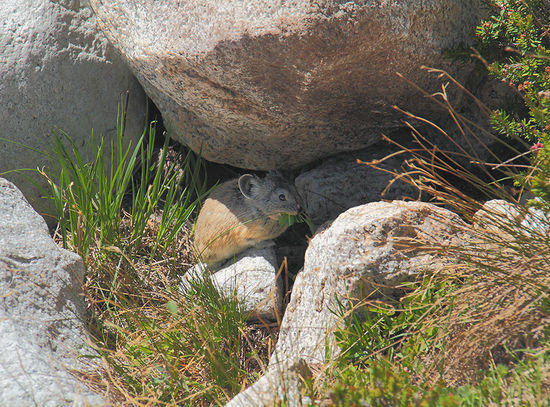
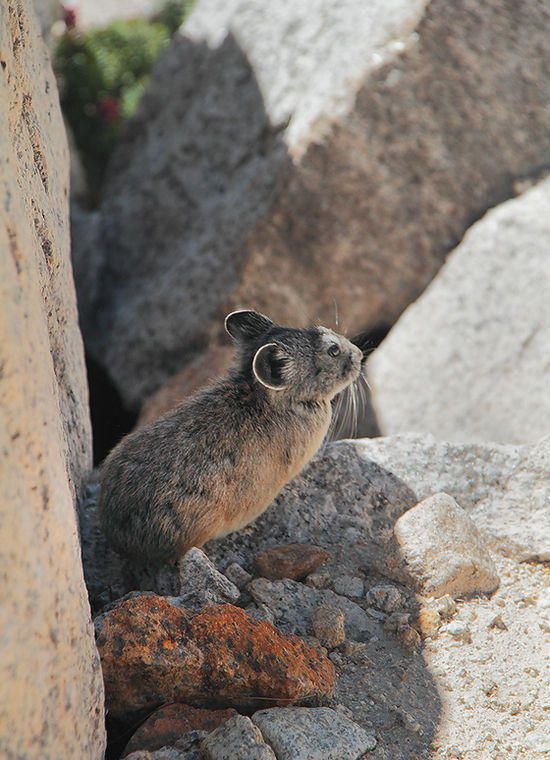
Edit: Wildlife Photo (same animal, almost the same place)
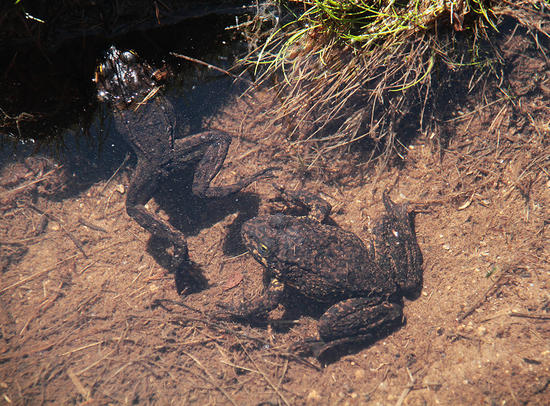
Edit: Wildlife Photo (Mountain Yellow-Legged Frogs)
Edit: Wildlife Photo (Yellow-Bellied Marmot)

Edit: Wildlife Photo (same animal, same place) This guy is looking for a handout.

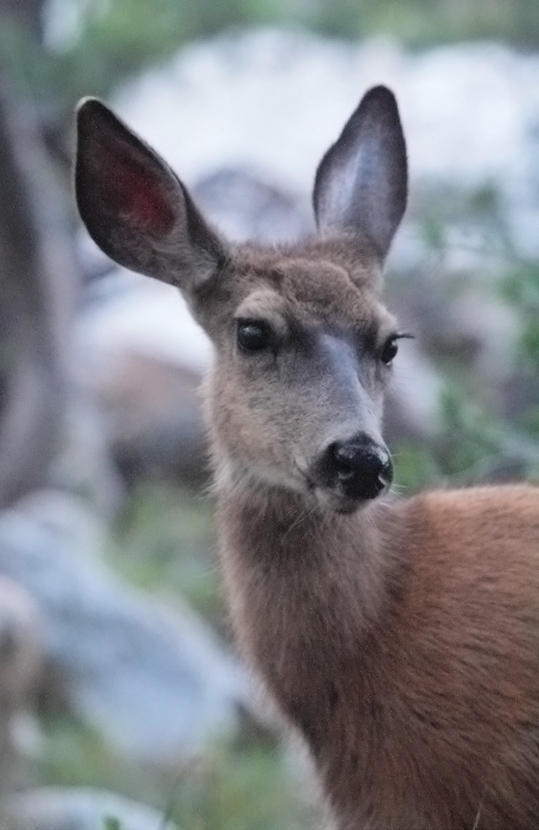
Edit: Wildlife Photo (Mule Deer)
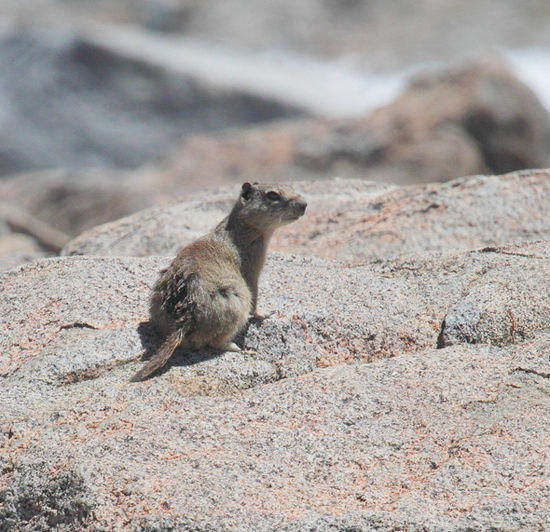
Edit: Wildlife Photo (Belding's Ground Squirrel)
–B.G.–